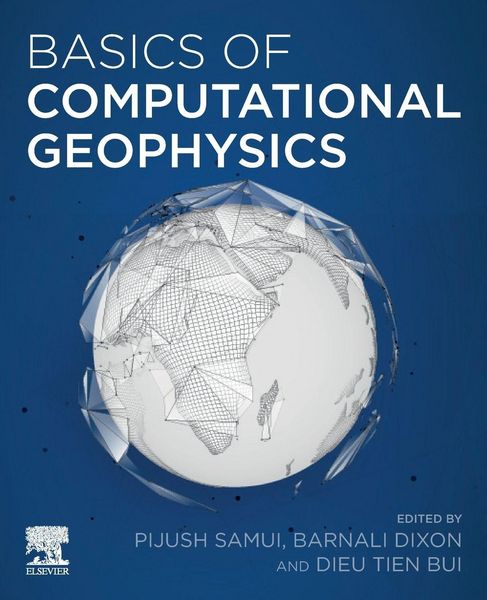
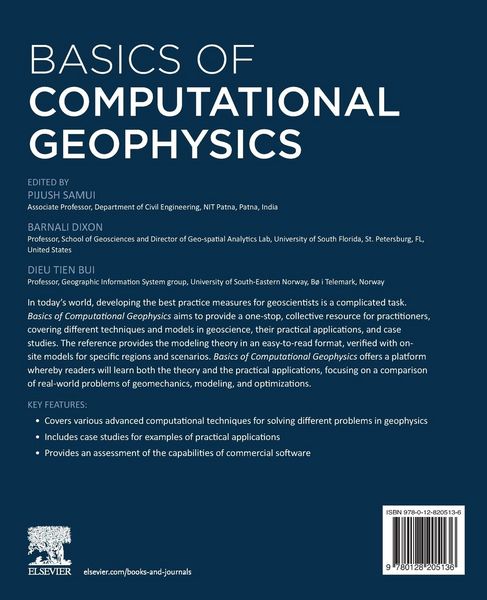
• Produktbild: Basics of Computational Geophysics
  • Produktbild: Basics of Computational Geophysics

Basics of Computational Geophysics

Fr. 211.00

inkl. gesetzl. MwSt., Versandkostenfrei


Beschreibung

Produktdetails

Einband

Taschenbuch

Erscheinungsdatum

30.11.2020

Herausgeber

Pijush Samui + weitere

Verlag

Elsevier Inc

Seitenzahl

436

Maße (L/B/H)

23.5/19.1/2.3 cm

Gewicht

746 g

Sprache

Englisch

ISBN

978-0-12-820513-6

Beschreibung

Portrait

Dr. Samui is an Associate Professor in the Department of Civil Engineering at NIT Patna, India. He received his PhD in Geotechnical Engineering from the Indian Institute of Science Bangalore, India, in 2008. His research interests include geohazard, earthquake engineering, concrete technology, pile foundation and slope stability, and application of AI for solving different problems in civil engineering. Dr. Samui is a repeat Elsevier editor but also a prolific contributor to journal papers, book chapters, and peer-reviewed conference proceedings.

Barnali Dixon is a professor and executive director of Initiative on Coastal Resilience and Adaptation (iCAR) and the director of Geospatial Analytics lab (G-SAL) at the University of South Florida. Her research interests include the development and application of spatially integrated decision support tools (SDST) using GIS, GPS and remote sensing tools for modeling and managing soil, land use and land-water interfaces (terrestrial sources and aquatics sinks, including coastal waters) using approximation tools. She is particularly interested in transdisciplinary modeling of land-water interface under climate change in the context of planning, adaptation, and resilience. I have secured over $1.5 million in funding, published 50+ refereed publications, nineteen monographs, and technical reports.

Dieu Tien Bui is Professor in GIS, in the Department of Business and IT at the University of South-Eastern Norway, Norway. He obtained a Master of Engineering, at Hanoi University of Mining and Geology, Hanoi, Vietnam, a PhD at the Department of Mathematical Sciences and Technology (IMT), Norwegian University, and was postdoctoral researcher in the same department. His research interests include GIS, remote sensing, artificial intelligence and machine learning. He published journal and review articles, and book chapters. .

Produktdetails

Einband

Taschenbuch

Erscheinungsdatum

30.11.2020

Herausgeber

Verlag

Elsevier Inc

Seitenzahl

436

Maße (L/B/H)

23.5/19.1/2.3 cm

Gewicht

746 g

Sprache

Englisch

ISBN

978-0-12-820513-6

Herstelleradresse

Libri GmbH
Europaallee 1
36244 Bad Hersfeld
DE

Email: gpsr@libri.de

Kundinnen und Kunden meinen

0 Bewertungen

Informationen zu Bewertungen

Zur Abgabe einer Bewertung ist eine Anmeldung im Konto notwendig. Die Authentizität der Bewertungen wird von uns nicht überprüft. Wir behalten uns vor, Bewertungstexte, die unseren Richtlinien widersprechen, entsprechend zu kürzen oder zu löschen.

Die Bewertungen sind nach Format, Anzahl Sterne und Datum sortiert.

Verfassen Sie die erste Bewertung zu diesem Artikel

Helfen Sie anderen Kund*innen durch Ihre Meinung

Kundinnen und Kunden meinen

0 Bewertungen filtern

Die Leseprobe wird geladen.
  • Produktbild: Basics of Computational Geophysics
  • Produktbild: Basics of Computational Geophysics
  • Part I: COMPUTATION & GEOPHYSICS APPLICATIONS

    1. Synthetic ground motions of the 2005 Kashmir M7.6 earthquake at the bedrock and at surface using stochastic dynamic finite fault modelling with a dynamic corner

    Hamid Sana

    2. Global particle swarm optimization technique in the interpretation of residual magnetic anomalies due to simple geo-bodies with idealized structure

    Arkoprovo Biswas and Anand Singh

    3. Emerging Techniques to Simulate Strong Ground Motion

    Sandeep Arora, Parveen Kumar and A. Joshi

    4. Earthquakes: Basics of seismology and seismic computational techniques

    Naresh Kumar Sr., Devajit Hazarika Sr. and Kalachand Sain

    5. Significance and limit of electrical resistivity survey for detection sub surface cavity: a case study from, Southern Western Ghats, India

    Mayank Joshi, Alka Gond, Prasobh. P. Rajan, B. S. S, Padma Rao B and Vivekanandan Nandakumar

    6. A review on Geophysical parameters comparison in Garhwal and Kumaun Himalaya region, India

    Sandeep Arora and Parveen Kumar

    7. Liquefaction Susceptibility of High Seismic region of Bihar considering Fine Content

    Sunita Kumari and Sufyan Ghani

    8. Evaluating the reliability of various geospatial prediction models in landslide risk zoning

    Chalantika L. Salui

    9. Fractals and Complex networks Applied to Earthquakes

    Denisse Pasten

    10. Liquefaction as a seismic hazard: scales, examples and analysis

    Hamid Sana

    11. Landslide Prediction and Field Monitoring for Darjeeling Himalayas: A case study from Kalimpong

    Neelima Satyam

    12. Improvement of Shear Strength of Cohesive Soils by Additives: A Review

    Amir H. Gandomi and Tamur Salik

    13. Static stress change from 6 February, 2017 (M 5.8) earthquake Northwestern Himalaya, India

    Mahesh prasad Parija, Arkoprovo Biswas and Shubhasmita Biswal

    14. Remote Sensing for Geology-Geophysics

    Surajit Panda and Krishnendu Banerjee

    PART II: COMPUTATION & GEOSCIENCE APPLICATIONS

    15. Prediction of Petrophysical Parameters using Probabilistic Neural NetworkTechnique

    Nagendra Pratap Singh

    16. Interpretation and Resolution of multiple structures from residual gravity anomaly data and application to mineral exploration

    Arkoprovo Biswas

    17. On fractal based estimations of soil subsidence.

    Tatyana P. Mokritskaya and Anatolii Tushev

    18. A Neural Network to predict spectral acceleration

    Amir H. Gandomi, Ali R. Kashani, Mohsen Akhani and Charles V. Camp

    19. Body tide prediction

    Sung-Ho Na

    20. Time series analysis of hydrometeorological data for the characterization of meltwater storage in glaciers of Garhwal Himalaya

    Amit Kumar, Akshaya Verma, Rakesh Bhambri and Kalachand Sain

    21. Trends in Frequency and Intensity of Tropical Cyclones in the Bay of Bengal: 1972-2015

    OMVIR SINGH and Pankaj Bhardwaj

    22. Application of machine learning models in hydrology: case study of stream temperature forecasting in the Drava River using coupled wavelet analysis and adaptive neuro-fuzzy inference systems model

    Senlin Zhu, Marijana Hadzima-Nyarko and Ognjen Bonacci