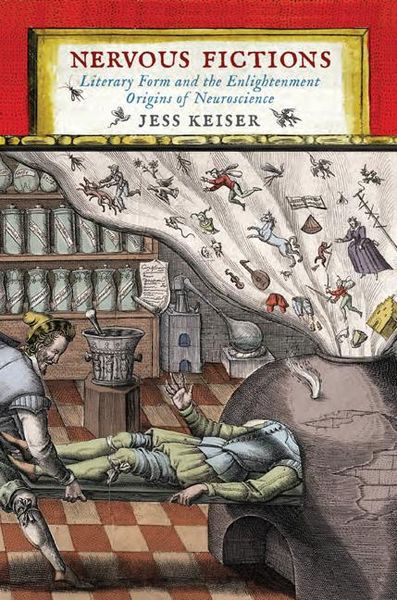
Nervous Fictions Literary Form and the Enlightenment Origins of Neuroscience
-
- Hardcover
- Taschenbuch
- eBook ausgewählt
-
Form:Einzelkauf Download
-
Sprache:Englisch
Fr. 56.90
inkl. gesetzl. MwSt.Beschreibung
Produktdetails
Format
ePUB
Kopierschutz
Nein
Family Sharing
Nein
Text-to-Speech
Ja
Erscheinungsdatum
21.09.2020
Verlag
Kensington BooksSeitenzahl
324 (Printausgabe)
Sprache
Englisch
EAN
9780813944791
"The brain contains ten thousand cells," wrote the poet Matthew Prior in 1718, "in each some active fancy dwells." In the seventeenth and eighteenth centuries, just as scientists began to better understand the workings of the nerves, the nervous system became the site for a series of elaborate fantasies. The pineal gland is transformed into a throne for the sovereign soul. Animal spirits march the nerves like parading soldiers. An internal archivist searches through cerebral impressions to locate certain memories. An anatomist discovers that the brain of a fashionable man is stuffed full of beautiful clothes and billet-doux. A hypochondriac worries that his own brain will be disassembled like a watch. A sentimentalist sees the entire world as a giant nervous system comprising sympathetic spectators.
Nervous Fictions is the first account of the Enlightenment origins of neuroscience and the "active fancies" it generated. By surveying the work of scientists (Willis, Newton, Cheyne), philosophers (Descartes, Cavendish, Locke), satirists (Swift, Pope), and novelists (Haywood, Fielding, Sterne), Keiser shows how attempts to understand the brain's relationship to the mind produced in turn new literary forms. Early brain anatomists turned to tropes to explicate psyche and cerebrum, just as poets and novelists found themselves exploring new kinds of mental and physical interiority. In this respect, literary language became a tool to aid scientific investigation, while science spurred literary invention.
Noch keine Bewertungen vorhanden
Verfassen Sie die erste Bewertung zu diesem Artikel
Helfen Sie anderen Kundinnen und Kunden durch Ihre Meinung.