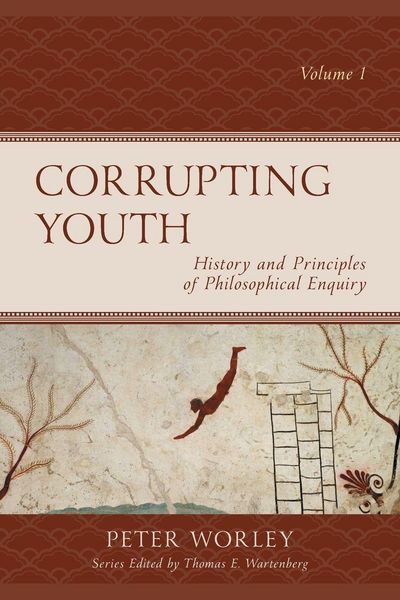
Produktbild: Corrupting Youth

Corrupting Youth History and Principles of Philosophical Enquiry

Fr. 47.90

inkl. gesetzl. MwSt., Versandkostenfrei


Beschreibung

Produktdetails

Einband

Taschenbuch

Erscheinungsdatum

15.02.2021

Verlag

Rowman & Littlefield

Seitenzahl

132

Maße (L/B/H)

22.9/15.2/0.7 cm

Gewicht

290 g

Sprache

Englisch

ISBN

978-1-4758-5920-1

Beschreibung

Produktdetails

Einband

Taschenbuch

Erscheinungsdatum

15.02.2021

Verlag

Rowman & Littlefield

Seitenzahl

132

Maße (L/B/H)

22.9/15.2/0.7 cm

Gewicht

290 g

Sprache

Englisch

ISBN

978-1-4758-5920-1

Herstelleradresse

Libri GmbH
Europaallee 1
36244 Bad Hersfeld
DE

Email: gpsr@libri.de

Kundinnen und Kunden meinen

0 Bewertungen

Informationen zu Bewertungen

Zur Abgabe einer Bewertung ist eine Anmeldung im Konto notwendig. Die Authentizität der Bewertungen wird von uns nicht überprüft. Wir behalten uns vor, Bewertungstexte, die unseren Richtlinien widersprechen, entsprechend zu kürzen oder zu löschen.

Die Bewertungen sind nach Format, Anzahl Sterne und Datum sortiert.

Verfassen Sie die erste Bewertung zu diesem Artikel

Helfen Sie anderen Kund*innen durch Ihre Meinung

Kundinnen und Kunden meinen

0 Bewertungen filtern

Die Leseprobe wird geladen.
  • Produktbild: Corrupting Youth
  • Foreword
    Preface
    A little background
    Acknowledgements
    Introduction to PhiE
    Part One: Philosophy and dialectic
    What is philosophy?
    Philosophy as conversation
    The 4 'R's
    Logos and flux
    Ambivalence: Two-eyed thinking
    The reason for reason in philosophy
    Philo-Sophia and the love of learning
    And to the children?
    A word about right and wrong answers in philosophy
    Dialectic
    The origins of dialectic
    Heraclitus
    The dialectical effect: thinking flows like a river
    Socrates
    Plato
    Aspects of Platonic dialectic
    Correspondence to PhiE
    Two dialectics in Plato's Parmenides
    Aristotle
    Aristotle and PhiE
    Community of Enquiry
    Part Two: Core values of PhiE
    Ancient core values of PhiE
    Exploration and discovery
    Dissent
    Autonomy
    Inquiry/Enquiry
    An open, questioning mind-set
    Friendship
    Friendship: xenia and knowing thyself
    Excellence
    Excellence and competition: the paradox of Socrates
    Oracy
    Oracy: Aoidos
    Oracy: small 'd' and big 'D' dialectics
    Part Three: pedagogical principles of PhiE
    A sensitive method
    A descriptive approach
    Philosophical maturity: was Plato wrong?
    Capability
    Interest and engagement
    The need for conditions
    The conditions
    Ideal speech situations
    Classroom culture
    PhiE begins with intuitions
    Within and without: is PhiE democratic?
    Truth and knowledge
    Ownership
    Two keystone principles in PhiE: Absence and Open Questioning Mindset
    Absence and Presence
    Socrates' midwifery principle
    From within
    Open Questioning Mindset
    Guess what's in my head
    Problematisation
    Blocking
    'Guess what's in your head' and intentional sensitivity
    Two aims of PhiE: dialectic and inclusion
    Socratic irony and questioning mindsets
    In summary
    Bibliography
    About the author