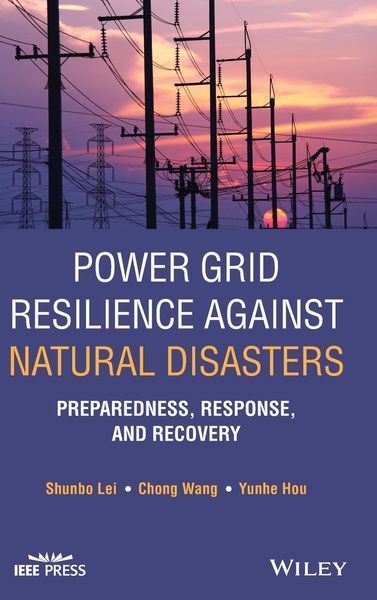
Power Grid Resilience Against Natural Disasters Preparedness, Response, and Recovery
Fr. 189.00
inkl. gesetzl. MwSt.,
Beschreibung
Produktdetails
Einband
Gebundene Ausgabe
Erscheinungsdatum
07.12.2022
Verlag
John Wiley & SonsSeitenzahl
336
Maße (L/B/H)
23.5/15.7/2.3 cm
Gewicht
638 g
Auflage
1. Auflage
Sprache
Englisch
ISBN
978-1-119-80147-4
How to protect our power grids in the face of extreme weather events
The field of structural and operational resilience of power systems, particularly against natural disasters, is of obvious importance in light of climate change and the accompanying increase in hurricanes, wildfires, tornados, frigid temperatures, and more. Addressing these vulnerabilities in service is a matter of increasing diligence for the electric power industry, and as such, targeted studies and advanced technologies are being developed to help address these issues generally-whether they be from the threat of cyber-attacks or of natural disasters.
Power Grid Resilience against Natural Disasters provides, for the first time, a comprehensive and systematic introduction to resilience-enhancing planning and operation strategies of power grids against extreme events. It addresses, in detail, the three necessary steps to ensure power grid success: the preparedness prior to natural disasters, the response as natural disasters unfold, and the recovery after the event. Crucially, the authors put forward state-of-the-art methods towards improving today's practices in managing these three arenas.
Power Grid Resilience against Natural Disasters readers will also find:
- Data, tables, and illustrations to supplement and clarify the points put forward in each chapter
- Case studies on realistic power systems and industry standards and practices related to the topics covered
- Potential to be a supplementary text in advanced level power engineering courses
Power Grid Resilience against Natural Disasters will be of interest to specialists and engineers, as well as planners and operators from industry. It can also be a useful resource for senior undergraduate students, postgraduate students, researchers, and research libraries. More, it will appeal to all readers with a strong background in power system analysis, operation and control, optimization methods, the Markov decision process, and probability and statistics.
Noch keine Bewertungen vorhanden
Verfassen Sie die erste Bewertung zu diesem Artikel
Helfen Sie anderen Kundinnen und Kunden durch Ihre Meinung.