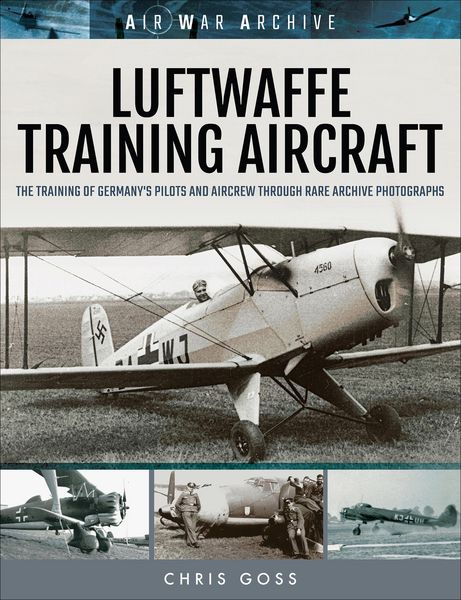
Luftwaffe Training Aircraft The Training of Germany's Pilots and Aircrew Through Rare Archive Photographs
-
- Taschenbuch
- eBook ausgewählt
-
Form:Einzelkauf Download
-
Sprache:Englisch
Fr. 18.90
inkl. gesetzl. MwSt.Beschreibung
Produktdetails
Format
ePUB 3
Kopierschutz
Nein
Family Sharing
Nein
Text-to-Speech
Ja
Erscheinungsdatum
12.11.2020
Verlag
Frontline BooksSeitenzahl
192 (Printausgabe)
Dateigröße
30364 KB
Sprache
Englisch
EAN
9781473899544
From a retired RAF Wing Commander, an introductory guide to the aerial warfare training methods implemented by Germany for airmen during World War II.
The often-unnoticed element in aerial warfare is the training, yet its value is beyond calculation. The Luftwaffe used a variety of aircraft in this fundamental role, with trainee pilots progressing from simpler, older machines to the more sophisticated, as well as heavier aircraft. Gradually airmen were introduced to newer, faster models that enabled them to experience, to some degree, the type of aircraft they would fly in combat.
Recruits would initially spend six months at a Fliegerersatzabteilung or training depot, where the main emphasis was on drill and physical training, with introductory lectures on the principles of wireless operation and map reading. This would be followed by two months studying general aeronautical subjects, before being sent to elementary flying school.
The various kinds of aircraft used for training depended upon the role each individual trainee would eventually undertake, from single-seat fighters to multiple-crew bombers or transports. In this, the Luftwaffe was also able to make use of captured enemy aircraft. It also established training units through the Occupied territories to enable its trainees to familiarize themselves with different conditions and terrain.
In the less-pressurized environment of the training schools away from the front line, more care could be taken over photography, resulting in the author of this extensive study of the wide range of aircraft used for training by the Luftwaffe, being able to assemble such a fine collection of excellent images.
The often-unnoticed element in aerial warfare is the training, yet its value is beyond calculation. The Luftwaffe used a variety of aircraft in this fundamental role, with trainee pilots progressing from simpler, older machines to the more sophisticated, as well as heavier aircraft. Gradually airmen were introduced to newer, faster models that enabled them to experience, to some degree, the type of aircraft they would fly in combat.
Recruits would initially spend six months at a Fliegerersatzabteilung or training depot, where the main emphasis was on drill and physical training, with introductory lectures on the principles of wireless operation and map reading. This would be followed by two months studying general aeronautical subjects, before being sent to elementary flying school.
The various kinds of aircraft used for training depended upon the role each individual trainee would eventually undertake, from single-seat fighters to multiple-crew bombers or transports. In this, the Luftwaffe was also able to make use of captured enemy aircraft. It also established training units through the Occupied territories to enable its trainees to familiarize themselves with different conditions and terrain.
In the less-pressurized environment of the training schools away from the front line, more care could be taken over photography, resulting in the author of this extensive study of the wide range of aircraft used for training by the Luftwaffe, being able to assemble such a fine collection of excellent images.
Noch keine Bewertungen vorhanden
Verfassen Sie die erste Bewertung zu diesem Artikel
Helfen Sie anderen Kundinnen und Kunden durch Ihre Meinung.