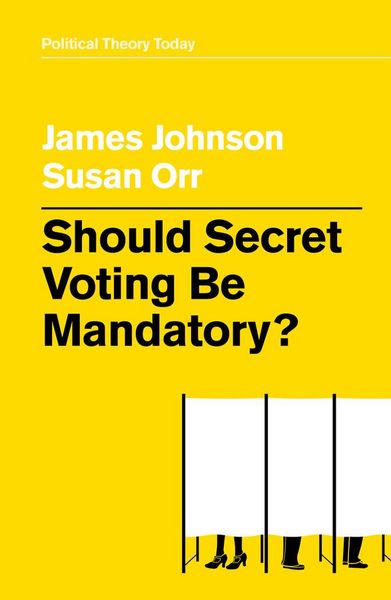
Should Secret Voting Be Mandatory?
-
- Hardcover
- Taschenbuch
- eBook ausgewählt
-
Form:Einzelkauf Download
-
Sprache:Englisch
Fr. 10.00
inkl. gesetzl. MwSt.Beschreibung
Produktdetails
Format
ePUB 3
Kopierschutz
Ja
Family Sharing
Nein
Text-to-Speech
Ja
Erscheinungsdatum
10.11.2020
Verlag
For DummiesSeitenzahl
140 (Printausgabe)
Dateigröße
150 KB
Auflage
1. Auflage
Sprache
Englisch
EAN
9781509538171
The secrecy of the ballot, a crucial basic element of representative democracy, is under threat. Attempts to make voting more convenient in the face of declining turnout - and the rise of the "ballot selfie" - are making it harder to guarantee secrecy.
Leading scholars James Johnson and Susan Orr go back to basics to analyze the fundamental issues surrounding the secret ballot, showing how secrecy works to protect voters from coercion and bribery. They argue, however, that this protection was always incomplete: faced with effective ballot secrecy, powerful actors turned to manipulating turnout - buying presence or absence at the polls - to obtain their electoral goals. The authors proceed to show how making both voting and voting in secret mandatory would foreclose both undue influence and turnout manipulation. This would enhance freedom for voters by liberating them from coercion or bribery in their choice of both whether and how to vote.
This thought-provoking and insightful text will be invaluable for students and scholars of democratic theory, elections and voting, and political behavior.
Leading scholars James Johnson and Susan Orr go back to basics to analyze the fundamental issues surrounding the secret ballot, showing how secrecy works to protect voters from coercion and bribery. They argue, however, that this protection was always incomplete: faced with effective ballot secrecy, powerful actors turned to manipulating turnout - buying presence or absence at the polls - to obtain their electoral goals. The authors proceed to show how making both voting and voting in secret mandatory would foreclose both undue influence and turnout manipulation. This would enhance freedom for voters by liberating them from coercion or bribery in their choice of both whether and how to vote.
This thought-provoking and insightful text will be invaluable for students and scholars of democratic theory, elections and voting, and political behavior.
Kundinnen und Kunden meinen
Verfassen Sie die erste Bewertung zu diesem Artikel
Helfen Sie anderen Kund*innen durch Ihre Meinung