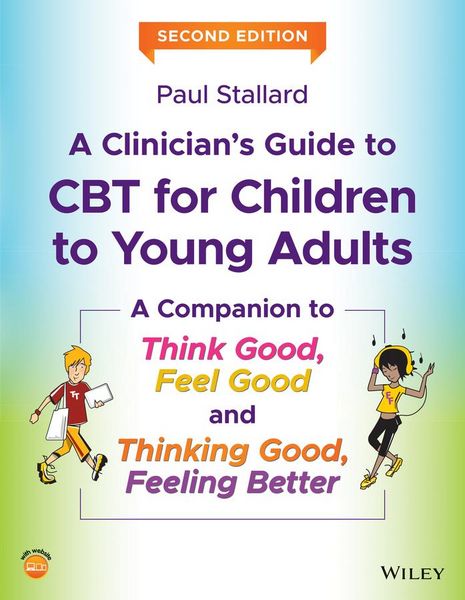
A Clinician's Guide to CBT for Children to Young Adults A Companion to Think Good, Feel Good and Thinking Good, Feeling Better
-
- Taschenbuch
- eBook ausgewählt
-
Form:Einzelkauf Download
-
Sprache:Englisch
-
eBook Format:ePUB 3
- ePUB 3 Fr. 44.00 ausgewählt
- PDF Fr. 44.00
Fr. 44.00
inkl. gesetzl. MwSt.Beschreibung
Produktdetails
Format
ePUB 3
Kopierschutz
Ja
Family Sharing
Nein
Text-to-Speech
Ja
Erscheinungsdatum
17.11.2020
Verlag
John Wiley & SonsSeitenzahl
(Printausgabe)
Dateigröße
14848 KB
Auflage
2. Auflage
Sprache
Englisch
EAN
9781119395461
A powerful and insightful clinical resource for CBT practitioners who work with children and young adults
The newly updated and thoroughly revised Second Edition of this companion to Think Good, Feel Good and Thinking Good, Feeling Better delivers guidance for clinicians using the author's seminal workbooks. This companion work builds upon the workbook materials by offering readers instruction on all aspects of the therapeutic process and a wide range of case studies highlighting specific therapies in action.
A Clinician's Guide covers topics including parental involvement, key cognitive distortions in children, formulations, challenging thoughts, guided discovery, and the use of imagery. The author also includes a chapter focusing on common potential problems that arise in therapy and strategies to overcome them.
The book highlights the underlying philosophy, process, and core skills of employing CBT with children and young people. Readers will appreciate the competency framework, which describes the CORE philosophy, PRECISE process, and the ABCs of specific techniques. The book also includes:
* Additional materials and handouts for use in therapy, including psycho-educational materials for children and parents on common problems, like depression, OCD, PTSD, and anxiety
* Downloadable, multi-use worksheets for use in the clinician's therapeutic sessions
* Practical, real-world case examples that shed light on the techniques and strategies discussed in the book
* A systematic approach to the use of cognitive behavioural therapy to treat common psychological problems
Perfect for professionals and trainees in child and adolescent mental health, like psychiatrists, clinical psychologists, educational psychologists, community psychiatric nurses, and occupational therapists, the book also belongs on the shelves of non-mental health professionals, including school nurses and social workers, who regularly work with children in a therapeutic setting.
The newly updated and thoroughly revised Second Edition of this companion to Think Good, Feel Good and Thinking Good, Feeling Better delivers guidance for clinicians using the author's seminal workbooks. This companion work builds upon the workbook materials by offering readers instruction on all aspects of the therapeutic process and a wide range of case studies highlighting specific therapies in action.
A Clinician's Guide covers topics including parental involvement, key cognitive distortions in children, formulations, challenging thoughts, guided discovery, and the use of imagery. The author also includes a chapter focusing on common potential problems that arise in therapy and strategies to overcome them.
The book highlights the underlying philosophy, process, and core skills of employing CBT with children and young people. Readers will appreciate the competency framework, which describes the CORE philosophy, PRECISE process, and the ABCs of specific techniques. The book also includes:
* Additional materials and handouts for use in therapy, including psycho-educational materials for children and parents on common problems, like depression, OCD, PTSD, and anxiety
* Downloadable, multi-use worksheets for use in the clinician's therapeutic sessions
* Practical, real-world case examples that shed light on the techniques and strategies discussed in the book
* A systematic approach to the use of cognitive behavioural therapy to treat common psychological problems
Perfect for professionals and trainees in child and adolescent mental health, like psychiatrists, clinical psychologists, educational psychologists, community psychiatric nurses, and occupational therapists, the book also belongs on the shelves of non-mental health professionals, including school nurses and social workers, who regularly work with children in a therapeutic setting.
Kundinnen und Kunden meinen
Verfassen Sie die erste Bewertung zu diesem Artikel
Helfen Sie anderen Kund*innen durch Ihre Meinung