
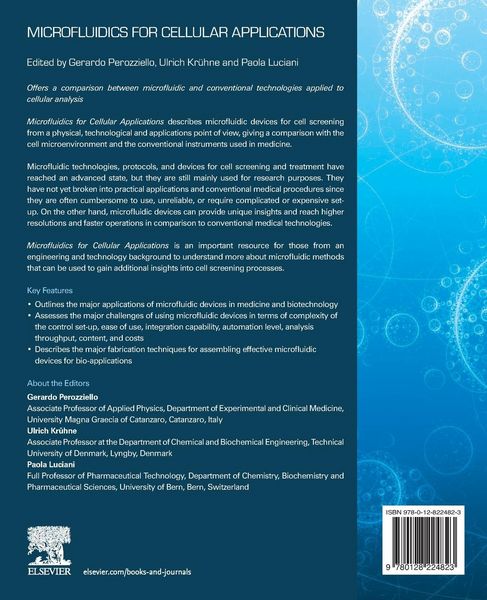
Microfluidics for Cellular Applications
Aus der Reihe
Micro and Nano Technologies
-
- Taschenbuch ausgewählt
- eBook
-
Sprache:Englisch
Fr. 251.00
inkl. gesetzl. MwSt.,
Beschreibung
Produktdetails
Einband
Taschenbuch
Erscheinungsdatum
24.04.2023
Herausgeber
Gerardo Perozziello + weitereVerlag
Elsevier Science & TechnologySeitenzahl
432
Maße (L/B/H)
23.5/19.1/2.2 cm
Gewicht
739 g
Sprache
Englisch
ISBN
978-0-12-822482-3
Microfluidics for Cellular Applications describes microfluidic devices for cell screening from a physical, technological and applications point-of-view, presenting a comparison with the cell microenvironment and conventional instruments used in medicine. Microfluidic technologies, protocols, devices for cell screening and treatment have reached an advanced state but are mainly used in research. Sections break them down into practical applications and conventional medical procedures and offers insights and analysis on how higher resolutions and fast operations can be reached. This is an important resource for those from an engineering and technology background who want to understand more and gain additional insights on cell screening processes.
Noch keine Bewertungen vorhanden
Verfassen Sie die erste Bewertung zu diesem Artikel
Helfen Sie anderen Kundinnen und Kunden durch Ihre Meinung.