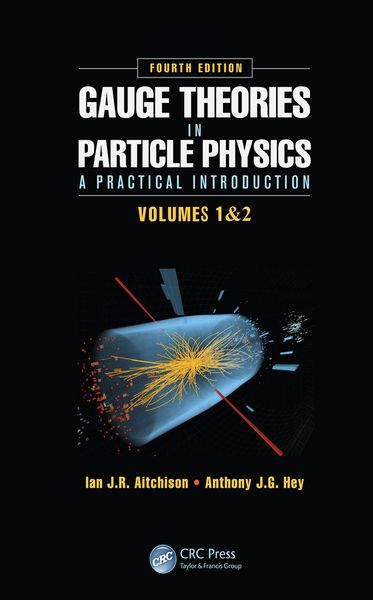
Gauge Theories in Particle Physics: A Practical Introduction, Fourth Edition - 2 Volume set
-
Form:Einzelkauf Download
-
Sprache:Englisch
-
Auflage:4. Auflage
Fr. 0.00
inkl. gesetzl. MwSt.Artikel erhalten
Beschreibung
Produktdetails
Format
Kopierschutz
Nein
Family Sharing
Nein
Text-to-Speech
Nein
Erscheinungsdatum
14.01.2021
Verlag
Taylor & Francis eBooksSeitenzahl
960 (Printausgabe)
Dateigröße
12341 KB
Auflage
4. Auflage
Sprache
Englisch
EAN
9781466591127
The fourth edition of this well-established, highly regarded two-volume set continues to provide a fundamental introduction to advanced particle physics while incorporating substantial new experimental results, especially in the areas of CP violation and neutrino oscillations. It offers an accessible and practical introduction to the three gauge theories included in the Standard Model of particle physics: quantum electrodynamics (QED), quantum chromodynamics (QCD), and the Glashow-Salam-Weinberg (GSW) electroweak theory.
In the first volume, a new chapter on Lorentz transformations and discrete symmetries presents a simple treatment of Lorentz transformations of Dirac spinors. Along with updating experimental results, this edition also introduces Majorana fermions at an early stage, making the material suitable for a first course in relativistic quantum mechanics.
Covering much of the experimental progress made in the last ten years, the second volume remains focused on the two non-Abelian quantum gauge field theories of the Standard Model: QCD and the GSW electroweak theory. A new chapter on CP violation and oscillation phenomena describes CP violation in B-meson decays as well as the main experiments that have led to our current knowledge of mass-squared differences and mixing angles for neutrinos. Exploring a new era in particle physics, this edition discusses the exciting discovery of a boson with properties consistent with those of the Standard Model Higgs boson. It also updates many other topics, including jet algorithms, lattice QCD, effective Lagrangians, and three-generation quark mixing and the CKM matrix.
This revised and updated edition provides a self-contained pedagogical treatment of the subject, from relativistic quantum mechanics to the frontiers of the Standard Model. For each theory, the authors discuss the main conceptual points, detail many practical calculations of physical quantities from first principles, and compare these quantitative predictions with experimental results, helping readers improve both their calculation skills and physical insight.
Kundinnen und Kunden meinen
Verfassen Sie die erste Bewertung zu diesem Artikel
Helfen Sie anderen Kund*innen durch Ihre Meinung