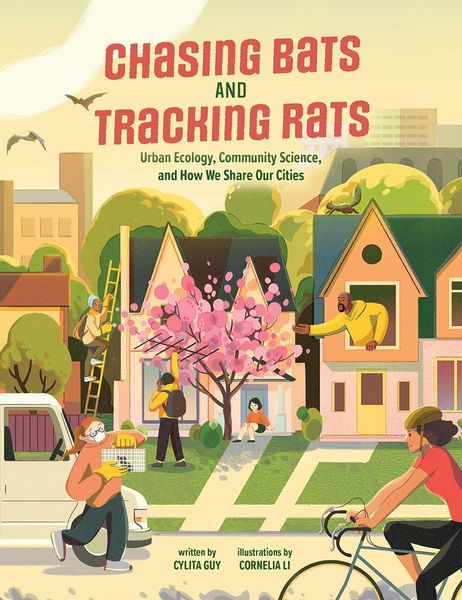
Chasing Bats and Tracking Rats Urban Ecology, Community Science, and How We Share Our Cities
-
- Englisch ausgewählt
Fr. 19.90
inkl. gesetzl. MwSt.,
-
Kostenlose Lieferung ab Fr. 30 Einkaufswert
Schweiz & Liechtenstein:
Versandkostenfrei ab Fr. 30.00
Versandkosten bis Fr. 30.00: Fr. 3.50Andere Lieferländer
Fr. 18.00 unabhängig vom Warenwert
Beschreibung
Produktdetails
Einband
Taschenbuch
Altersempfehlung
8 - 12 Jahr(e)
Erscheinungsdatum
30.11.2021
Illustriert von
Cornelia Li
Verlag
Ingram Publishers ServicesSeitenzahl
108
Maße (L/B/H)
24.4/18.6/0.8 cm
Gewicht
306 g
Sprache
Englisch
ISBN
978-1-77321-539-6
Gripping narrative non-fiction with STEM and social justice themes that proves cities can be surprisingly wild places—and why understanding urban nature matters.
What can city bees tell us about climate change? How are we changing coyote behavior? And what the heck is a science bike? Featuring the work of a diverse group of eleven scientists—herself included!—Dr. Cylita Guy shows how studying urban wildlife can help us make cities around the world healthier for all of their inhabitants. In the process, Guy reveals how social injustices like racism can affect not only how scientists study city wildlife, but also where urban critters are likelier to thrive. Sidebars include intriguing animal facts and the often-wacky tools used by urban ecologists, from a ratmobile to a bug vacuum. Cornelia Li’s engaging illustrations bring the scientists’ fieldwork adventures to life, while urban ecology challenges encourage readers to look for signs of wildlife in their own neighborhoods.
Noch keine Bewertungen vorhanden
Verfassen Sie die erste Bewertung zu diesem Artikel
Helfen Sie anderen Kundinnen und Kunden durch Ihre Meinung.