Gutscheinbedingungen

*Gültig bis 20.09.2026 auf (fast) alles. Ausgeschlossen sind Smartboxen, Zeitschriften, Tickets, Lebensmittel, Gaming-Elektroartikel, Tinte/Toner, Gutscheine, Geschenkkarten, Blumen und Abos | Einlösbar in allen Buchhandlungen von Orell Füssli, Barth Bücher, Buchladen Rapunzel, Schuler Orell Füssli, Stauffacher und ZAP unter Vorweisung des Gutscheins, auf www.orellfüssli.ch durch Eingabe des Gutscheincodes. Beim Service „eBooks verschenken“ und bei eBook-Käufen via eReader nicht einlösbar | Mindesteinkaufswert: Fr. 100.- | Nicht mit anderen Rabatten kumulierbar.

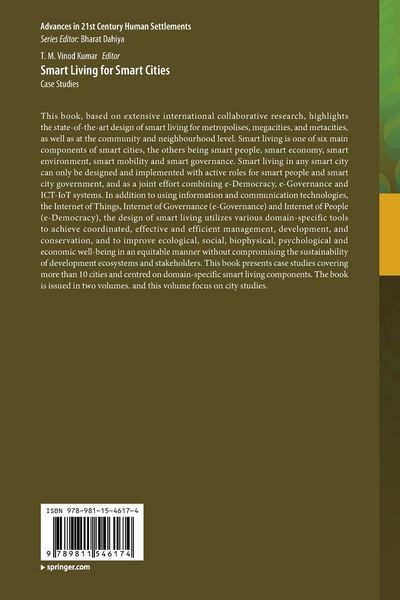
  • Produktbild: Smart Living for Smart Cities
  • Produktbild: Smart Living for Smart Cities

Smart Living for Smart Cities Case Studies

Fr. 155.00

inkl. gesetzl. MwSt., Versandkostenfrei


Beschreibung

Produktdetails

Einband

Taschenbuch

Erscheinungsdatum

06.05.2021

Abbildungen

XIII, 454 p. 319 illus., 298 illus. in color.

Herausgeber

T. M. Vinod Kumar

Verlag

Springer Singapore

Seitenzahl

454

Maße (L/B/H)

23.5/15.5/2.6 cm

Gewicht

703 g

Auflage

1. Auflage

Sprache

Englisch

ISBN

978-981-15-4617-4

Beschreibung

Portrait

Professor T. M. Vinod Kumar has 50 years of professional experience and is specialized in Urban and Regional Planning, Urban and Regional Infrastructure, Urban Environmental Management, Application of GIS in Urban Planning, Models in Planning, Urban Design and Smart Cities. He has extensive consultancy experience in urban and rural development, infrastructure, tourism, and health care throughout India, and in new town planning and development, city centre and housing planning, and structure planning in Malaysia. He has worked in Bhutan, China, Pakistan, Nepal and India as a Regional Program Coordinator for the International Centre for Integrated Mountain Development. Academically, he has worked at the School of Planning and Architecture, New Delhi as a Professor, Head of the Department of Urban Planning, Head of the Centre for Analysis and Systems Studies, Head of the Centre for Urban Studies, and finally Dean of Studies at the School of Planning and Architecture, New Delhi. He also worked as a Planner-Engineer with the Ford Foundation, India. He is a former Visiting Professor at Bandung Institute of Technology Indonesia, and current Visiting Professor at the National Institute of Technology, Calicut. He has authored numerous books and journal articles, and been a Project Manager for many consulting projects in India and abroad. He coordinated and edited Geographic Information System for Smart Cities (Copal:2014), E-Governance for Smart Cities (Springer:2015), Smart Economy in Smart Cities (Springer:2016), E-Democracy for Smart Cities (Springer:2017), Smart Metropolitan Regional Development-Economic and Spatial Design Strategies (Springer-Nature:2018) and Smart Environment for Smart Cities (Springer-Nature:2019).

Produktdetails

Einband

Taschenbuch

Erscheinungsdatum

06.05.2021

Abbildungen

XIII, 454 p. 319 illus., 298 illus. in color.

Herausgeber

T. M. Vinod Kumar

Verlag

Springer Singapore

Seitenzahl

454

Maße (L/B/H)

23.5/15.5/2.6 cm

Gewicht

703 g

Auflage

1. Auflage

Sprache

Englisch

ISBN

978-981-15-4617-4

Herstelleradresse

Springer-Verlag KG
Sachsenplatz 4-6
1201 Wien
AT

Email: ProductSafety@springernature.com

Noch keine Bewertungen vorhanden

Verfassen Sie die erste Bewertung zu diesem Artikel

Helfen Sie anderen Kundinnen und Kunden durch Ihre Meinung.

Kundinnen und Kunden meinen

Bewertungen (0)

  • Produktbild: Smart Living for Smart Cities
  • Produktbild: Smart Living for Smart Cities
  • Part 1: Introduction.- Chapter 1: Smart Living for Smart Cities.-Part 2: City studies.- Chapter 2: Smart Living for Smart Hong Kong.- Chapter 3: Smart laws and regulations for Smart Living Case of Dehradun.- Chapter 4: Smart Heathy Living for Smart Kozhikode Metropolitan Area.- Chapter 5: Regeneration of Smart Spaces for Smart Living in Kozhikode Metropolitan Region (KMR).- Chapter 6: Smart Initiatives In Sustainable Historic Capital city of The Himalayas- Shimla .- Part 3: Conclusion.- Chapter 7: International Collaborative Research Smart Living for Smart Cities and Conclusions of city studies.