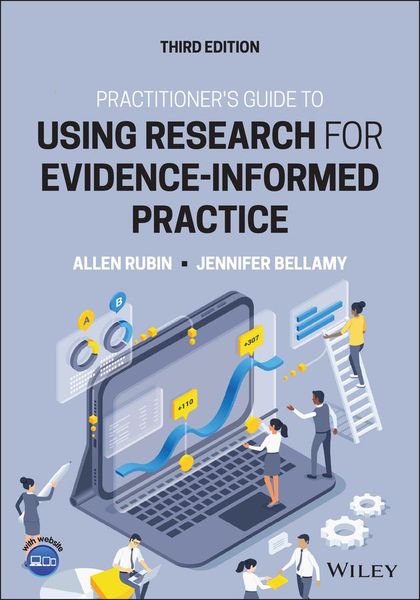
Practitioner's Guide to Using Research for Evidence-Informed Practice
-
- Englisch ausgewählt
Fr. 133.00
inkl. gesetzl. MwSt.,
Beschreibung
Produktdetails
Einband
Taschenbuch
Erscheinungsdatum
12.04.2022
Verlag
John Wiley & Sons IncSeitenzahl
304
Maße (L/B/H)
25/17.4/1.4 cm
Gewicht
610 g
Auflage
3rd edition
Sprache
Englisch
ISBN
978-1-119-85856-0
The latest edition of an essential text to help students and practitioners distinguish between research studies that should and should not influence practice decisions
Now in its third edition, Practitioner's Guide to Using Research for Evidence-Informed Practice delivers an essential and practical guide to integrating research appraisal into evidence-informed practice. The book walks you through the skills, knowledge, and strategies you can use to identify significant strengths and limitations in research.
The ability to appraise the veracity and validity of research will improve your service provision and practice decisions. By teaching you to be a critical consumer of modern research, this book helps you avoid treatments based on fatally flawed research and methodologies.
Practitioner's Guide to Using Research for Evidence-Informed Practice, Third Edition offers:
* An extensive introduction to evidence-informed practice, including explorations of unethical research and discussions of social justice in the context of evidence-informed practice.
* Explanations of how to appraise studies on intervention efficacy, including the criteria for inferring effectiveness and critically examining experiments.
* Discussions of how to critically appraise studies for alternative evidence-informed practice questions, including nonexperimental quantitative studies and qualitative studies.
A comprehensive and authoritative blueprint for critically assessing research studies, interventions, programs, policies, and assessment tools, Practitioner's Guide to Using Research for Evidence-Informed Practice belongs in the bookshelves of students and practitioners of the social sciences.
Now in its third edition, Practitioner's Guide to Using Research for Evidence-Informed Practice delivers an essential and practical guide to integrating research appraisal into evidence-informed practice. The book walks you through the skills, knowledge, and strategies you can use to identify significant strengths and limitations in research.
The ability to appraise the veracity and validity of research will improve your service provision and practice decisions. By teaching you to be a critical consumer of modern research, this book helps you avoid treatments based on fatally flawed research and methodologies.
Practitioner's Guide to Using Research for Evidence-Informed Practice, Third Edition offers:
* An extensive introduction to evidence-informed practice, including explorations of unethical research and discussions of social justice in the context of evidence-informed practice.
* Explanations of how to appraise studies on intervention efficacy, including the criteria for inferring effectiveness and critically examining experiments.
* Discussions of how to critically appraise studies for alternative evidence-informed practice questions, including nonexperimental quantitative studies and qualitative studies.
A comprehensive and authoritative blueprint for critically assessing research studies, interventions, programs, policies, and assessment tools, Practitioner's Guide to Using Research for Evidence-Informed Practice belongs in the bookshelves of students and practitioners of the social sciences.
Noch keine Bewertungen vorhanden
Verfassen Sie die erste Bewertung zu diesem Artikel
Helfen Sie anderen Kundinnen und Kunden durch Ihre Meinung.