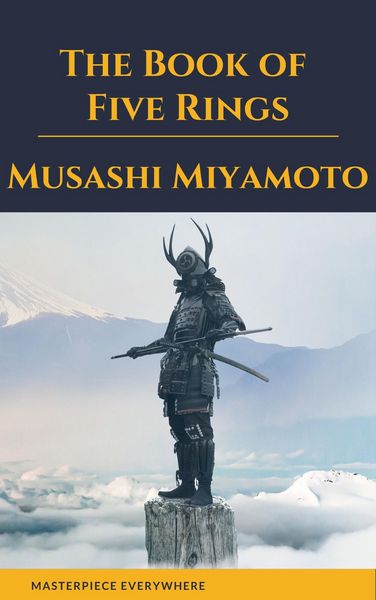
The Book of Five Rings
-
- Hardcover
- Taschenbuch
- eBook ausgewählt
-
Form:Einzelkauf Download
-
Sprache:Englisch
- Deutsch Fr. 12.90
- Englisch ausgewählt
-
Verlag:Masterpiece Everywhere
- Reading Time Fr. 1.00
- Reading Time Fr. 1.00
- Start Publishing LLC Fr. 1.00
- Masterpiece Everywhere Fr. 1.00
- Masterpiece Everywhere ausgewählt
- Masterpiece Everywhere Fr. 1.00
- ATOZ Classics Fr. 1.00
- ATOZ Classics Fr. 1.00
- Icarsus Fr. 1.00
- Classics HQ Fr. 1.00
- Rmb Fr. 1.00
- Booklassic Fr. 1.00
- Pocket Classic Fr. 1.00
- Flip Fr. 0.50
- Flip Fr. 0.50
- Flip Fr. 1.00
- Flip Fr. 1.00
- Classics for all Fr. 1.00
- Knowledge house Fr. 1.00
- MyBooks Classics Fr. 1.00
Fr. 1.00
inkl. gesetzl. MwSt.Beschreibung
Produktdetails
Format
ePUB
Kopierschutz
Nein
Family Sharing
Ja
Text-to-Speech
Ja
Erscheinungsdatum
27.07.2021
Verlag
Masterpiece EverywhereSeitenzahl
2000 (Printausgabe)
Dateigröße
718 KB
Sprache
Englisch
EAN
9782378079802
Contains Active Table of Contents (HTML) and include a bonus link to the free audio book.
The Book of Five Rings ( ¿¿¿ Go Rin no Sho) is a text on kenjutsu and the martial arts in general, written by the Japanese swordsman Miyamoto Musashi around 1645. There have been various translations made over the years, and it enjoys an audience considerably broader than only that of martial artists and people across East Asia: for instance, some foreign business leaders find its discussion of conflict and taking the advantage to be relevant to their work in a business context. The modern-day Hyoho Niten Ichi-ryu employs it as a manual of technique and philosophy.
Musashi establishes a "no-nonsense" theme throughout the text. For instance, he repeatedly remarks that technical flourishes are excessive, and contrasts worrying about such things with the principle that all technique is simply a method of cutting down one's opponent. He also continually makes the point that the understandings expressed in the book are important for combat on any scale, whether a one-on-one duel or a massive battle. Descriptions of principles are often followed by admonitions to "investigate this thoroughly" through practice rather than trying to learn them by merely reading.
Musashi describes and advocates a two-sword fencing style (nitojutsu): that is, wielding both katana and wakizashi, contrary to the more traditional method of wielding the katana two-handed. However, he only explicitly describes wielding two swords in a section on fighting against many adversaries. The stories of his many duels rarely refer to Musashi himself wielding two swords, although, since they are mostly oral traditions, their details may be inaccurate. Musashi states within the volume that one should train with a long sword in each hand, thereby training the body and improving one's ability to use two blades simultaneously
(wikipedia)
The Book of Five Rings ( ¿¿¿ Go Rin no Sho) is a text on kenjutsu and the martial arts in general, written by the Japanese swordsman Miyamoto Musashi around 1645. There have been various translations made over the years, and it enjoys an audience considerably broader than only that of martial artists and people across East Asia: for instance, some foreign business leaders find its discussion of conflict and taking the advantage to be relevant to their work in a business context. The modern-day Hyoho Niten Ichi-ryu employs it as a manual of technique and philosophy.
Musashi establishes a "no-nonsense" theme throughout the text. For instance, he repeatedly remarks that technical flourishes are excessive, and contrasts worrying about such things with the principle that all technique is simply a method of cutting down one's opponent. He also continually makes the point that the understandings expressed in the book are important for combat on any scale, whether a one-on-one duel or a massive battle. Descriptions of principles are often followed by admonitions to "investigate this thoroughly" through practice rather than trying to learn them by merely reading.
Musashi describes and advocates a two-sword fencing style (nitojutsu): that is, wielding both katana and wakizashi, contrary to the more traditional method of wielding the katana two-handed. However, he only explicitly describes wielding two swords in a section on fighting against many adversaries. The stories of his many duels rarely refer to Musashi himself wielding two swords, although, since they are mostly oral traditions, their details may be inaccurate. Musashi states within the volume that one should train with a long sword in each hand, thereby training the body and improving one's ability to use two blades simultaneously
(wikipedia)
Noch keine Bewertungen vorhanden
Verfassen Sie die erste Bewertung zu diesem Artikel
Helfen Sie anderen Kundinnen und Kunden durch Ihre Meinung.