• Produktbild: Cycling & Walking for Regional Development
  • Produktbild: Cycling & Walking for Regional Development

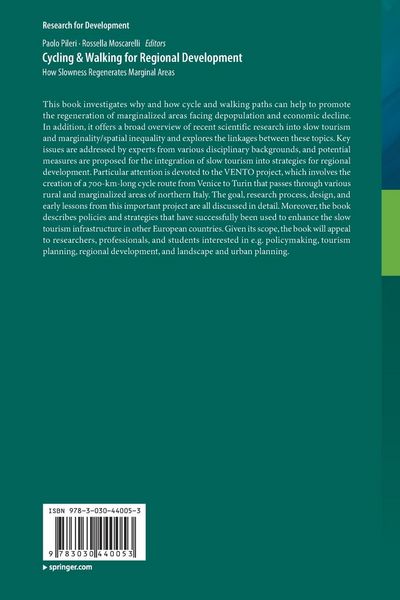
Cycling & Walking for Regional Development How Slowness Regenerates Marginal Areas

Aus der Reihe Research for Development

Fr. 201.00

inkl. gesetzl. MwSt., Versandkostenfrei


Beschreibung

Produktdetails

Einband

Taschenbuch

Erscheinungsdatum

29.08.2021

Herausgeber

Paolo Pileri + weitere

Verlag

Springer

Seitenzahl

249

Maße (L/B/H)

23.5/15.5/1.5 cm

Gewicht

400 g

Auflage

1st ed. 2021

Sprache

Englisch

ISBN

978-3-030-44005-3

Beschreibung

Rezension

“This volume is an essential contribution … should be of interest to regional and rural development researchers and policymakers, regional planners, tourism scholars, mobilities researchers, and activists seeking to find the right synergies between active travel, sustainable tourism and the revaluation of marginalised territories. The book serves as an introduction to the intersection of these research domains and joins the exhaustive body of evidence that foregrounds place-based responses to lagging or regional discontent.” (Wilbert den Hoed, Regional Studies, Vol. 57 (10), 2023)

Portrait

Paolo Pileri is a Full Professor of Urban Planning at the Department of Architecture and Urban Studies, Politecnico di Milano, Milan, Italy. His research interests have consistently brought together environmental issues with urban and landscape planning, and many of his research efforts have involved projects focusing on sustainable mobility as a way to better link people and landscapes. In this context, he has been working on the VENTO project to connect “forgotten” but nonetheless stunning Italian landscapes along the Po River by means of an extensive cycle path. This is not merely about the path itself, but also the ability of a territory and landscape project to generate a new, green/local economy and new high-quality jobs. Professor Pileri is the author or editor of numerous publications, ranging from books and journal articles to popular works.

Rossella Moscarelli is currently engaged in a Ph.D. project titled “Inner areas and slow lines: an opportunity to regeneratemarginalized territories in Italy” at the Department of Architecture and Urban Studies, Politecnico di Milano. Holding an M.Sc. (cum laude) in Environmental and Technological Architecture, she is an active collaborator in the VENTO research group and has also studied public policies relating to, and the impacts of, the Camino de Santiago in Spain. She is the author of numerous publications on slow tourism infrastructure, land consumption, and regeneration. 

Produktdetails

Einband

Taschenbuch

Erscheinungsdatum

29.08.2021

Herausgeber

Verlag

Springer

Seitenzahl

249

Maße (L/B/H)

23.5/15.5/1.5 cm

Gewicht

400 g

Auflage

1st ed. 2021

Sprache

Englisch

ISBN

978-3-030-44005-3

Herstelleradresse

Springer-Verlag GmbH
Tiergartenstr. 17
69121 Heidelberg
DE

Email: ProductSafety@springernature.com

Noch keine Bewertungen vorhanden

Verfassen Sie die erste Bewertung zu diesem Artikel

Helfen Sie anderen Kundinnen und Kunden durch Ihre Meinung.

Kundinnen und Kunden meinen

Bewertungen (0)

  • Produktbild: Cycling & Walking for Regional Development
  • Produktbild: Cycling & Walking for Regional Development
  • From Slow Tourism to Slow Travel: An Idea for Marginal Regions.- The Seat and the Saddle. How Slow is Quick and Fast is Stuck.- Marginality from Theory to Practices.- Marginalised Areas as a Public Policy Concern.- Italian Policies on Marginal Territories: An Overview.- Slowness to Discover the Ordinary Italian Landscape.- Food on the Bike.- The Role of Historic Roads to Preserve and Valorize the Landscape.- Cultural Heritage Preservation and Territorial Attractiveness: A Spatial Multidimensional Evaluation Approach.- Slow Travel Project for Enhancing Territories: Motivations and Directions.- Design, Public Engagement and Communication: Reframing Methodology.- Narration of Cultural Heritage as Anti-fragility Tool.- Learning from the Experience: A Set of European Policies.- The United Kingdom's National Cycle Network: Paths for Everyone, Past, Present and Future.- The Singularity of the Camino de Santiago as a Contemporary Tourism Case.- The Success of the Cycle Tourist Backbone Along the Danube in Germany and Austria.