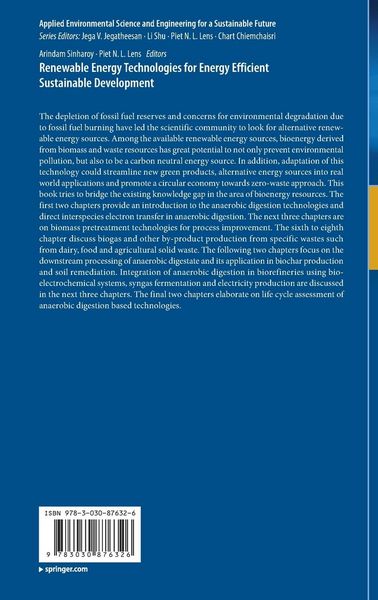
• Produktbild: Renewable Energy Technologies for Energy Efficient Sustainable Development
  • Produktbild: Renewable Energy Technologies for Energy Efficient Sustainable Development

Renewable Energy Technologies for Energy Efficient Sustainable Development

Fr. 218.00

inkl. gesetzl. MwSt., Versandkostenfrei


Beschreibung

Produktdetails

Einband

Gebundene Ausgabe

Erscheinungsdatum

04.01.2022

Herausgeber

Arindam Sinharoy + weitere

Verlag

Springer

Seitenzahl

414

Maße (L/B/H)

24.1/16/2.9 cm

Gewicht

793 g

Auflage

1st ed. 2022

Sprache

Englisch

ISBN

978-3-030-87632-6

Beschreibung

Portrait

Dr. Arindam Sinharoy 

Dr. Sinharoy is currently working as postdoctoral researcher in the Department of Microbiology and Ryan Institute at National University of Ireland Galway. His current research work focuses on biological removal of chalcogen compounds (sulfur, selenium and tellurium) from wastewater and their recovery as nanoparticles either in their elemental form or as metal chalcogenide particles. Prior to joining NUIG, he completed his Ph.D on biological conversion of carbon monoxide for bioenergy and environmental applications at the Indian Institute of Technology Guwahati, India. He has authored and co-authored over 20 peer-reviewed journal publications, book chapters and currently editing two books. His areas of research expertise include bioenergy, syngas fermentation, bioprocess development for waste to energy and value added products, biokinetics of pollutant removal, heavy metal removal, chalcogen removal and their bioconversion.  

Prof. Piet N.L. Lens 

Prof.Dr.ir. Lens is established professor of New Energy Technologies at National University Ireland Galway. He is also Professor Environmental Biotechnology at UNESCO-IHE (Delft, the Netherlands), adjunct professor at Tampere University of Technology (Finland) and was previously on the faculty of the Sub-Department of Environmental Technology at Wageningen University (1999-2006), where he still has a zero nomination. Prof. Lens trained in Environmental Sanitation, then obtained his Ph.D. in Environmental Engineering at University Gent (Belgium). He is founding Editor-in-Chief of the Review Journal “Re/Views in Environmental Science and Bio/Technology” and founding editor of the IWA Publishing series “Integrated Environmental Technology”. Besides innovative research, he is also a leader in education and capacity-building, initiating several joint MSc and PhD degree programmes and organising numerous study-days, conferences, summer schools and short courses. He has (co-)authored over 550 scientific publications and edited 12 book volumes. His awards include the IWA Publishing Award (2002), a Marie Curie Excellence Grant (2004), nomination as IWA fellow (2010) and IWA Distinguished fellow (2015) and nomination as IBA fellow (2019). His research focuses on biofilms, sulfur biotechnology, metal speciation, bioavailability and removal, natural treatment systems, anaerobic wastewater and waste gas treatment for resource recovery and reuse. 

Produktdetails

Einband

Gebundene Ausgabe

Erscheinungsdatum

04.01.2022

Herausgeber

Verlag

Springer

Seitenzahl

414

Maße (L/B/H)

24.1/16/2.9 cm

Gewicht

793 g

Auflage

1st ed. 2022

Sprache

Englisch

ISBN

978-3-030-87632-6

Herstelleradresse

Springer-Verlag GmbH
Tiergartenstr. 17
69121 Heidelberg
DE

Email: ProductSafety@springernature.com

Kundinnen und Kunden meinen

0 Bewertungen

Informationen zu Bewertungen

Zur Abgabe einer Bewertung ist eine Anmeldung im Konto notwendig. Die Authentizität der Bewertungen wird von uns nicht überprüft. Wir behalten uns vor, Bewertungstexte, die unseren Richtlinien widersprechen, entsprechend zu kürzen oder zu löschen.

Die Bewertungen sind nach Format, Anzahl Sterne und Datum sortiert.

Verfassen Sie die erste Bewertung zu diesem Artikel

Helfen Sie anderen Kund*innen durch Ihre Meinung

Kundinnen und Kunden meinen

0 Bewertungen filtern

  • Produktbild: Renewable Energy Technologies for Energy Efficient Sustainable Development
  • Produktbild: Renewable Energy Technologies for Energy Efficient Sustainable Development
  • Part 1: Process fundamentals.- Chapter 1: Fundamentals of biofuel production from anaerobic digestion: Metabolic pathways and interferences.- Chapter 2: Direct interspecies electron transfer for intensification of biogas production.- Part 2: Pretreatment.- Chapter 3: Adsorbents for the detoxification of lignocellulosic wastes hydrolysates to improve fermentative processes to bioenergy production.- Chapter 4: Pretreatment of lignocellulosic materials to enhance biogas production through anaerobic digestion.- Chapter 5: Biogas production from dairy cattle residues - definition of the pretreatment approach through a bibliometric analysis of publications and patents.- Part 3: AD of specific waste-streams.- Chapter 6: Anaerobic digestion of dairy industry wastewater.- Chapter 7: Solid state anaerobic digestion of agricultural waste.- Chapter 8: Food waste biorefinery for bioenergy and value-added products.- Part 4: Downstream processing for resource recovery.- Chapter 9: Valorization ofanaerobic digestate for production of value added products.- Chapter 10: Biochar produced from organic waste digestate and its potential utilization for soil remediation: An overview.- Part 5: Integration of AD in biorefineries.- Chapter 11: Integration of bioelectrochemical systems with anaerobic digestion.- Chapter 12: Use of biogas for electricity driven appliances.- Chapter 13: Syngas fermentation for bioenergy production: recent advances in bioreactor systems.- Part 6: Life cycle analysis.- Chapter 14: Up and downstream technologies of anaerobic digestion from life cycle assessment perspective.- Chapter 15: Life cycle analysis of anaerobic digestion systems.