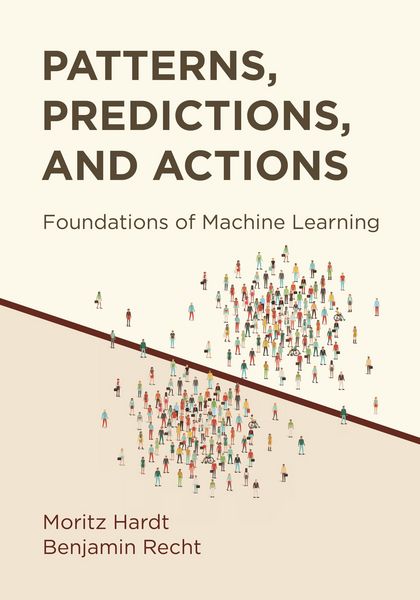
Produktbild: Patterns, Predictions, and Actions - Foundations of Machine Learning

Patterns, Predictions, and Actions - Foundations of Machine Learning Foundations of Machine Learning

Fr. 99.90

inkl. gesetzl. MwSt., Versandkostenfrei


Beschreibung

Produktdetails

Einband

Gebundene Ausgabe

Erscheinungsdatum

18.10.2022

Abbildungen

41 b/w illus. 10 tables.

Verlag

University Presses

Seitenzahl

320

Maße (L/B/H)

25.8/17.9/2.5 cm

Gewicht

730 g

Sprache

Englisch

ISBN

978-0-691-23373-4

Beschreibung

Produktdetails

Einband

Gebundene Ausgabe

Erscheinungsdatum

18.10.2022

Abbildungen

41 b/w illus. 10 tables.

Verlag

University Presses

Seitenzahl

320

Maße (L/B/H)

25.8/17.9/2.5 cm

Gewicht

730 g

Sprache

Englisch

ISBN

978-0-691-23373-4

Herstelleradresse

Libri GmbH
Europaallee 1
36244 Bad Hersfeld
DE

Email: gpsr@libri.de

Noch keine Bewertungen vorhanden

Verfassen Sie die erste Bewertung zu diesem Artikel

Helfen Sie anderen Kundinnen und Kunden durch Ihre Meinung.

Kundinnen und Kunden meinen

Bewertungen (0)

  • Produktbild: Patterns, Predictions, and Actions - Foundations of Machine Learning
    • List of Figures
    • List of Tables
    • Preface
    • Acknowledgments
    • 1 Introduction
      • Ambitions of the twentieth century
      • Pattern classi¿cation
      • Prediction and action
      • Chapter notes
    • 2 Fundamentals of Prediction
      • Modeling knowledge
      • Prediction via optimization
      • Types of errors and successes
      • The Neyman-Pearson Lemma
      • Decisions that discriminate
      • Chapter notes
    • 3 Supervised Learning
      • Sample versus population
      • Supervised learning
      • A ¿rst learning algorithm: The perceptron
      • Connection to empirical risk minimization
      • Formal guarantees for the perceptron
      • Chapter notes
    • 4 Representations and Features
      • Measurement
      • Quantization
      • Template matching
      • Summarization and histograms
      • Nonlinear predictors
      • Chapter notes
    • 5 Optimization
      • Optimization basics
      • Gradient descent
      • Applications to empirical risk minimization
      • Insights from quadratic functions
      • Stochastic gradient descent
      • Analysis of the stochastic gradient method
      • Implicit convexity
      • Regularization
      • Squared loss methods and other optimization tools
      • Chapter notes
    • 6 Generalization
      • Generalization gap
      • Overparameterization: Empirical phenomena
      • Theories of generalization
      • Algorithmic stability
      • Model complexity and uniform convergence
      • Generalization from algorithms
      • Looking ahead
      • Chapter notes
    • 7 Deep Learning
      • Deep models and feature representation
      • Optimization of deep nets
      • Vanishing gradients
      • Generalization in deep learning
      • Chapter notes
    • 8 Datasets
      • The scienti¿c basis of machine learning benchmarks
      • A tour of datasets in di¿erent domains
      • Longevity of benchmarks
      • Harms associated with data
      • Toward better data practices
      • Limits of data and prediction
      • Chapter notes
    • 9 Causality
      • The limitations of observation
      • Causal models
      • Causal graphs
      • Interventions and causal e¿ects
      • Confounding
      • Experimentation, randomization, potential outcomes
      • Counterfactuals
      • Chapter notes
    • 10 Causal Inference in Practice
      • Design and inference
      • The observational basics: Adjustment and controls
      • Reductions to model ¿tting
      • Quasi-experiments
      • Limitations of causal inference in practice
      • Chapter notes
    • 11 Sequential Decision Making and Dynamic Programming
      • From predictions to actions
      • Dynamical systems
      • Optimal sequential decision making
      • Dynamic programming
      • Computation
      • Partial observation and the separation heuristic
      • Chapter notes
    • 12 Reinforcement Learning
      • Exploration-exploitation trade-ös: Regret and PAC-error
      • Unknown models and approximate dynamic programming
      • Certainty equivalence is often optimal
      • The limits of learning in feedback loops
      • Chapter notes
    • 13 Epilogue
      • Beyond pattern classi¿cation?
    • 14 Mathematical Background
      • Common notation
      • Multivariable calculus and linear algebra
      • Probability
      • Estimation
    • Bibliography
    • Index