• Produktbild: Crime Prevention and Justice in 2030
  • Produktbild: Crime Prevention and Justice in 2030

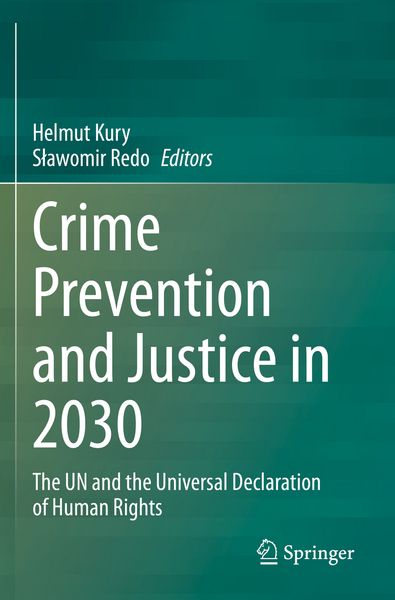
Crime Prevention and Justice in 2030 The UN and the Universal Declaration of Human Rights

Fr. 209.00

inkl. gesetzl. MwSt., Versandkostenfrei


Beschreibung

Produktdetails

Einband

Taschenbuch

Erscheinungsdatum

30.01.2022

Abbildungen

XXIV, 768 p. 21 illus., 3 illus. in color.

Herausgeber

Helmut Kury + weitere

Verlag

Springer

Seitenzahl

768

Maße (L/B/H)

23.5/15.5/4.3 cm

Gewicht

1177 g

Auflage

1st ed. 2021

Sprache

Englisch

ISBN

978-3-030-56229-8

Beschreibung

Portrait


Prof. Dr. habil. Dr. h.c. mult., Dipl.-Psych. Helmut
Kury
studied Psychology at the University of Freiburg (Freiburg im Brsg., Germany), Diploma, Dr. in Psychology and Habilitation at the University of Freiburg. Between 1970 and 1973 Assistant Teacher at the University of Freiburg, Institute for Psychology, from 1973 – 1980 and from 1989 to 2006 Senior Researcher at the Max Planck-Institute for Foreign and International Penal Law in Freiburg im Brsg., Department of Criminology (MPI). 1980 – 1988 first Director of the new established Criminological Research Institute of Lower Saxony (KFN). Research in offender rehabilitation, crime prevention, attitudes to punishment, fear or crime, punitiveness, alternatives to punishment, mediation, victim offender restitution, methodological problems of empirical social science research, especially in criminology, international comparison of crime and punishment. Many scientific contacts on the background of cooperation with former Soviet states and developing countries. Round about 700 scientific publications, most recent ones: Kury, H., Ferdinand, T.N. (Eds.)(2008). International Perspectives on Punitivity. Bochum: Universitätsverlag Dr. Brockmeyer; Kury, H. (Ed.)(2008). Fear of crime – Punitivity. New Developments in Theory and Research. Bochum: Universitätsverlag Dr. Brockmeyer; Kury, H., Shea, E. (Eds.)(2011). Punitivity – International Developments. 3 Vols., Bochum: Universitätsverlag Dr. Brockmeyer; Kury, H., Redo, S., Shea, E. (Eds.)(2016). Women and Children as Victims and Offenders: Background, Prevention, Reintegration. Suggestions for Succeeding Generations. International Publishing/CH: Springer, 2 Vols., Kury, H., Kuhlmann, A. (2016). Mediation in Germany and Other Western Countries. Kriminologijos studijos, Vilniaus Universitetas, 4, 5-46.

Sławomir Redo, Dr. hab.
(Law/Criminology) is Visiting Professor of United Nations Law. Member of the United Nations Studies Association. F. United Nations Senior Crime Prevention and Criminal Justice Expert and staff of the UN Office on Drugs and Crime (ret.); He had been involved in numerous projects implementing the UN standards and norms in crime prevention and criminal justice. In other capacities he assisted in the implementation of the United Nations Convention against Transnational Organized Crime, and on-line international crime prevention and criminal justice education.


Produktdetails

Einband

Taschenbuch

Erscheinungsdatum

30.01.2022

Abbildungen

XXIV, 768 p. 21 illus., 3 illus. in color.

Herausgeber

Verlag

Springer

Seitenzahl

768

Maße (L/B/H)

23.5/15.5/4.3 cm

Gewicht

1177 g

Auflage

1st ed. 2021

Sprache

Englisch

ISBN

978-3-030-56229-8

Herstelleradresse

Springer-Verlag GmbH
Tiergartenstr. 17
69121 Heidelberg
DE

Email: ProductSafety@springernature.com

Noch keine Bewertungen vorhanden

Verfassen Sie die erste Bewertung zu diesem Artikel

Helfen Sie anderen Kundinnen und Kunden durch Ihre Meinung.

Kundinnen und Kunden meinen

Bewertungen (0)

  • Produktbild: Crime Prevention and Justice in 2030
  • Produktbild: Crime Prevention and Justice in 2030

  • Prologue
    by Helmut Kury and Sławomir Redo.-
    Part I – Rule of Law and Realities of Life in the Context of the 2030 Justice and Crime Prevention:
    Democracy – Human Rights – Rule of Law: European Developments and the Importance of an Independent Judiciary
    by Friedrich Forsthuber.-
    Youth Perception on Hate Crimes, Hate Speeches and Nationalism in Contemporary India
    by J. Maria Agnes Sasitha.-
    Incorporating the United Nations Norms into Iranian Post-Revolution Criminal Policy: A Criminological-Victimological Approach
    by Mehrdad Rayejian Asli.-
    Part II –  Leaving No One Behind: Intergenerational Vulnerability and Educating for Justice:
    Perspectives on Elderly Crime and Victimization in the Future
    by Peter C. Kratcoski and Maximilian Edelbacher.-
    Universal Basic Income (UBI) for Reducing Inequalities and Increasing Socio-Economic Inclusion: A Proposal for a New Sustained Policy Perspective
    by Inez Wijngaarde, Jebamalai Vinanchiarachi, and Jeff Readman.-
    Prisoners and their Families – The Effects of Imprisonment on the Family
    by Helmut Kury.-
    Dealing with Mental Illness and Violence in the (Youth-)Prison
    by Helmut Kury and Romy Heße.-
    On Nelson Mandela Rule 63, Prisoner’s Moral Vulnerability and Development in the context of the 2030 United Nations Sustainable World
    by Sławomir Redo and Krzysztof Sawicki.-
    Parents who hit. Troubled Families and Children’s Happiness: Do Gender and National Context make a Difference?  
    by Ineke Haen Marshall, Candence Wills and Chris E. Marshall.-
    The UN Global Study on Children Deprived of Liberty – The Role of Academia in “Making the Invisible and Forgotten Visible”
    by Manfred Nowak and Manu Krishan.-
    Part III – Living in Harmony with Nature: Mother Earth’s Criminology:
    United Nations Initiatives in Preventing Environmental Crime
    by Rob White.-
    Assessing the Viability of Environmental Projects for a Crime Prevention-InspiredCulture of Lawfulness
    by Wiesław Pływaczewski, Joanna Narodowska and Maciej Duda.-
    Actualising the Right to Adequate Standard of Living: A Critical Examination of Green Criminology from an Indian Perspective by Murugesan Srinivasan and Alagesan Shankar Prakash.- Notes on the Case of Orangutan Sandra, the non-human Subject of Rights
    by Pedro R. David.-
    Part IV –  Ethics and Science in the Service of Countering Crime:
    Surveillance and the Impossible Search for Ideal Behaviour
    by Toine Spapens.-
    Ethics and the Development of Artificial Intelligence – Challenges and Dilemmas in the Context of the 2030 United Nations Agenda for Sustainable Development
    by Aneta Breczko, Wojciech Filipkowski and Izabela Kraśnicka.-
    From Wonders as Crime to Forensics in Service of the 2030 United Nations Agenda
    by Emil W. Pływaczewski, Ewa M. Guzik-Makaruk, Wojciech Filipkowski and Emilia Jurgielewicz-Delegacz.-
    The Rule of Law, Peacebuilding, and Agenda 2030: Lessons from the Western Balkans
    by Alistair D. Edgar.-
    Part V – Research & the Promotion of Peaceful and Inclusive Societies:
    Crime, Victimization, and Intentions to Migrate in the Northern Triangle
    by Christopher S. Inkpen, Wayne J. Pitts and Pamela Lattimore.-
    Criminal Violence and its Prevention in Context. Specific Challenges for the In-tegration of Refugees and Migrants in the 21st Century
    by Anastasia Chalkia.-
    Legal Education for Profit and the United Nations Call for “Quality Education” and “Strong Institutions” in the 2030 Sustainable Development Agenda
    by Riaz Tejani.-
    Money Laundering: China and its Evolving Criminal Policy Response
    by Ling Zhou and Hanming Xu.-
    The Policy Relevance of Comparative Criminology: On Evidence-Based Policies, Policy Learning and the Scales of the Discipline
    by Susanne Karstedt.-
    Part VI – Countering Art Crime & Violence:
    United Nations Perspective on Preventing Transnational Organised Crime against Cultural Property in the Era of Sustainable Development and Restitution Arguments
    by Kamil Zeidler and Julia Stepnowska.-
    Reducing Violent Crime by 50% before 2030: Decisive Action Now to Achieve these SDGs
    by Irwin Waller.-
    Part VII – Philosophies of Law & New Legal Realities in the Context of the 2030 Justice and Crime:
    The Erosion of Justice Symbolism
    by Yvon Dandurand and Jessica Jahn.-
    The Relevance of Philosophical and Religious Ideas to the United Nations Quest for Universalizing Criminal Justice
    by Sławomir Redo.-
    The Universal Declaration of Human Rights: Public International Law and the Confucian Legal Culture for 2030 and Beyond
    by Ying-Jun Zhang.-
    Is Socrates Mortal? On the Impact of Socratic Logic on Teaching and Learning the United Nations Crime Prevention Law
    by Sławomir Redo.-
    Reflections on the ‘Right to Justice’ – Now and in the Future
    by Karol Rutkowski.-
    Part VIII – Faith and Crime Prevention:
    TheFaith-based Organizations and the United Nations
    by Michael Platzer.-
    Turning the Tables on the War on Terror: The Alliance of Civilization as a United Nations Response to it
    by Tina L. Bertrand.-
    Spirituality, Crime Prevention and Criminal Justice: The Ongoing Significance of Faith-Based Organizations to the Work of the United Nations
    by Thomas Walsh.-
    Epilogue
    by Sławomir Redo and Helmut Kury.