Gutscheinbedingungen

*Gültig bis 21.06.2026 auf (fast) alles. Ausgeschlossen sind Smartboxen, Zeitschriften, Tickets, Lebensmittel, Gaming-Elektroartikel, Tinte/Toner, Gutscheine, Geschenkkarten, Blumen und Abos | Einlösbar in allen Buchhandlungen von Orell Füssli, Barth Bücher, Buchladen Rapunzel, Schuler Orell Füssli, Stauffacher und ZAP unter Vorweisung des Gutscheins, auf www.orellfüssli.ch durch Eingabe des Gutscheincodes. Beim Service „eBooks verschenken“ und bei eBook-Käufen via eReader nicht einlösbar | Mindesteinkaufswert: Fr. 30.- | Nicht mit anderen Rabatten kumulierbar.

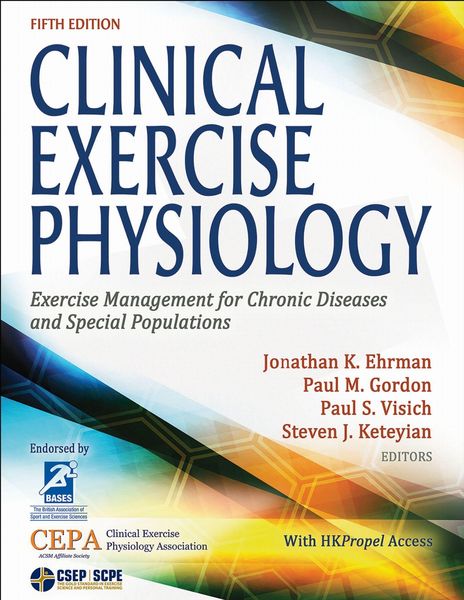
Produktbild: Clinical Exercise Physiology

Clinical Exercise Physiology Exercise Management for Chronic Diseases and Special Populations

Fr. 158.00

inkl. gesetzl. MwSt., Versandkostenfrei


Beschreibung

Produktdetails

Einband

Taschenbuch

Erscheinungsdatum

21.04.2022

Herausgeber

Jonathan K. Ehrman + weitere

Verlag

Human Kinetics Publishers

Seitenzahl

656

Maße (L/B/H)

27.7/21.1/3 cm

Gewicht

1794 g

Sprache

Englisch

ISBN

978-1-71820-044-9

Beschreibung

Portrait

Jonathan K. Ehrman, PhD, is the associate program director of preventive cardiology at Henry Ford Hospital in Detroit, where he also serves as chair of the institutional review board. He has a 36-year background in clinical exercise physiology and is certified by the American College of Sports Medicine (ACSM) as a clinical exercise physiologist and as a program director. He previously served as the chair of the clinical exercise physiologist credentialing committee for ACSM.

Dr. Ehrman is the author of more than 200 manuscripts and abstracts as well as several textbooks and chapters. He currently serves as editor in chief of the Journal of Clinical Exercise Physiology and was an associate editor of the 10th edition of ACSM’s Guidelines for Exercise Testing and Prescription. He is also the coeditor of the sixth edition of the American Association of Cardiovascular and Pulmonary Rehabilitation’s Guidelines for Cardiac Rehabilitation Programs. He is a fellow of ACSM and the American Association of Cardiovascular and Pulmonary Rehabilitation and is a member of the American Heart Association and the American College of Cardiology. Dr. Ehrman earned his PhD in clinical exercise physiology from The Ohio State University.

Paul M. Gordon, PhD, MPH, is a professor and head of the department of health, human performance, and recreation at Baylor University. He is certified by the American College of Sports Medicine (ACSM) as a clinical exercise physiologist and has over 20 years of experience teaching clinical exercise physiology curricula and directing cardiopulmonary rehabilitation programs. Gordon’s areas of expertise include physical activity and lifestyle-based research related to obesity and its comorbidities across the life span. He has published more than 200 papers and abstracts as well as several chapters, including contributions to ACSM’s Guidelines for Exercise Testing and Prescription. He has also served as an examiner and coordinator for ACSM certification and credentialing.

Dr. Gordon is a fellow of ACSM, the Obesity Society, and the Centers for Disease Control Physical Activity Research Program. He is an international member of the Royal Society of Medicine. He earned his PhD in exercise physiology and an MPH in epidemiology from the University of Pittsburgh.

Paul S. Visich, PhD, MPH, is a professor and chair of the exercise and sports performance department at the University of New England. He has over 20 years of experience in clinical exercise physiology and previously served as director of the Human Performance Laboratory in the College of Health Professions at Central Michigan University. He worked for 12 years in a clinical setting that included cardiac and pulmonary rehabilitation and primary disease prevention. His research interests involve the assessment of cardiovascular disease risk factors in children, the influence of resistance training in elderly populations, and altitude physiology.

Dr. Visich previously served as a member of the American College of Sport Medicine (ACSM) exercise physiology credentialing committee and as chair of their professional education committee. He is the author of more than 70 published scientific articles and abstracts. He earned a PhD in exercise physiology and an MPH in epidemiology from the University of Pittsburgh.

Steven J. Keteyian, PhD, has more than 40 years of experience working as a clinical exercise physiologist. He is program director of preventive cardiology at the Henry Ford Hospital in Detroit. He is also an adjunct professor in the department of physiology at Wayne State University in Detroit. Over the course of his career, Dr. Keteyian has focused on exercise and physical activity in both healthy individuals and those with chronic diseases. He is the author of more than 250 scientific articles and book chapters, as well as four textbooks, and he previously served as editor in chief for ACSM's Health & Fitness Journal.

Dr. Keteyian is a member of the American Association of Cardiovascular and Pulmonary Rehabilitation and the American Heart Association. He earned his PhD from Wayne State University in Detroit.

Produktdetails

Einband

Taschenbuch

Erscheinungsdatum

21.04.2022

Herausgeber

Verlag

Human Kinetics Publishers

Seitenzahl

656

Maße (L/B/H)

27.7/21.1/3 cm

Gewicht

1794 g

Sprache

Englisch

ISBN

978-1-71820-044-9

Herstelleradresse

Libri GmbH
Europaallee 1
36244 Bad Hersfeld
DE

Email: gpsr@libri.de

Kundinnen und Kunden meinen

0 Bewertungen

Informationen zu Bewertungen

Zur Abgabe einer Bewertung ist eine Anmeldung im Konto notwendig. Die Authentizität der Bewertungen wird von uns nicht überprüft. Wir behalten uns vor, Bewertungstexte, die unseren Richtlinien widersprechen, entsprechend zu kürzen oder zu löschen.

Die Bewertungen sind nach Format, Anzahl Sterne und Datum sortiert.

Verfassen Sie die erste Bewertung zu diesem Artikel

Helfen Sie anderen Kund*innen durch Ihre Meinung

Kundinnen und Kunden meinen

0 Bewertungen filtern

  • Produktbild: Clinical Exercise Physiology
  • Part I. Introduction to Clinical Exercise Physiology

    Chapter 1. The Profession of Clinical Exercise Physiology
    Jonathan K. Ehrman, PhD, Paul M. Gordon, PhD, MPH, Paul S. Visich, PhD, MPH, and Steven J. Keteyian, PhD
    The Past, Present, and Future of Clinical Exercise Physiology
    Professional Organizations and Certifications Throughout the World
    Professionalization of Clinical Exercise Physiology
    Conclusion

    Chapter 2. Promoting a Physically Active Lifestyle
    Anna G. Beaudry, BS, Danielle A. Young, PsyD, and Annie T. Ginty, PhD
    Benefits of Physical Activity
    Participation in Regular Physical Activity
    Conclusion

    Chapter 3. General Principles of Pharmacology
    Steven J. Keteyian, PhD
    General Properties of Drugs
    Routes of Administration
    Phases of Drug Effect
    Mechanism of Action
    Pharmacotherapy
    Conclusion

    Chapter 4. General Interview and Examination Skills
    Lizbeth R. Brice, MD
    General Interview
    Physical Examination
    Conclusion

    Chapter 5. Graded Exercise Testing
    Steven J. Keteyian, PhD
    Indications
    Contraindications
    Procedures for Preparing, Conducting, and Interpreting a Graded Exercise Test
    Graded Exercise Testing With Diagnostic Imaging
    Conclusion

    Chapter 6. Exercise Prescription
    Steven J. Keteyian, PhD
    Exercise Training Sequence
    Goal Setting
    Principles of Exercise Prescription
    Cardiorespiratory Endurance
    Skeletal Muscle Strength and Endurance
    Flexibility Training
    Conclusion

    Chapter 7. Clinical Exercise Programming
    Jonathan K. Ehrman, PhD
    Cardiac Rehabilitation
    Pulmonary Rehabilitation
    Supervised Exercise Therapy for Patients With Peripheral Artery Disease
    Cancer Rehabilitation
    Renal Rehabilitation
    General Exercise Programs for Patients With Chronic Disease
    Conclusion

    Part II. Diseases of the Endocrine System and Metabolic Disorders

    Chapter 8. Diabetes
    Sheri R. Colberg, PhD
    Definition
    Scope
    Pathophysiology
    Clinical Considerations
    Exercise Prescription
    Exercise Training
    Conclusion
    Chapter 9. Obesity
    David C. Murdy, MD, Dennis J. Kerrigan, PhD, and Jonathan K. Ehrman, PhD
    Definition
    Scope
    Pathophysiology
    Clinical Considerations
    Exercise Prescription
    Exercise Training
    Conclusion

    Chapter 10. Hypertension
    Yin Wu, PhD, and Linda S. Pescatello, PhD
    Definition
    Scope
    Pathophysiology
    Clinical Considerations
    Exercise Prescription
    Exercise Training
    Conclusion

    Chapter 11. Hyperlipidemia and Dyslipidemia
    Paul G. Davis, PhD, Peter W. Grandjean, PhD, Stephen F. Crouse, PhD, and J. Larry Durstine, PhD
    Definition
    Scope
    Pathophysiology
    Clinical Considerations
    Exercise Prescription
    Exercise Training
    Conclusion

    Chapter 12. Metabolic Syndrome
    James R. Churilla, PhD, MPH, MS
    Definition
    Scope
    Pathophysiology
    Clinical Considerations
    Exercise Prescription
    Exercise Training
    Conclusion

    Chapter 13. Chronic Kidney Disease
    Samuel Headley, PhD, Kenneth Wilund, PhD, and Michael Germain, MD
    Definition
    Scope
    Pathophysiology
    Clinical Considerations
    Exercise Prescription
    Exercise Training
    Conclusion

    Part III. Diseases of the Cardiovascular System

    Chapter 14. Acute Coronary Syndromes
    Ray W. Squires, PhD
    Pathophysiology
    Clinical Assessment
    Exercise Training: Inpatient Cardiac Rehabilitation
    Exercise Training: Early Outpatient Cardiac Rehabilitation
    Exercise Prescription
    Conclusion

    Chapter 15. Revascularization of the Heart
    Neil A. Smart, PhD
    Definition
    Scope
    Pathophysiology
    Clinical Considerations
    Exercise Prescription and Training
    Conclusion

    Chapter 16. Chronic Heart Failure
    Steven J. Keteyian, PhD
    Definition
    Scope
    Pathophysiology
    Clinical Considerations
    Exercise Prescription
    Exercise Training
    Conclusion

    Chapter 17. Peripheral Artery Disease
    Ryan J. Mays, PhD, MPH, Ivan P. Casserly, MB, BCh, and Judith G. Regensteiner, PhD
    Definition
    Scope
    Pathophysiology
    Clinical Considerations
    Exercise Prescription
    Exercise Training
    Conclusion

    Chapter 18. Cardiac Electrical Pathophysiology
    Kerry J. Stewart, EdD, and David D. Spragg, MD
    Definition
    Scope
    Pathophysiology
    Clinical Considerations
    Exercise Prescription and Training
    Conclusion

    Part IV. Diseases of the Respiratory System

    Chapter 19. Chronic Obstructive Pulmonary Disease
    Satvir S. Dhillon, MSc, Dennis Jensen, PhD, and Jordan A. Guenette, PhD
    Definition
    Scope
    Pathophysiology
    Clinical Considerations
    Exercise Prescription
    Exercise Training
    Conclusion

    Chapter 20. Asthma
    Louis-Philippe Boulet, MD, Simon Bacon, PhD, and AndrÉanne CÔtÉ, MD
    Definition
    Scope
    Pathophysiology
    Clinical Considerations
    Exercise Prescription
    Exercise Training
    Conclusion

    Chapter 21. Cystic Fibrosis
    Kelley Crawford, DPT, CCS
    Definition
    Scope
    Pathophysiology
    Clinical Considerations
    Exercise Prescription
    Exercise Training
    Conclusion

    Part V. Diseases of the Immune System and Oncology

    Chapter 22. Cancer
    Dennis J. Kerrigan, PhD, and Karen Wonders, PhD
    Definition
    Scope
    Pathophysiology
    Clinical Considerations
    Exercise Prescription
    Exercise Training
    Conclusion

    Chapter 23. Human Immunodeficiency Virus
    Vitor H.F. Oliveira, PhD, MS, Christine Horvat Davey, PhD, RN, and Allison R. Webel, PhD, RN
    Definition
    Scope
    Pathophysiology
    Clinical Considerations
    Exercise Prescription
    Exercise Training
    Conclusion

    Part VI. Disorders of the Bones and Joints

    Chapter 24. Arthritis
    Melissa Nayak, MD, and Andrew K. Cunningham, MD
    Definition
    Scope
    Pathophysiology
    Clinical Considerations
    Exercise Prescription
    Exercise Training
    Conclusion

    Chapter 25. Osteoporosis
    Lora M. Giangregorio, PhD
    Definition
    Scope
    Pathophysiology
    Clinical Considerations
    Exercise Prescription
    Exercise Training
    Conclusion

    Chapter 26. Nonspecific Low Back Pain
    Peter Ronai, MS
    Definition
    Scope
    Pathophysiology
    Clinical Considerations
    Exercise Prescription and Training
    Conclusion

    Part VII. Disorders of the Neuromuscular System

    Chapter 27. Spinal Cord Injury
    Sean M. Tweedy, PhD, Emma M. Beckman, PhD, Mark J. Connick, PhD, Anne L. Hart, PhD, Kati Karinharju, PhD, Kelly M. Clanchy, PhD, and Timothy Geraghty, FAFRM (RACP)
    Definition
    Scope
    Pathophysiology
    Clinical Considerations
    Exercise Prescription
    Exercise Training
    Conclusion

    Chapter 28. Multiple Sclerosis
    Ulrik Dalgas, PhD, and Lars G. Hvid, PhD
    Definition
    Scope
    Pathophysiology
    Clinical Considerations
    Exercise Prescription
    Exercise Training
    Conclusion

    Chapter 29. Cerebral Palsy
    DÉsirÉe B. Maltais, PT, PhD
    Definition
    Scope
    Pathophysiology
    Clinical Considerations
    Exercise Prescription
    Exercise Training
    Conclusion

    Chapter 30. Stroke
    Christopher J. Womack, PhD
    Definition
    Scope
    Pathophysiology
    Clinical Considerations
    Exercise Prescription
    Conclusion

    Chapter 31. Parkinson’s Disease
    Angela L. Ridgel, PhD, and Brandon S. Pollock, PhD
    Definition
    Scope
    Pathophysiology
    Clinical Considerations
    Exercise Prescription
    Exercise Training
    Conclusion

    Part VIII. Special Populations

    Chapter 32. Children
    Timothy J. Michael, PhD, and Carol Weideman, PhD
    Definition
    Scope
    Clinical Considerations
    Exercise Prescription
    Exercise Training
    Conclusion

    Chapter 33. Older Adults
    Jerome L. Fleg, MD, and Daniel E. Forman, MD
    Definition
    Scope
    Pathophysiology
    Clinical Considerations
    Exercise Prescription and Training
    Conclusion

    Chapter 34. Depression
    Grace M. McKeon, PhD Candidate, and Simon Rosenbaum, PhD
    Definition
    Scope
    Pathophysiology
    Clinical Considerations
    Exercise Prescription and Training
    Conclusion

    Chapter 35. Intellectual Disability
    Tracy Baynard, PhD, and Bo Fernhall, PhD
    Definition
    Scope
    Pathophysiology
    Clinical Considerations
    Exercise Prescription
    Exercise Training
    Conclusion