• Produktbild: Microfinance to Combat Global Recession and Social Exclusion
  • Produktbild: Microfinance to Combat Global Recession and Social Exclusion

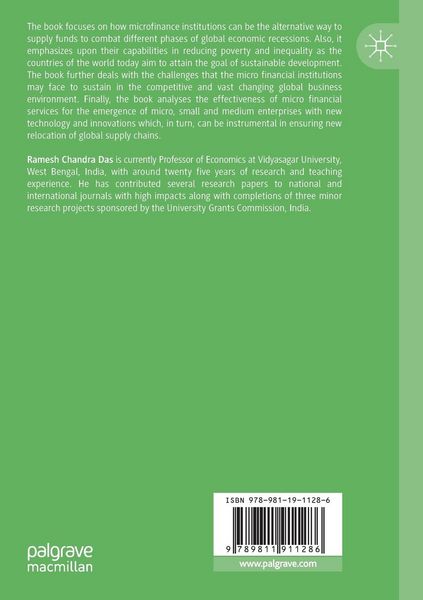
Microfinance to Combat Global Recession and Social Exclusion An Empirical Investigation

Fr. 201.00

inkl. gesetzl. MwSt., Versandkostenfrei


Beschreibung

Produktdetails

Einband

Taschenbuch

Erscheinungsdatum

21.07.2023

Herausgeber

Ramesh Chandra Das

Verlag

Springer Singapore

Seitenzahl

299

Maße (L/B/H)

21/14.8/1.9 cm

Auflage

1st ed. 2022

Sprache

Englisch

ISBN

978-981-19-1128-6

Beschreibung

Portrait

Ramesh Chandra Das  is currently Professor of Economics at Vidyasagar University, West Bengal, India.  He has contributed several research papers to national and international journals with high impacts along with completions of three minor research projects sponsored by the University Grants Commission, India.

Produktdetails

Einband

Taschenbuch

Erscheinungsdatum

21.07.2023

Herausgeber

Ramesh Chandra Das

Verlag

Springer Singapore

Seitenzahl

299

Maße (L/B/H)

21/14.8/1.9 cm

Auflage

1st ed. 2022

Sprache

Englisch

ISBN

978-981-19-1128-6

Herstelleradresse

Springer-Verlag GmbH
Tiergartenstr. 17
69121 Heidelberg
DE

Email: ProductSafety@springernature.com

Kundinnen und Kunden meinen

0 Bewertungen

Informationen zu Bewertungen

Zur Abgabe einer Bewertung ist eine Anmeldung im Konto notwendig. Die Authentizität der Bewertungen wird von uns nicht überprüft. Wir behalten uns vor, Bewertungstexte, die unseren Richtlinien widersprechen, entsprechend zu kürzen oder zu löschen.

Die Bewertungen sind nach Format, Anzahl Sterne und Datum sortiert.

Verfassen Sie die erste Bewertung zu diesem Artikel

Helfen Sie anderen Kund*innen durch Ihre Meinung

Kundinnen und Kunden meinen

0 Bewertungen filtern

  • Produktbild: Microfinance to Combat Global Recession and Social Exclusion
  • Produktbild: Microfinance to Combat Global Recession and Social Exclusion
  • Chapter 1: Global Recession and Microfinance Institutions: Challenges and Opportunities.- Chapter 2: Are microfinance institutions unscathed from the recession? – An empirical reconsideration.- Chapter 3: Microfinance as a Strategy to Curb the Global Recession.- Chapter 4: Developing Strategies to Improve Microfinance System in Turkey with Fuzzy Logic.- Chapter 5: Efficiency of MFIs and financial inclusion in West Bengal: A DEA Approach.- Chapter 6: The Road So Far to Micro Insurance: The Financial Revolution in the Services for The Poor.- Chapter 7: Concentration of Financial Resources: Evidence from Indian Unorganised Manufacturing Enterprises.- Chapter 8: Financial Inclusion through Microfinance: Is it Possible?.- Chapter 9: Microfinance, Financial Inclusion and Income Inequalities: Are there Co-movements?.- Chapter 10: Political Economy of microfinance from the gender and politics point of view: As a way for enhancing social inclusion of women to the workforce.- Chapter 11: Assessing the Impact of Microfinance on Poverty and Inequality: A Study of 5 SAARC Nations using Causality Analysis.- Chapter 12: Sustainability of Indian Microfinance Institutions after Andhra Crisis: Evidences of Financial vis-à-vis Social Performance.- Chapter 13: Role of Microfinance Institutions in Social Inclusion – A Study with Reference to India.- Chapter 14: Role of Microfinance in reduction of Poverty in India.- Chapter 15: Predicting the Likelihood of Loan Default Among Marginalized Population: A Case Study on Rural Bengal.- Chapter 16: Effects of Financial widening Activities on Self-employment Opportunities in Nigeria: Implication on Global recession and Social Exclusion.- Chapter 17: Accessing Microfinance Potentiality – Combating Global Recession through Local Intervention.- Chapter 18: Assessing the Spatial-temporal Accessibility of Micro-finance in the Greater Accra Region of Ghana: A Geographical Information System Analysis.- Chapter 19: Microfinance in South Asia and SocialInclusion.- Chapter 20: Financial education vs university programs.