Gutscheinbedingungen

*Gültig bis 04.08.2026 auf (fast) alles. Ausgeschlossen sind Smartboxen, Zeitschriften, Tickets, Lebensmittel, Gaming-Elektroartikel, Tinte/Toner, Gutscheine, Geschenkkarten, Blumen und Abos | Einlösbar in allen Buchhandlungen von Orell Füssli, Barth Bücher, Buchladen Rapunzel, Papeterie Köhler, Schuler Orell Füssli, Stauffacher und ZAP unter Vorweisung des Gutscheins, auf www.orellfüssli.ch durch Eingabe des Gutscheincodes. Beim Service „eBooks verschenken“ und bei eBook-Käufen via eReader nicht einlösbar | Mindesteinkaufswert: Fr. 30.- | Nicht mit anderen Rabatten kumulierbar.

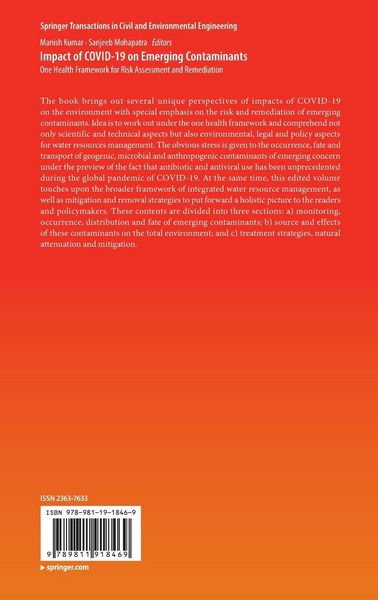
  • Produktbild: Impact of COVID-19 on Emerging Contaminants
  • Produktbild: Impact of COVID-19 on Emerging Contaminants

Impact of COVID-19 on Emerging Contaminants One Health Framework for Risk Assessment and Remediation

Fr. 191.00

inkl. gesetzl. MwSt., Versandkostenfrei


Beschreibung

Produktdetails

Einband

Gebundene Ausgabe

Erscheinungsdatum

25.05.2022

Herausgeber

Manish Kumar + weitere

Verlag

Springer Singapore

Seitenzahl

427

Maße (L/B/H)

24.1/16/3 cm

Gewicht

846 g

Auflage

1st ed. 2022

Sprache

Englisch

ISBN

978-981-19-1846-9

Beschreibung

Portrait

Dr. Manish Kumar is a Professor and Head of the Sustainability Cluster at School of Engineering, University of Petroleum and Energy Studies, Dehradun, Uttarakhand, India. He is Ph.D in Urban Engineering from the University of Tokyo, Japan, and has received several prestigious recognitions/fellowship, such as Water Advanced Research and Innovation (WARI) Fellowship, Japan Society for the promotion of Science (JSPS) foreign research fellowship, Brain Korea (BK)-21 post-doctoral fellowship, Monbukagakusho scholarship, Linnaeus-Palme stipend from SIDA, Sweden, Research Fellowship from CSIR, India and others. Prof. Kumar is active in the fields of contaminant transport and modeling, heavy metal speciation and toxicity, wastewater surveillance,  emerging contaminants and water supply. He has over 200 publications to his credit. He is a Fellow of Royal Society for Chemistry (FRSC), London, UK. He is among the top 2% of researchers as per the list of Stanford University, USA.His ResearchGate score is above 97.5 percentile of the researchers in the world.


Dr. Sanjeeb Mohapatra  after finishing his Ph.D. degree at Environmental Science and Engineering Department, Indian Institute of Technology (IIT) Bombay, India, joined the National University of Singapore (NUS), Singapore, to pursue his postdoctoral degree. His research interest broadly covers the monitoring of emerging contaminants (ECs), photo-degradation and enzymatic degradation of ECs, and the role of dissolved organic matter in deciding the fate of such contaminants. He is a recipient of the Water Advanced Research Innovation (WARI) Fellowship awarded by the Department of Science and Technology (DST), India, University of Nebraska Lincoln, USA, Daugherty Water for Food Global Institute (DWFI), USA and Indo-U.S. Science and Technology Forum (IUSSTF). He is a recipient Newton-Bhabha Fellowship jointly awarded by Department of Scienceand Technology (DST), Government of India, and British Council, U.K and DST-INSPIRE fellowship offered by DST, India. Dr. Mohapatra also won several international and local awards for his research work for the last couple of years and has many publications in reputed journals, book chapters, and refereed conferences to his credit.

Produktdetails

Einband

Gebundene Ausgabe

Erscheinungsdatum

25.05.2022

Herausgeber

Verlag

Springer Singapore

Seitenzahl

427

Maße (L/B/H)

24.1/16/3 cm

Gewicht

846 g

Auflage

1st ed. 2022

Sprache

Englisch

ISBN

978-981-19-1846-9

Herstelleradresse

Springer-Verlag KG
Sachsenplatz 4-6
1201 Wien
AT

Email: GPSR Kontakt

Noch keine Bewertungen vorhanden

Verfassen Sie die erste Bewertung zu diesem Artikel

Helfen Sie anderen Kundinnen und Kunden durch Ihre Meinung.

Kundinnen und Kunden meinen

Bewertungen (0)

  • Produktbild: Impact of COVID-19 on Emerging Contaminants
  • Produktbild: Impact of COVID-19 on Emerging Contaminants
  • COVID-19 and antimicrobial resistance: A coincidental correlation.- WBE role in COVID-19 management: An perspective of European Union perspective.- Temporal variation of WBE: How can it be meaning fully used?.- Pathways of antiviral resistance in post-covid anthropocene.