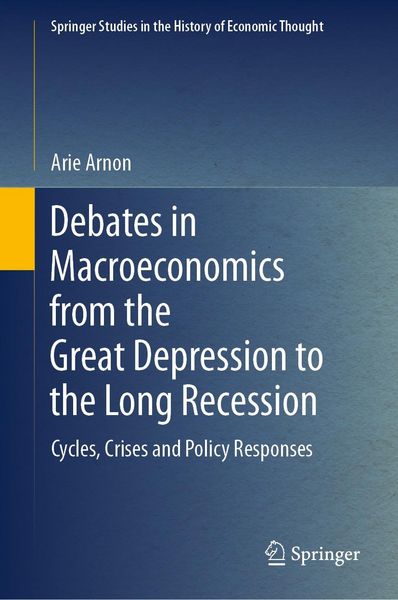
Debates in Macroeconomics from the Great Depression to the Long Recession Cycles, Crises and Policy Responses
-
- Hardcover
- Taschenbuch
- eBook ausgewählt
-
Form:Einzelkauf Download
-
Sprache:Englisch
Fr. 125.90
inkl. gesetzl. MwSt.Beschreibung
Produktdetails
Format
Kopierschutz
Nein
Family Sharing
Nein
Text-to-Speech
Nein
Erscheinungsdatum
06.05.2022
Verlag
SpringerSeitenzahl
318 (Printausgabe)
Dateigröße
6112 KB
Sprache
Englisch
EAN
9783030977030
This book assesses major schools of thought in macroeconomic theory between the Great Depression and the Long Recession, focusing on their analysis of cycles, crises and macro-policy. It explores the road from the dominance of Keynesian ideas to those of New Classical Macroeconomics (NCM) toward the end of the millennium.
The book covers the early influential work of Knut Wicksell; the economic debates of the 1930s, with core contributions from John Maynard Keynes and Friedrich von Hayek; the rise of Keynesianism in the 1950s and its decline since the 1970s; the rise of Monetarism in the 1960s; and NCM's subsequent rise to prominence.
Finally, the book outlines how macroeconomics has evolved from its birth in the 1930s as a theory separate from microeconomics, resulting in a split between macro- and micro-theories, and ended up with a new hegemonic paradigm based on microfoundations. The ensuing policy thinking witnessed a transformation from "active" macro-policy after the Great Depression to a far more "passive" macro-policy during the last quarter of the twentieth century, which may have contributed to missing the signs of the impending Long Recession of 2008.
"When the 2008 crisis struck, macroeconomists were caught with models that were theoretically elegant yet inappropriate to the needs of the moment. A broader historical perspective may have prevented the jettisoning of Keynesian models that had proved useful in the past and might have done so again. This highly readable book by Arie Arnon is a wonderful antidote to economists' short time horizon and contributes mightily to restore the profession's "collective memory" of the diversity of ideas within macroeconomics."
Professor Dani Rodrik, Harvard Kennedy SchoolKundinnen und Kunden meinen
Verfassen Sie die erste Bewertung zu diesem Artikel
Helfen Sie anderen Kund*innen durch Ihre Meinung