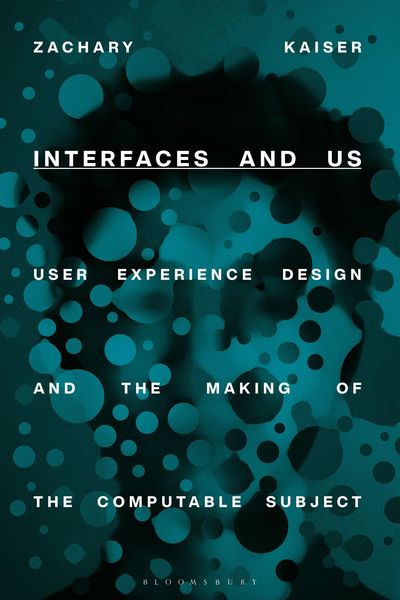
Produktbild: Interfaces and Us

Interfaces and Us User Experience Design and the Making of the Computable Subject

Fr. 42.90

inkl. gesetzl. MwSt., Versandkostenfrei


Beschreibung

Produktdetails

Einband

Taschenbuch

Erscheinungsdatum

09.02.2023

Verlag

Bloomsbury

Seitenzahl

224

Maße (L/B/H)

23.1/15.5/1.3 cm

Gewicht

444 g

Sprache

Englisch

ISBN

978-1-350-24524-2

Beschreibung

Produktdetails

Einband

Taschenbuch

Erscheinungsdatum

09.02.2023

Verlag

Bloomsbury

Seitenzahl

224

Maße (L/B/H)

23.1/15.5/1.3 cm

Gewicht

444 g

Sprache

Englisch

ISBN

978-1-350-24524-2

Herstelleradresse

Libri GmbH
Europaallee 1
36244 Bad Hersfeld
DE

Email: gpsr@libri.de

Noch keine Bewertungen vorhanden

Verfassen Sie die erste Bewertung zu diesem Artikel

Helfen Sie anderen Kundinnen und Kunden durch Ihre Meinung.

Kundinnen und Kunden meinen

Bewertungen (0)

Die Leseprobe wird geladen.
  • Produktbild: Interfaces and Us
  • Acknowledgements
    Introduction

    1. Historical and Conceptual Roots of the Computable Subjectivity
    Introduction: Disrupting the Insurance Industry-"Convenience" and "Freedom"
    Producing and Looping, or, Biopolitics and Biopower
    The Value of Convenience
    Freedom and Countercultural Technocracy
    The Selfish System: Cybernetics and Rational Choice Theory
    Markets as Information Processors: Cybernetics and Economics
    The Neoliberal Governmentality
    Conclusion: Foundations and Ramifications

    2. Data=World
    Introduction: Can You "See" Your Dream Data?
    Data and World: An Origin Story
    Computational Instrumentation: Templates and Translations
    How Computational Instruments Disappear
    Conclusion: The Great Inversion, or, Operationalism's Legacy

    3. Prediction and the Stabilization of Identity
    Introduction: Whisper and the Scrambling of Algorithmic Anticipation
    The Digital Production of Fragmentation and Alienation
    Ontological Insecurity: One Consequence of Fragmentation and Alienation
    The Digital Mirror Self: Soothing Ontological Insecurity with Computation
    The Role of UX in Producing, then Soothing, Ontological Insecurity
    Consequences: Soft Biopower and the Proscription of Potential
    Conclusion: Becoming Cyborgs

    4. The Moral Imperative of Normality through Computational Optimization
    Introduction: The Optimized Professor and the Pressures of Optimization
    Measurement, Normativity, and Morality: Two Origin Stories
    The Moral Imperative of Self-Optimizing Technologies: The Case of the Amazon Halo
    Consequences: Anxiety, Superfluity, and the Instrumentalization of Interpersonal Interaction
    Conclusion: Fighting for Servitude as if it Were Salvation

    5. The Questions of Political Economy and the Role of Design Education
    Introduction
    Question 1: The Issue of Political Economy and Chile's Socialist Cybernetics
    Question 2: The Role of Design Education in Resisting the "Reality" of the Computable Subjectivity and the Reformist Approach
    Conclusion: Returning to Political Economy and the Limits of the Reformist Approach to Design Education

    Conclusion: Towards a Luddite Design Education
    The Politics of UX and the Computable Subject as the Ideal Political Subject
    The Lingering Problem: The Computable Subjectivity and Political Economy
    The Revolutionary Approach: Luddite Design Education
    A Provisional Program of Luddite Design Education
    A Luddite Design Education, Now

    Bibliography
    Index