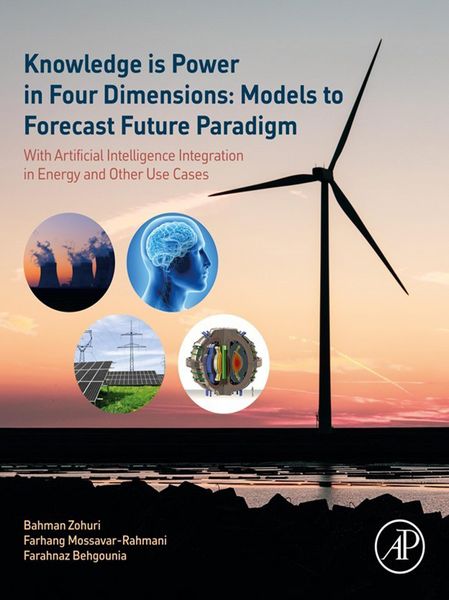
Knowledge is Power in Four Dimensions: Models to Forecast Future Paradigm With Artificial Intelligence Integration in Energy and Other Use Cases
-
- Taschenbuch
- eBook ausgewählt
-
Form:Einzelkauf Download
-
Sprache:Englisch
Fr. 166.90
inkl. gesetzl. MwSt.Beschreibung
Produktdetails
Format
ePUB 3
Kopierschutz
Nein
Family Sharing
Nein
Text-to-Speech
Ja
Erscheinungsdatum
14.07.2022
Verlag
Elsevier Science & Techn.Seitenzahl
998 (Printausgabe)
Dateigröße
95519 KB
Sprache
Englisch
EAN
9780323951135
Knowledge is Power in Four Dimensions: Models to Forecast Future Paradigms, Forecasting Energy for Tomorrow's World with Mathematical Modeling and Python Programming Driven Artificial Intelligence delivers knowledge on key infrastructure topics in both AI technology and energy. Sections lay the groundwork for tomorrow's computing functionality, starting with how to build a Business Resilience System (BRS), data warehousing, data management, and fuzzy logic. Subsequent chapters dive into the impact of energy on economic development and the environment and mathematical modeling, including energy forecasting and engineering statistics. Energy examples are included for application and learning opportunities.
A final section deliver the most advanced content on artificial intelligence with the integration of machine learning and deep learning as a tool to forecast and make energy predictions. The reference covers many introductory programming tools, such as Python, Scikit, TensorFlow and Kera.
- Helps users gain fundamental knowledge in technology infrastructure, including AI, machine learning and fuzzy logic
- Compartmentalizes data knowledge into near-term and long-term forecasting models, with examples involving both renewable and non-renewable energy outcomes
- Advances climate resiliency and helps readers build a business resiliency system for assets
A final section deliver the most advanced content on artificial intelligence with the integration of machine learning and deep learning as a tool to forecast and make energy predictions. The reference covers many introductory programming tools, such as Python, Scikit, TensorFlow and Kera.
- Helps users gain fundamental knowledge in technology infrastructure, including AI, machine learning and fuzzy logic
- Compartmentalizes data knowledge into near-term and long-term forecasting models, with examples involving both renewable and non-renewable energy outcomes
- Advances climate resiliency and helps readers build a business resiliency system for assets
Kundinnen und Kunden meinen
Verfassen Sie die erste Bewertung zu diesem Artikel
Helfen Sie anderen Kund*innen durch Ihre Meinung