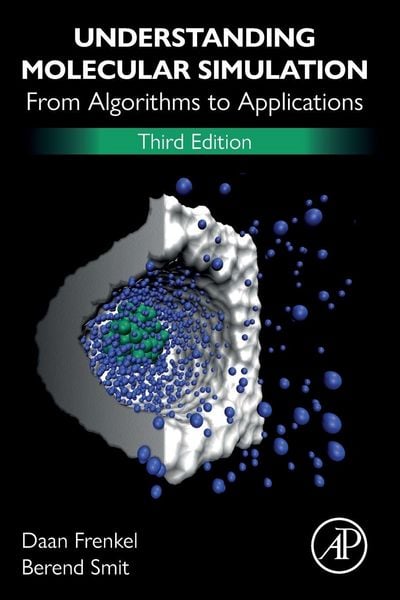
Understanding Molecular Simulation From Algorithms to Applications
-
- Hardcover
- Taschenbuch ausgewählt
- eBook
-
Sprache:Englisch
Fr. 148.00
inkl. gesetzl. MwSt.,
Beschreibung
Produktdetails
Einband
Taschenbuch
Erscheinungsdatum
18.07.2023
Verlag
Elsevier Science & TechnologySeitenzahl
754
Maße (L/B/H)
22.9/15.4/3.7 cm
Gewicht
1178 g
Auflage
3. Auflage
Sprache
Englisch
ISBN
978-0-323-90292-2
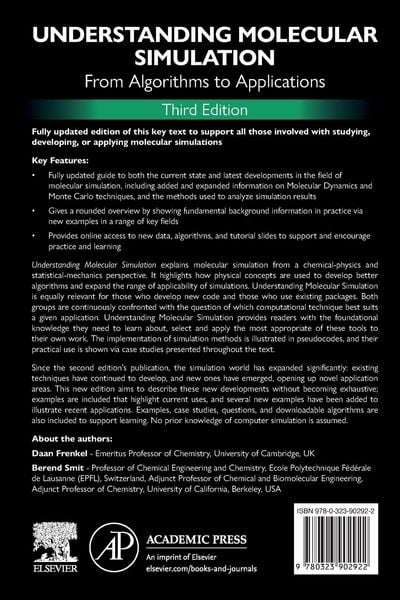
Understanding Molecular Simulation explains molecular simulation from a chemical-physics and statistical-mechanics perspective. It highlights how physical concepts are used to develop better algorithms and expand the range of applicability of simulations. Understanding Molecular Simulation is equally relevant for those who develop new code and those who use existing packages. Both groups are continuously confronted with the question of which computational technique best suits a given application. Understanding Molecular Simulation provides readers with the foundational knowledge they need to learn about, select and apply the most appropriate of these tools to their own work. The implementation of simulation methods is illustrated in pseudocodes, and their practical use is shown via case studies presented throughout the text. Since the second edition's publication, the simulation world has expanded significantly: existing techniques have continued to develop, and new ones have emerged, opening up novel application areas. This new edition aims to describe these new developments without becoming exhaustive; examples are included that highlight current uses, and several new examples have been added to illustrate recent applications. Examples, case studies, questions, and downloadable algorithms are also included to support learning. No prior knowledge of computer simulation is assumed.
Noch keine Bewertungen vorhanden
Verfassen Sie die erste Bewertung zu diesem Artikel
Helfen Sie anderen Kundinnen und Kunden durch Ihre Meinung.