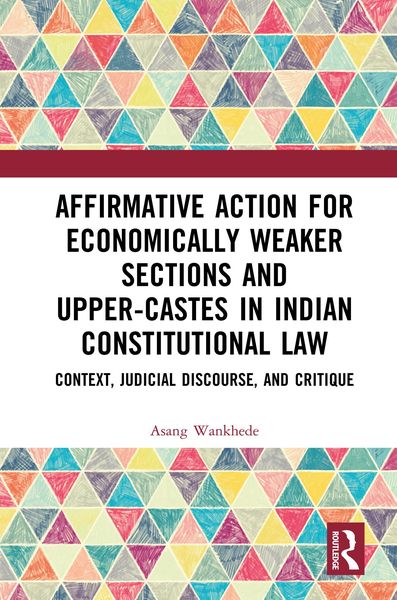
Affirmative Action for Economically Weaker Sections and Upper-Castes in Indian Constitutional Law Context, Judicial Discourse, and Critique
-
- Hardcover
- Taschenbuch
- eBook ausgewählt
-
Form:Einzelkauf Download
-
Sprache:Englisch
-
eBook Format:ePUB 3
- ePUB 3 Fr. 60.90 ausgewählt
- PDF Fr. 60.90
Fr. 60.90
inkl. gesetzl. MwSt.Beschreibung
Produktdetails
Format
ePUB 3
Kopierschutz
Ja
Family Sharing
Nein
Text-to-Speech
Ja
Erscheinungsdatum
30.09.2022
Verlag
Taylor & Francis eBooksSeitenzahl
222 (Printausgabe)
Auflage
1. Auflage
Sprache
Englisch
EAN
9781000655223
This book examines the controversial 103rd Constitutional Amendment to the Indian Constitution that introduced an income and asset ownership-based new constitutional standard for determining backwardness marking a significant shift in the government's social and public policy. It also analyses state level policies towards backwardness recognition of upper-caste dominant groups through case studies of Maharashtra, Haryana, and Gujarat. It provides an analytical and descriptive account of the proliferation of reservation policy in India and critiques these interventions to assess their implication on constitutional jurisprudence. Further, it assesses the theoretical and empirical challenges such developments pose to the principle of substantive equality and scope of affirmative action policies in Indian constitutional law and general discrimination law theory. The monograph shows how opening up of reservations for dominant upper-caste groups and general category will have implications for the constitutional commitment to addressing deeply entrenched marginalisation emanating from the traditional social hierarchy and the understanding of substantive equality in Indian Constitutional law. Further, it highlights key contradictions, incoherence, and internal tension in the design of the reservations for Economically Weaker Sections
Critical, comprehensive, and cogently argued, this book will contribute and shape ongoing constitutional policy and judicial debates. It will be of great interest to scholars and researchers of law, Indian politics, affirmative action, social policy, and public policy.
Noch keine Bewertungen vorhanden
Verfassen Sie die erste Bewertung zu diesem Artikel
Helfen Sie anderen Kundinnen und Kunden durch Ihre Meinung.