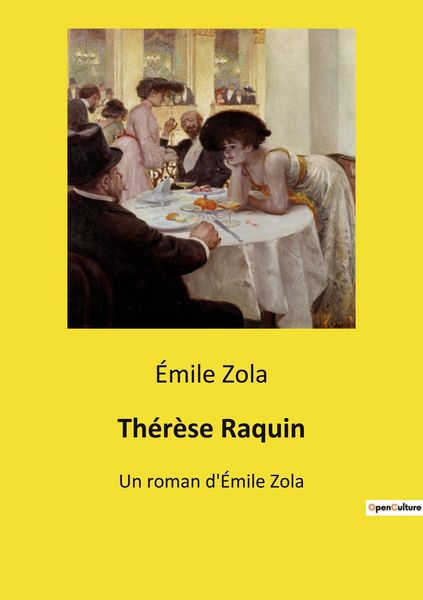
At the end of Rue Guenegaud, a narrow arcade opens like a wound in the city, wet, shadowed, and airless. That first image sets the tone for this English edition of Émile Zola's naturalist novel, where the Arcade of the Pont Neuf becomes more than a setting. It is a corridor of damp tiles, dirty glass, and hurried footsteps, a place people cross only to save time, yet one that seems to hold them in place the moment they enter it. Inside that passage, the old mercery shop takes over the story. Madame Raquin, once a shopkeeper in Vernon, has settled in Paris with her son Camille and her niece Thérèse, and the business on the ground floor becomes the center of their life. Zola makes the shop feel closed and airless, filled with dull goods, faded counters, and the repeated gestures of trade. Daily routine settles over the family, and the same visits, the same remarks, and the same faces begin to define their world. Camille is drawn as weak, dependent, and without much force of will, while Thérèse stands out as alert and tightly held in check by years of confinement and obedience. Their home life is watched with the clinical eye that marks Zola's fiction, where bodies, habits, and surroundings all speak at once. The English translation preserves the sharp physical detail of the opening pages, from the filthy glazing above the arcade to the greenish reflections on the shop windows, so that the reader feels the pressure of the place as much as the atmosphere of the household. The novel also introduces Laurent, Camille's former companion, whose presence brings another kind of energy into the cramped domestic space. He is practical, physical, and rooted in appetite, a contrast to the frailty that dominates the household. From the beginning, Thérèse and Laurent are drawn into a private tension that grows out of the rooms they share and the absences that leave them exposed to one another. Zola builds the story through glances, silences, and bodily reactions, letting desire emerge as something that seems to rise from the very walls. Around the main figures, a small circle of secondary characters reinforces the daily rhythm of the novel. Madame Raquin's Thursday evenings gather familiar visitors such as Michaud, Grivet, Suzanne, and Olivier, whose polite talk and repeated routines deepen the sense of a life enclosed by habit. These scenes of bourgeois sociability are not decorative. They show how the family's domestic world is tied to the neighborhood, the shop, and the narrow social customs of Parisian life, all rendered with unsparing precision. Thérèse Raquin is often read as a classic of naturalist fiction, and this English edition makes that force easy to feel. Zola writes Paris as a place of commerce, humidity, and shadow, where the mercery, the arcade, and the apartment above it form a single oppressive environment. If you want a 19th century French novel in English that combines psychological tension, urban detail, and the hard edge of naturalism, this is a compelling place to begin. Let the arcade draw you in, and see how long you can stay inside it. The English text keeps the atmosphere stark and immediate, and that is part of the book's power. Every surface seems worn, every habit repeated, every room narrowed by use. It is a story of domestic confinement, Parisian shopkeeping, and uneasy desire, told with a precision that turns setting into pressure. If that is the kind of classic novel you seek, this edition offers a first page that still grips the reader without letting go.