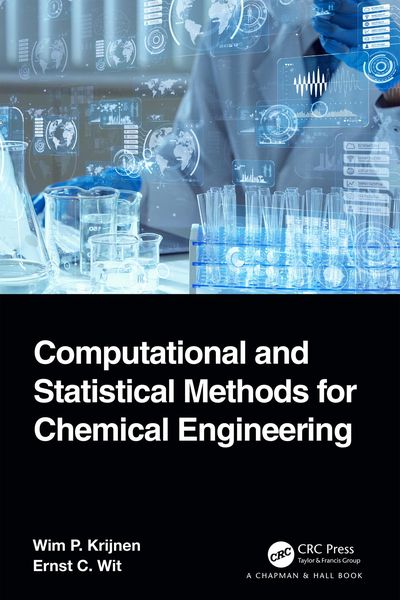
Computational and Statistical Methods for Chemical Engineering
-
Form:Einzelkauf Download
-
Sprache:Englisch
-
eBook Format:PDF
- ePUB 3 Fr. 126.90
- PDF Fr. 126.90 ausgewählt
Fr. 126.90
inkl. gesetzl. MwSt.Beschreibung
Produktdetails
Format
Kopierschutz
Ja
Family Sharing
Nein
Text-to-Speech
Nein
Erscheinungsdatum
19.12.2022
Verlag
Taylor & Francis eBooksSeitenzahl
308 (Printausgabe)
Auflage
1. Auflage
Sprache
Englisch
EAN
9781000822601
In the recent decades, the emerging new molecular measurement techniques and their subsequent availability in chemical database has allowed easier retrieval of the associated data by the chemical analyst. Before the data revolution, most books focused either on mathematical modeling of chemical processes or exploratory chemometrics. Computational and Statistical Methods for Chemical Engineering aims to combine these two approaches and provide aspiring chemical engineers a single, comprehensive account of computational and statistical methods.
The book consists of four parts:
- Part I discusses the necessary calculus, linear algebra, and probability background that the student may or may not have encountered before.
- Part II provides an overview on standard computational methods and approximation techniques useful for chemical engineering systems.
- Part III covers the most important statistical models, starting from simple measurement models, via linear models all the way to multivariate, non-linear stochiometric models.
- Part IV focuses on the importance of designed experiments and robust analyses.
Each chapter is accompanied by an extensive selection of theoretical and practical exercises. The book can be used in combination with any modern computational environment, such as R, Python and MATLAB. Given its easy and free availability, the book includes a bonus chapter giving a simple introduction to R programming.
This book is particularly suited for undergraduate students in Chemical Engineering who require a semester course in computational and statistical methods. The background chapters on calculus, linear algebra and probability make the book entirely self-contained. The book takes its examples from the field of chemistry and chemical engineering. In this way, it motivates the student to engage actively with the material and to master the techniques that have become crucial for the modern chemical engineer.
Noch keine Bewertungen vorhanden
Verfassen Sie die erste Bewertung zu diesem Artikel
Helfen Sie anderen Kundinnen und Kunden durch Ihre Meinung.