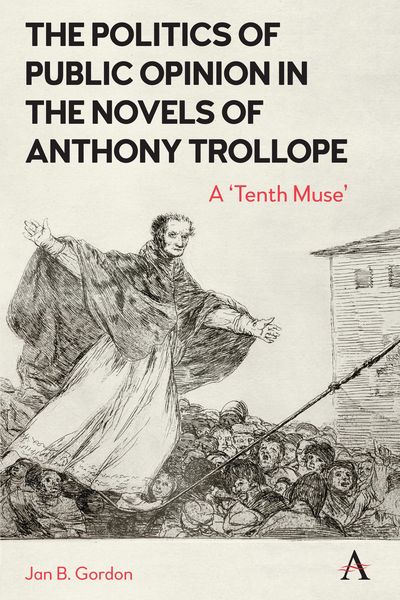
The Politics of Public Opinion in the Novels of Anthony Trollope A 'Tenth Muse'
-
- Hardcover
- Taschenbuch
- eBook ausgewählt
-
Form:Einzelkauf Download
-
Sprache:Englisch
Fr. 38.90
inkl. gesetzl. MwSt.Beschreibung
Produktdetails
Format
ePUB
Kopierschutz
Nein
Family Sharing
Nein
Text-to-Speech
Ja
Erscheinungsdatum
17.01.2023
Verlag
Anthem PressSeitenzahl
244 (Printausgabe)
Sprache
Englisch
EAN
9781839986949
The figurative "body" of public opinion presents challenges to readers of the nineteenth-century British fiction insofar as it lacks the markers of an autonomous subject. It replaces direct address with intimations of surveillance and interpellation, reading characters and their actions as we read it for our situationally within it. In the novels of Anthony Trollope who continually refers to a vox populi, public opinion has an economy, as a kind of "currency" in which reputation is priced and marketed while itself seeming inconclusive and undeveloped, even among its self-appointed spokesmen.
It takes its place among a number of institutions that knit the country together as a network of conveyances with different points of entry: roads, railroads, ports and canals and the post office in which Trollope served as a civil servant for over 30 years. One such institution is the expanding bureaucracy which mediates between the people and those who regulate human activity and its exposure to government regulation. The ex-posure (literally to be placed outside oneself) is one of the ways in which public opinion, lacking a responsible subjectivity that can be held to account, removes individual subjectivity, threatening (or enabling) a rebirth in accountability. Yet, for all of its potentially subversive qualities, public opinion is a collective narrative-disguising itself as a unitary voice-that often misreads character and, in the Parliamentary Novels, ideology. As it is vulnerable to being misread by politicians, public opinion also misreads, especially the arrivistes attempting to enter the social and economic life of the country. Because of its resistance to inscriptive genres, the vox populi may well represent the lost orality of the epic to which critics like Georg Lukaks have called our attention.
Noch keine Bewertungen vorhanden
Verfassen Sie die erste Bewertung zu diesem Artikel
Helfen Sie anderen Kundinnen und Kunden durch Ihre Meinung.