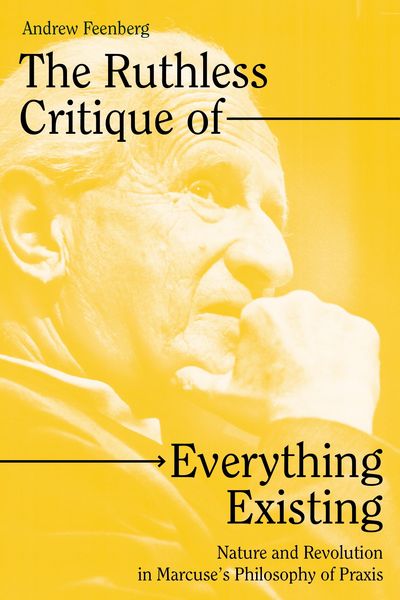
The Ruthless Critique of Everything Existing Nature and Revolution in Marcuse's Philosophy of Praxis
-
- Taschenbuch
- eBook ausgewählt
-
Form:Einzelkauf Download
-
Sprache:Englisch
Fr. 28.90
inkl. gesetzl. MwSt.Beschreibung
Produktdetails
Format
ePUB
Kopierschutz
Nein
Family Sharing
Nein
Text-to-Speech
Ja
Erscheinungsdatum
28.02.2023
Verlag
VersoSeitenzahl
256 (Printausgabe)
Sprache
Englisch
EAN
9781804290842
For several years after 1968, Herbert Marcuse was one of the most famous philosophers in the world. He became the face of Frankfurt School Critical Theory for a generation in turmoil. His fame rested on two remarkable books, Eros and Civilization and One-Dimensional Man. These two books represent the utopian hopes and dystopian fears of the time.
In the 1960s and 70s, young people seeking a theoretical basis for their revolution found it in his work. Marcuse not only supported their struggles against imperialism and race and gender discrimination, he foresaw the far-reaching implications of the destruction of the natural environment. Marcuse's Marxism was influenced by Husserl and Heidegger, Hegel and Freud. These eclectic sources grounded an original critique of advanced capitalism focused on the social construction of subjectivity and technology. Marcuse contrasted the "one-dimensionality" of conformist experience with the "new sensibility" of the New Left. The movement challenged a society that "delivered the goods" but devastated the planet with its destructive science and technology. A socialist revolution would fail if it did not transform these instruments into means of liberation, both of nature and human beings. This aspiration is alive today in the radical struggle over climate change. Marcuse offers theoretical resources for understanding that struggle.
In the 1960s and 70s, young people seeking a theoretical basis for their revolution found it in his work. Marcuse not only supported their struggles against imperialism and race and gender discrimination, he foresaw the far-reaching implications of the destruction of the natural environment. Marcuse's Marxism was influenced by Husserl and Heidegger, Hegel and Freud. These eclectic sources grounded an original critique of advanced capitalism focused on the social construction of subjectivity and technology. Marcuse contrasted the "one-dimensionality" of conformist experience with the "new sensibility" of the New Left. The movement challenged a society that "delivered the goods" but devastated the planet with its destructive science and technology. A socialist revolution would fail if it did not transform these instruments into means of liberation, both of nature and human beings. This aspiration is alive today in the radical struggle over climate change. Marcuse offers theoretical resources for understanding that struggle.
Kundinnen und Kunden meinen
Verfassen Sie die erste Bewertung zu diesem Artikel
Helfen Sie anderen Kund*innen durch Ihre Meinung