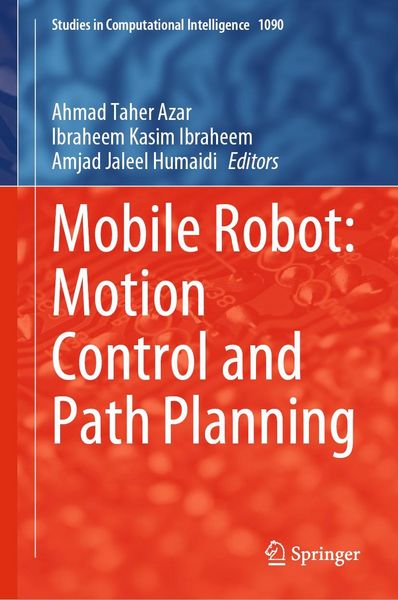
Mobile Robot: Motion Control and Path Planning
-
- Hardcover
- Taschenbuch
- eBook ausgewählt
-
Form:Einzelkauf Download
-
Sprache:Englisch
Fr. 287.90
inkl. gesetzl. MwSt.Beschreibung
Produktdetails
Format
Kopierschutz
Nein
Family Sharing
Nein
Text-to-Speech
Nein
Erscheinungsdatum
30.06.2023
Herausgeber
Ahmad Taher Azar + weitereVerlag
Springer Nature SwitzerlandSeitenzahl
670 (Printausgabe)
Dateigröße
28667 KB
Sprache
Englisch
EAN
9783031265648
This book presents the recent research advances in linear and nonlinear control techniques. From both a theoretical and practical standpoint, motion planning and related control challenges are key parts of robotics. Indeed, the literature on the planning of geometric paths and the generation of time-based trajectories, while accounting for the compatibility of such paths and trajectories with the kinematic and dynamic constraints of a manipulator or a mobile vehicle, is extensive and rich in historical references. Path planning is vital and critical for many different types of robotics, including autonomous vehicles, multiple robots, and robot arms. In the case of multiple robot route planning, it is critical to produce a safe path that avoids colliding with objects or other robots. When designing a safe path for an aerial or underwater robot, the 3D environment must be considered. As the number of degrees of freedom on a robot arm increases, so does the difficulty of path planning.As a result, safe pathways for high-dimensional systems must be developed in a timely manner.
Nonetheless, modern robotic applications, particularly those requiring one or more robots to operate in a dynamic environment (e.g., human-robot collaboration and physical interaction, surveillance, or exploration of unknown spaces with mobile agents, etc.), pose new and exciting challenges to researchers and practitioners.
For instance, planning a robot's motion in a dynamic environment necessitates the real-time and online execution of difficult computational operations. The development of efficient solutions for such real-time computations, which could be offered by specially designed computational architectures, optimized algorithms, and other unique contributions, is thus a critical step in the advancement of present and future-oriented robotics.
Kundinnen und Kunden meinen
Verfassen Sie die erste Bewertung zu diesem Artikel
Helfen Sie anderen Kund*innen durch Ihre Meinung