Gutscheinbedingungen

*Gültig bis 07.06.2026 auf (fast) alles. Ausgeschlossen sind Smartboxen, Zeitschriften, Tickets, Lebensmittel, Gaming-Elektroartikel, Tinte/Toner, Gutscheine, Geschenkkarten, Blumen und Abos | Einlösbar in allen Buchhandlungen von Orell Füssli, Barth Bücher, Buchladen Rapunzel, Schuler Orell Füssli, Stauffacher und ZAP unter Vorweisung des Gutscheins, auf www.orellfüssli.ch durch Eingabe des Gutscheincodes. Beim Service „eBooks verschenken“ und bei eBook-Käufen via eReader nicht einlösbar | Mindesteinkaufswert: Fr. 100.- | Nicht mit anderen Rabatten kumulierbar.

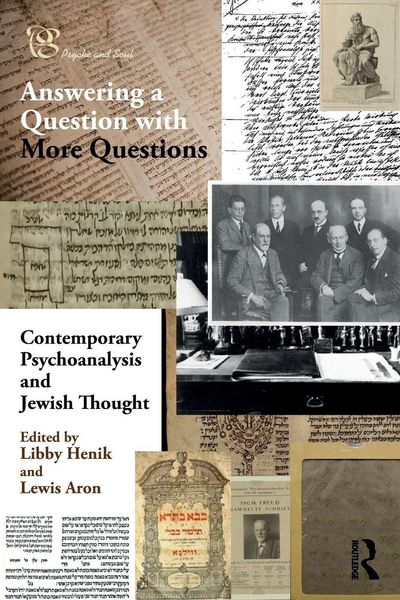
  • Produktbild: Contemporary Psychoanalysis and Jewish Thought
  • Produktbild: Contemporary Psychoanalysis and Jewish Thought

Contemporary Psychoanalysis and Jewish Thought Answering a Question with More Questions

Fr. 61.90

inkl. gesetzl. MwSt., Versandkostenfrei


Beschreibung

Produktdetails

Einband

Taschenbuch

Erscheinungsdatum

31.10.2023

Herausgeber

Libby Henik + weitere

Verlag

Taylor & Francis

Seitenzahl

258

Maße (L/B/H)

23.4/15.6/1.4 cm

Gewicht

367 g

Sprache

Englisch

ISBN

978-1-03-221071-1

Beschreibung

Rezension

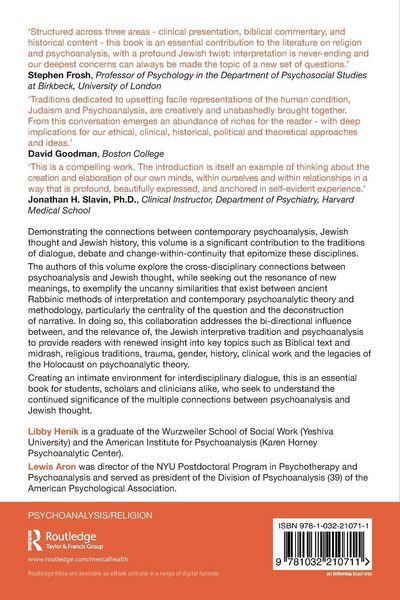
'Lew Aron's and Libby Henik's previous two volumes in the Answering a Question with a Question series have provided a vital set of materials linking psychoanalysis and Jewish thought. In this new collection, dedicated to Aron and including a self-reflective chapter by him, debates produced by this linkage are advanced in a gripping and fertile way. Structured across three areas - clinical presentation, biblical commentary, and historical content - the book is an essential contribution to the literature on religion and psychoanalysis, with a profound Jewish twist: interpretation is never-ending and our deepest concerns can always be made the topic of a new set of questions.'

Stephen Frosh, Professor of Psychology in the Department of Psychosocial Studies at Birkbeck, University of London

'This is a beautiful, rich, and theoretically complex book. Dedicated to the memory of Lew Aron, the contributors explore the links between Jewish and psychoanalytic thought. Its contributors, many world-renowned scholars, address a multiplicity of overlapping issues organized around the threads of Judaism and psychoanalysis.'

Joyce Slochower, NYU Postdoctoral Program

'The third volume in this important series continues to illustrate the mutuality of influence between Judaism and psychoanalysis - how they encounter, inform and transform each other.'

Seth Aronson, Psy.D., Director of Training, Training and Supervising Analyst, William Alanson White Institute; Faculty, Yeshivat Chovevei Torah

'In this third volume of the series, traditions dedicated to upsetting facile representations of the human condition, Judaism and Psychoanalysis, are once again creatively and unabashedly brought together. From this conversation emerges an abundance of riches for the reader-with deep implications on our ethical, clinical, historical, political and theoretical approaches and ideas. The authors should be applauded for bringing us such powerful and dimensional ways of formulating ourselves drawing from the wealth of these traditions.'

David Goodman, Boston College

'My encounter with Libby Henik's new book-the next volume in a series that she co-wrote and edited with my late friend and colleague Lew Aron-has been a beautiful discovery for me. Each of the chapters has a tantalizing frame in which one gets the feeling of "just let me read a little more..." But it was my reading of Libby Henik's own introduction that left me thinking, "Oh my God I have to take a closer look at this." Outwardly about the fundamental similarities of psychoanalytic and Jewish modes of thought, the introduction is itself an example of thinking about the creation and elaboration of our own minds, within ourselves and within relationships, in a way that is extraordinarily profound, beautifully expressed, and anchored in self-evident experience.'

Jonathan H. Slavin, Ph.D., Clinical Instructor, Department of Psychiatry, Harvard Medical School: Adjunct Clinical Professor, Postdoctoral Program in Psychotherapy and Psychoanalysis, New York University; Former President, Division of Psychoanalysis (39), American Psychological Association; Founding President, Massachusetts Institute for Psychoanalysis

Produktdetails

Einband

Taschenbuch

Erscheinungsdatum

31.10.2023

Herausgeber

Verlag

Taylor & Francis

Seitenzahl

258

Maße (L/B/H)

23.4/15.6/1.4 cm

Gewicht

367 g

Sprache

Englisch

ISBN

978-1-03-221071-1

Herstelleradresse

Libri GmbH
Europaallee 1
36244 Bad Hersfeld
DE

Email: gpsr@libri.de

Kundinnen und Kunden meinen

0 Bewertungen

Informationen zu Bewertungen

Zur Abgabe einer Bewertung ist eine Anmeldung im Konto notwendig. Die Authentizität der Bewertungen wird von uns nicht überprüft. Wir behalten uns vor, Bewertungstexte, die unseren Richtlinien widersprechen, entsprechend zu kürzen oder zu löschen.

Die Bewertungen sind nach Format, Anzahl Sterne und Datum sortiert.

Verfassen Sie die erste Bewertung zu diesem Artikel

Helfen Sie anderen Kund*innen durch Ihre Meinung

Kundinnen und Kunden meinen

0 Bewertungen filtern

Die Leseprobe wird geladen.
  • Produktbild: Contemporary Psychoanalysis and Jewish Thought
  • Produktbild: Contemporary Psychoanalysis and Jewish Thought
  • Introduction  Part 1: Clinical Presentation  1. "You are Requested to Raise Your Eyes and See": The Reconstruction of Religious and Psychoanalytic Belief during the Analytic Encounter  2. God at an Impasse: Devotion, Social Justice and the Psychoanalytic Subject  3. This Bread Is Not My Body: Biblical Manna as a Psychoanalytic Paradigm  4. God's Influence on My Psychoanalytic Vision and Values  Part 2: Biblical Commentary  5. In the Beginning, There Was... Envy  6. The Unthinkable Satanic: A Psychoanalytic Insight into the Shofar as Sympton  7. Abraham Bound and Unbound: The Akedah  Part 3: Historical Content  8. Trauma, Gender and the Stories of Jewish Women: The Other Within  9. Fearing the Theoretical Other: The Legacy of Kohut's Erasure of the Analyst's Trauma  10. Give Me Permission to Remember: Judith S. Kestenberg and the Memory of the Holocaust  11. Freud's Moses, Schoenberg's Moses: Two Expressions of Trauma