• Produktbild: Environmental Criminology
  • Produktbild: Environmental Criminology

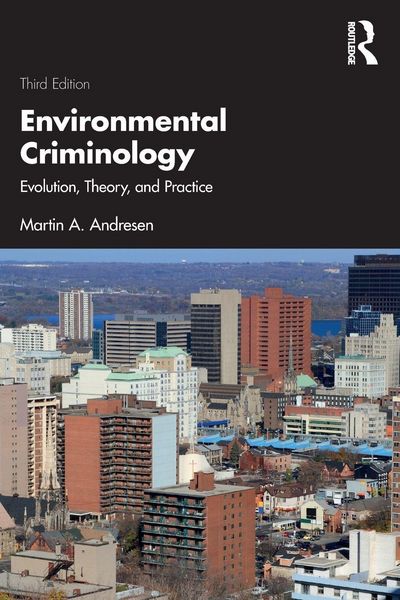
Environmental Criminology Evolution, Theory, and Practice

Fr. 73.90

inkl. gesetzl. MwSt., Versandkostenfrei


Beschreibung

Produktdetails

Einband

Taschenbuch

Erscheinungsdatum

09.11.2023

Abbildungen

schwarz-weiss Illustrationen, Raster, schwarz-weiss, Tabellen, schwarz-weiss

Verlag

Taylor & Francis

Seitenzahl

388

Maße (L/B/H)

23.4/15.6/2.1 cm

Gewicht

840 g

Auflage

3. Auflage

Sprache

Englisch

ISBN

978-1-03-245475-7

Beschreibung

Rezension

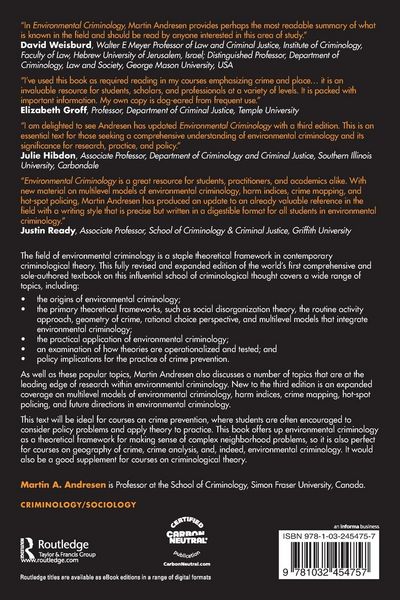
"In Environmental Criminology, Martin Andresen provides perhaps the most readable summary of what is known in the field. But he also thoughtfully considers where the field has been and where it is going, providing one of the most sophisticated descriptions of Environmental Criminology to date. This means that this book will be equally useful to students and scholars, and should be read by anyone interested in this area of study."

David Weisburd, Walter E Meyer Professor of Law and Criminal Justice, Institute of Criminology, Faculty of Law, Hebrew University of Jerusalem, Israel; Distinguished Professor, Department of Criminology, Law and Society, George Mason University, USA

"I've used this book as required reading in my courses emphasizing crime and place. It covers the theories that underpin the field of Environmental Criminology and their link to crime prevention practice before discussing a variety of the core methods in use. The text is engagingly and clearly written. The illustrations are well-done and helpful. This book is an invaluable resource for students, scholars, and professionals at a variety of levels. It is packed with important information. My own copy is dog-eared from frequent use."

Elizabeth Groff, Professor, Department of Criminal Justice, Temple University

"I am delighted to see Andresen has updated Environmental Criminology with a third edition. This is an essential text for those seeking a comprehensive understanding of environmental criminology and its significance for research, practice, and policy".

Julie Hibdon, Associate Professor, Department of Criminology and Criminal Justice, Southern Illinois University, Carbondale

"Environmental Criminology is a great resource for students, practitioners, and academics alike. With new material on multilevel models of environmental criminology, harm indices, crime mapping, and hot-spot policing, Martin Andresen has produced an update to an already valuable reference in the field with a writing style that is precise but written in a digestible format for all students in environmental criminology."

Justin Ready, Associate Professor, School of Criminology & Criminal Justice, Griffith University

Produktdetails

Einband

Taschenbuch

Erscheinungsdatum

09.11.2023

Abbildungen

schwarz-weiss Illustrationen, Raster, schwarz-weiss, Tabellen, schwarz-weiss

Verlag

Taylor & Francis

Seitenzahl

388

Maße (L/B/H)

23.4/15.6/2.1 cm

Gewicht

840 g

Auflage

3. Auflage

Sprache

Englisch

ISBN

978-1-03-245475-7

Herstelleradresse

Libri GmbH
Europaallee 1
36244 Bad Hersfeld
DE

Email: gpsr@libri.de

Kundinnen und Kunden meinen

0 Bewertungen

Informationen zu Bewertungen

Zur Abgabe einer Bewertung ist eine Anmeldung im Konto notwendig. Die Authentizität der Bewertungen wird von uns nicht überprüft. Wir behalten uns vor, Bewertungstexte, die unseren Richtlinien widersprechen, entsprechend zu kürzen oder zu löschen.

Die Bewertungen sind nach Format, Anzahl Sterne und Datum sortiert.

Verfassen Sie die erste Bewertung zu diesem Artikel

Helfen Sie anderen Kund*innen durch Ihre Meinung

Kundinnen und Kunden meinen

0 Bewertungen filtern

Die Leseprobe wird geladen.
  • Produktbild: Environmental Criminology
  • Produktbild: Environmental Criminology
  • Part I: Early work on the ecology of crime 1.The beginnings of the geography of crime 2.Social disorganization theory Part II:Theories within environmental criminology 3.Routine activity approach 4.Geometry of crime 5.Rational choice perspective 6.Theoretical integration in environmental criminology 7.Crime prevention: theory PART III:The practice of environmental criminology 8.Crime prevention: implementation, evaluation, and empirical evidence 9.Crime measurement 10.Spatial issues with crime analysis 11.Hot spots of crime 12.The temporal dimension of crime 13.Environmental criminology and the crime drop 14.Geographic profiling 15.(Near-) repeat victimization 16.Journey to crime 17.Crime and place