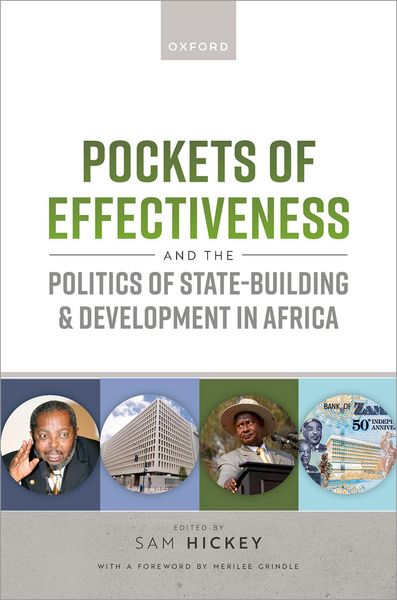
Pockets of Effectiveness and the Politics of State-building and Development in Africa
-
Form:Einzelkauf Download
-
Sprache:Englisch
-
eBook Format:ePUB
- PDF Fr. 100.90
- ePUB Fr. 89.90 ausgewählt
Fr. 89.90
inkl. gesetzl. MwSt.Beschreibung
Produktdetails
Format
ePUB
Kopierschutz
Ja
Family Sharing
Nein
Text-to-Speech
Ja
Erscheinungsdatum
03.07.2023
Herausgeber
Sam HickeyVerlag
OUP eBookSeitenzahl
240 (Printausgabe)
Dateigröße
7126 KB
Sprache
Englisch
EAN
9780192688378
This is an open access title available under the terms of a CC BY-BC-ND 4.0 International License. It is free to read at Oxford Scholarship Online and offered as a free PDF download from OUP and selected open access locations. Why do certain parts of the state in Africa work so effectively despite operating in difficult governance contexts? How do 'pockets of bureaucratic effectiveness' emerge and become sustained over time? And what does this tell us about the prospects for state-building and development in Africa? Repeated economic and social crises have demanded that development thinkers and policy actors have had to engage with the critical role that states play in delivering development. Pockets of Effectiveness and the Politics of State-building and Development in Africa shows that politics is the driving factor that shapes how well state agencies perform their roles. It deploys a new conceptual framework - the power domains approach - to explore the shifting fortunes of key state agencies in five countries - Ghana, Kenya, Rwanda, Uganda, and Zambia - over the past three decades. Our original research reveals when, how and why political rulers decide to build effective state agencies and enable them to deliver certain forms of economic development - often through forming strategic coalitions with senior bureaucrats and with international support - and also when this support falters and gives way to a politics of survival. Comparative analysis identifies two potential trajectories towards state-building in Africa, each shaped by different configurations of social and political power. The book critiques the role that international development agencies have played in (mis)shaping the state in Africa and suggests a new strategic agenda for building the state capacities required to deliver sustained development at the current juncture. The book closes with critical commentaries from two leading scholars in the field, to help place our work in context and establish the next steps for research and strategy in this increasingly important area of development theory and practice.
Kundinnen und Kunden meinen
Verfassen Sie die erste Bewertung zu diesem Artikel
Helfen Sie anderen Kund*innen durch Ihre Meinung