Gutscheinbedingungen

*Gültig bis 07.06.2026 auf (fast) alles. Ausgeschlossen sind Smartboxen, Zeitschriften, Tickets, Lebensmittel, Gaming-Elektroartikel, Tinte/Toner, Gutscheine, Geschenkkarten, Blumen und Abos | Einlösbar in allen Buchhandlungen von Orell Füssli, Barth Bücher, Buchladen Rapunzel, Schuler Orell Füssli, Stauffacher und ZAP unter Vorweisung des Gutscheins, auf www.orellfüssli.ch durch Eingabe des Gutscheincodes. Beim Service „eBooks verschenken“ und bei eBook-Käufen via eReader nicht einlösbar | Mindesteinkaufswert: Fr. 100.- | Nicht mit anderen Rabatten kumulierbar.

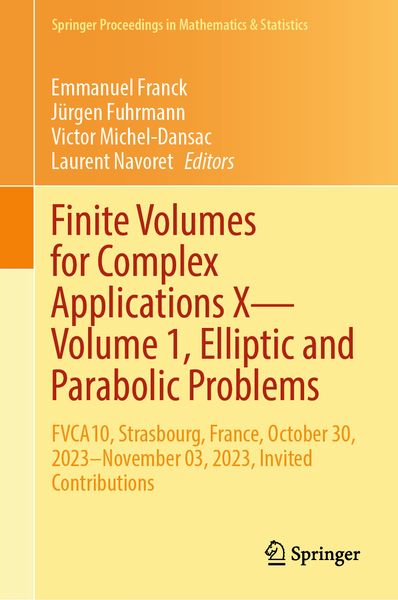
Produktbild: Finite Volumes for Complex Applications X—Volume 1, Elliptic and Parabolic Problems
Band 432

Finite Volumes for Complex Applications X—Volume 1, Elliptic and Parabolic Problems FVCA10, Strasbourg, France, October 30, 2023–November 03, 2023, Invited Contributions

Fr. 241.00

inkl. gesetzl. MwSt., Versandkostenfrei


Beschreibung

Produktdetails

Einband

Gebundene Ausgabe

Erscheinungsdatum

02.10.2023

Herausgeber

Emmanuel Franck + weitere

Verlag

Springer

Seitenzahl

396

Maße (L/B/H)

24.1/16/2.6 cm

Gewicht

850 g

Sprache

Englisch

ISBN

978-3-031-40863-2

Beschreibung

Produktdetails

Einband

Gebundene Ausgabe

Erscheinungsdatum

02.10.2023

Herausgeber

Verlag

Springer

Seitenzahl

396

Maße (L/B/H)

24.1/16/2.6 cm

Gewicht

850 g

Sprache

Englisch

ISBN

978-3-031-40863-2

Herstelleradresse

Springer-Verlag KG
Sachsenplatz 4-6
1201 Wien
AT

Email: ProductSafety@springernature.com

Kundinnen und Kunden meinen

0 Bewertungen

Informationen zu Bewertungen

Zur Abgabe einer Bewertung ist eine Anmeldung im Konto notwendig. Die Authentizität der Bewertungen wird von uns nicht überprüft. Wir behalten uns vor, Bewertungstexte, die unseren Richtlinien widersprechen, entsprechend zu kürzen oder zu löschen.

Die Bewertungen sind nach Format, Anzahl Sterne und Datum sortiert.

Verfassen Sie die erste Bewertung zu diesem Artikel

Helfen Sie anderen Kund*innen durch Ihre Meinung

Kundinnen und Kunden meinen

0 Bewertungen filtern

  • Produktbild: Finite Volumes for Complex Applications X—Volume 1, Elliptic and Parabolic Problems
  • Invited papers, R. Abgrall, A personal discussion on conservation, and how to formulate it.- W. Boscheri, C. Birke and C. Klingenberg, A high order semi-implicit scheme for ideal magnetohydrodynamics.- A. Artoni, P. F. Antonietti, R. Corradi, I. Mazzieri, N. Parolini, D. Rocchi, P. Schito and Francesco F. Semeraro, AeroSPEED: a high order acoustic solver for aeroacoustic applications.- C. Cancès, M. Herda and A. Massimini, Finite volumes for a generalized Poisson-Nernst-Planck system with crossdiffusion and size exclusion.- X. D. Sánchez and J. Ryan, Magic SIAC Toolbox: A Codebase of Effective, Efficient, and Flexible Filters.- C. Helzel and E. Chudzik, A Review of Cartesian Grid Active Flux Methods for Hyperbolic Conservation Laws.- C. Rohde, Moving-Mesh Finite-Volume Methods for Hyperbolic Interface Dynamics.- M. Peszynska, Mixed dimensional modeling with overlapping continua on Cartesian grids for complex applications.- Contributed papers: Pierre-Loïc Bacq, Antoine Gerschenfeldand Michael Ndjinga, PolyMAC: staggered finite volume methods on general meshes for incompressible Navier-Stokes problems.- C. Bauzet, F. Nabet, K. Schmitz and A. Zimmermann, Finite Volume Approximations for Non-Linear Parabolic Problems with Stochastic Forcing.- F. Benkhaldoun and Abdallah Bradji, A new analysis for a super-convergence result in the divergence norm for Lowest Order Raviart-Thomas Mixed Finite Elements combined with the Crank-Nicolson method applied to one dimensional parabolic equations.- Benkhaldoun, Fayssal, Bradji, Abdallah, An L∞(H1)–error estimate for Gradient Schemes applied to time fractional diffusion equations.- Jerome Bonelle and Thomas Fonty, Compatible Discrete Operator schemes for solidification and segregation phenomena.- M. Boutilier, K. Brenner and V. Dolean, Trefftz approximation space for Poisson equation in perforated domains.- C. Cancès, J. Cauvin-Vila, C. Chainais-Hillairet and V. Ehrlacher, Structure Preserving Finite Volume Approximation of Cross-Diffusion Systems Coupled by a Free Interface.- C. Chainais-Hillairet and M. Alfaro, Finite volume scheme for the diffusive field-road model: study of the long time behaviour.- C. Chainais-Hillairet, R. Eymard and J. Fuhrmann, An approximate two-point Dirichlet flux for quasilinear convection diffusion equations.- Z. Chehade and Y. Coudière, The Two-Point Finite Volume Scheme for the Microscopic Bidomain Model of Electrocardiology.- E. Chénier, C. Le Potier, Erell Jamelot and Andrew Peitavy, Improved Crouzeix-Raviart scheme for the Stokes problem.- S. Clément, F. Lemarié and E. Blayo, Towards a finite volume discretization of the atmospheric surface layer consistent with physical theory.- J. Droniou, M. Laaziri and R. Masson, Thermodynamically Consistent discretisation of a Thermo-HydroMechanical model.- E. Eggenweiler, J. Nickl and I. Rybak, Justification of Generalized Interface Conditions for Stokes-Darcy Problems.- J. Fuhrmann, B. Gaudeul and C. Keller, Two entropic finite volume schemes for a Nernst–Planck–Poisson system with ion volume constraints.- M. Gander, J. Hennicker, R. Masson and T. Vanzan, Dimensional reduction by Fourier analysis of a Stokes-Darcy fracture model.- M. Heida, Finite Volumes for Simulation of Large Molecules.- M. M. Knodel, Arne Nägel, Eva Herrmann and Gabriel Wittum, PDE models of virus replication merging 2D manifold and 3D volume effects evaluated at realistic reconstructed cell geometries.- S. Krell and J. Moatti, Structure-preserving schemes for drift-diffusion systems on general meshes: DDFV vs HFV.- S. Matera, D. Runge and C. Merdon, Reduced Basis Approach for convection-diffusion equations with non-linear boundary reaction conditions.- J. Moatti, A skeletal high-order structure preserving scheme for advection-diffusion equations.- G. Narváez, M. Ferrand, T. Fonty and S. Benhamadouche, Automatic solid reconstructionfrom 3-D points set for flow simulation via an immersed boundary method.- L. Ruan and I. Rybak, Stokes–Brinkman–Darcy Models for Coupled Free-Flow and Porous-Medium Systems.- P. Strohbeck, C. Riethmüller, D. Göddeke and I. Rybak, Robust and Efficient Preconditioners for Stokes–Darcy Problems.- C. Thomas, S. Mazen and El-Houssaine Quenjel, A DDFV Scheme for Incompressible Two-Phase Flow Degenerate Problem in Porous Media.- Author Index.