
Gutscheinbedingungen

*Gültig bis 07.06.2026 auf (fast) alles. Ausgeschlossen sind Smartboxen, Zeitschriften, Tickets, Lebensmittel, Gaming-Elektroartikel, Tinte/Toner, Gutscheine, Geschenkkarten, Blumen und Abos | Einlösbar in allen Buchhandlungen von Orell Füssli, Barth Bücher, Buchladen Rapunzel, Schuler Orell Füssli, Stauffacher und ZAP unter Vorweisung des Gutscheins, auf www.orellfüssli.ch durch Eingabe des Gutscheincodes. Beim Service „eBooks verschenken“ und bei eBook-Käufen via eReader nicht einlösbar | Mindesteinkaufswert: Fr. 100.- | Nicht mit anderen Rabatten kumulierbar.

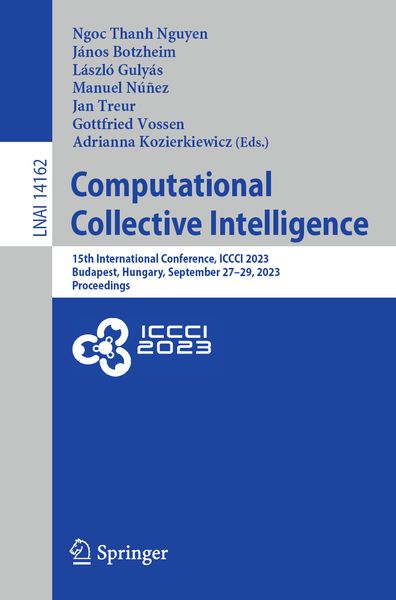
  • Produktbild: Computational Collective Intelligence
  • Produktbild: Computational Collective Intelligence

Computational Collective Intelligence 15th International Conference, ICCCI 2023, Budapest, Hungary, September 27–29, 2023, Proceedings

Fr. 161.00

inkl. gesetzl. MwSt., Versandkostenfrei


Beschreibung

Produktdetails

Einband

Taschenbuch

Erscheinungsdatum

14.09.2023

Herausgeber

Ngoc Thanh Nguyen + weitere

Verlag

Springer

Seitenzahl

849

Maße (L/B/H)

23.5/15.5/4.7 cm

Gewicht

1305 g

Auflage

1st ed. 2023

Sprache

Englisch

ISBN

978-3-031-41455-8

Beschreibung

Produktdetails

Einband

Taschenbuch

Erscheinungsdatum

14.09.2023

Herausgeber

Verlag

Springer

Seitenzahl

849

Maße (L/B/H)

23.5/15.5/4.7 cm

Gewicht

1305 g

Auflage

1st ed. 2023

Sprache

Englisch

ISBN

978-3-031-41455-8

Herstelleradresse

Springer-Verlag GmbH
Tiergartenstr. 17
69121 Heidelberg
DE

Email: ProductSafety@springernature.com

Kundinnen und Kunden meinen

0 Bewertungen

Informationen zu Bewertungen

Zur Abgabe einer Bewertung ist eine Anmeldung im Konto notwendig. Die Authentizität der Bewertungen wird von uns nicht überprüft. Wir behalten uns vor, Bewertungstexte, die unseren Richtlinien widersprechen, entsprechend zu kürzen oder zu löschen.

Die Bewertungen sind nach Format, Anzahl Sterne und Datum sortiert.

Verfassen Sie die erste Bewertung zu diesem Artikel

Helfen Sie anderen Kund*innen durch Ihre Meinung

Kundinnen und Kunden meinen

0 Bewertungen filtern

  • Produktbild: Computational Collective Intelligence
  • Produktbild: Computational Collective Intelligence
  • Collective Intelligence and Collective Decision-Making .- Hybrid Genetic Algorithms to Determine 2-Optimality Consensus for a Collective of Ordered Partitions.- From Fragmented Data to Collective Intelligence: A Data Fabric Approach for University Knowledge Management.- An Architecture for Enabling Collective Intelligence in IoT Networks.- Self-Organizing Maps for Data Purchase Support in Data Marketplaces.- Agent based model of elementary school group learning – a case study.-  Deep Learning Techniques .- Deep Reinforcement Learning for Jointly Resource Allocation and Trajectory Planning in UAV-assisted Networks.- DNGAE: Deep Neighborhood Graph Autoencoder for robust blindhyperspectral unmixing.- Unlocking the Potential of Deep Learning and Filter Gabor for Facial Emotion Recognition.- Graph Convolution Collaborative Filtering with Dense Embeddings.- Automatic Quantization for Convolutional Neural Networks Based on Enhanced Bare-BonesParticle Swarm Optimization for Chest X-ray Image Classification.- A Convolutional Autoencoder Approach for Weakly Supervised Anomaly Video Detection.- Sparsity-invariant Convolution for Forecasting Irregularly Sampled Time Series.- Efficient Sparse Networks from Watts-Strogatz Network Priors.-  Natural Language Processing .- Exploring the Role of Monolingual Data in Cross-Attention Pre-Training for Neural Machine Translation.- Development of a dictionary for preschool children with weak speech skills based on the Word2Vec method.- An abstractive automatic summarization approach based on a text comprehension model of cognitive psychology.- Detecting Duplicate Multiple Choice Questions in The Large Question Bank.- A Context-Aware Approach for Improving Dialog Act Detection in a Multilingual Conversational Platform.-  Data Minning and Machine learning .- Efficient Association Rules Minimization Using a Double-Stage Quine-McCluskey-Based Approach.- Complexity-Based Code Embeddings.- Differentially Private Copulas, DAG and Hybrid Methods: a Comprehensive Data Utility Study.- Analysing Android Apps Classification and Categories Validation by using Latent Dirichlet Allocation.- Staircase Recognition based on Possibilistic Feature Quality Assessment Method.-  Social Networks and Intelligent Systems .- Toward effective link prediction based on local information in organizational social networks.- A new topic modeling method for tweets comparison.- Measuring gender: A machine learning approach to social media demographics and author profiling.- Crisis Detection by Social and Remote Sensing Fusion: A selective Attention Approach.- Educational Videos Recommendation System Based On Topic Modeling.-  Cybersecurity, Blockchain Technology and Internet of Things .- A Two-hop Neighborhood Based Berserk Detection Algorithm for Probabilistic Model of Consensus in Distributed Ledger Systems.- Trust Assessment on Data Stream Imputation in IoT Environments.- Optimizing Merkle Tree Structure for Blockchain transactions by a DCProgramming approach.- Wearable Tag for Indoor Localization in the context of Ambient Assisted Living.- Hyperledger blockchain-enabled cold chain application for flower logistics.- A Fully Decentralized Privacy-Enabled Federated Learning System.-  Cooperative Strategies for Decision Making and Optimization .- Two-dimensional Pheromone in Ant Colony Optimization.- Analysis of different reinsertion strategies in Steady State GeneticAlgorithm.- Traffic Optimization by Local Bacterial Memetic Algorithm.- Optimizing Fire Control Monitoring System in Smart Cities.-  Computational Intelligence for Digital Content Understanding .- Desertification Detection in Satellite Images using Siamese Variational Autoencoder with Transfer Learning.- Speaker Identification Enhancement Using Emotional Features.- Classification of punches in Olympic boxing using static RGB cameras.- Learning Human Postures using Lab-Depth HOG Descriptors.- SemiMemes: A Semi-supervised Learning Approach for Multimodal Memes Analysis.- Extrinsic Calibration Framework for Camera-Lidar Fusion using Recurrent Residual Network.- GAN-based Data Augmentation and Pseudo-Label Refinement for Unsupervised Domain Adaptation Person Re-Identification.- Intelligent Automated Pancreas Segmentation using U-Net Model Variants.-  Knowledge Engineering and Apllication for Industry 4.0 .- Energy and Congestion Awareness Traffic Scheduling in HybridSoftware-Defined Network with Flow Splitting.- "Is Proton good enough?" - a performance comparison between gaming on Windows and Linux.- Complete Coverage and Path Planning for Emergency Response by UAVs in Disaster Areas.- Complete Coverage and Path Planning for Emergency Response by UAVs in Disaster Areas.- Complex layers of ranked prognostic models.- Project Team Members competences configuration: a proactive andreactive approach.-  Computational Intelligence in Medical Applications .- Teeth disease recognition based on X-ray images.- Predicting Alzheimer’s Disease Diagnosis Risk over Time with Survival Machine Learning on the ADNI Cohort.- MEP: A Comprehensive Medicines Extraction System on Prescriptions.- New Approaches to Monitoring Respiratory Activity as Part of an Intelligent Model for Stress Assessment.- An Adaptive Network Model for Anorexia Nervosa: Addressing the Effects of Therapy.- ReVQ-VAE: A Vector Quantization-Variational Autoencoder for COVID-19 chest X-Ray image.-  Ensemble Models and Data Fusion .- Credit Risk Scoring Using a Data Fusion Approach.- Goal-oriented Classification of Football Results.- Learning from Imbalanced Data Streams Using Rotation-based Ensemble Classifiers.- DE-Forest – optimized decision tree ensemble.- Mining multiple class imbalanced datasets using aspecialized balancing algorithm and the Adaboost technique.- Investigation and prediction of Cognitive Load During Memory and Arithmetic Tasks.