
Band 14142
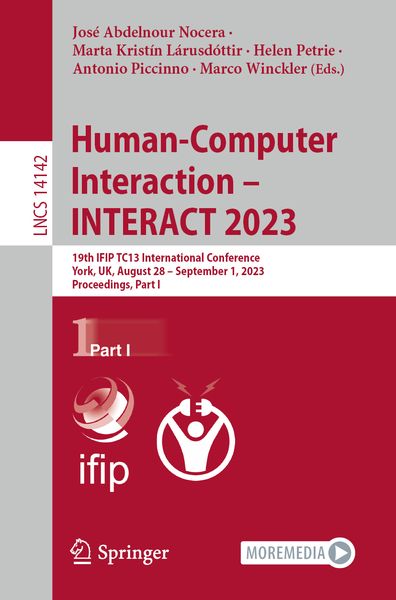
Human-Computer Interaction – INTERACT 2023 19th IFIP TC13 International Conference, York, UK, August 28 – September 1, 2023, Proceedings, Part I
Aus der Reihe
Lecture Notes in Computer Science
-
- Taschenbuch ausgewählt
- eBook
-
Sprache:Englisch
-
Auflage:1st edition 2023
Fr. 137.00
inkl. gesetzl. MwSt.,
Beschreibung
Produktdetails
Einband
Taschenbuch
Erscheinungsdatum
25.08.2023
Herausgeber
José Abdelnour Nocera + weitereVerlag
SpringerSeitenzahl
653
Maße (L/B/H)
23.5/15.5/3.7 cm
Gewicht
1025 g
Auflage
1st edition 2023
Sprache
Englisch
ISBN
978-3-031-42279-9
The four-volume set LNCS 14442 -14445 constitutes the proceedings of the 19th IFIP TC 13 International Conference on Human-Computer Interaction, INTERACT 2023, held in York, UK, in August/September 2023.
The 71 full papers and 58 short papers included in this book were carefully reviewed and selected from 406 submissions. They were organized in topical sections as follows: 3D Interaction; Accessibility; Accessibility and Aging; Accessibility for Auditory/Hearing Disabilities; Co-Design; Cybersecurity and Trust; Data Physicalisation and Cross-device; Eye-Free, Gesture Interaction and Sign Language; Haptic interaction and Healthcare applications; Self-Monitoring; Human-Robot Interaction; Information Visualization; Information Visualization and 3D Interaction; Interacting with Children; Interaction with Conversational Agents; Methodologies for HCI; Model-Based UI Design and Testing; Montion Sickness, Stress and Risk perception in 3D Environments and Multisensory interaction; VR experiences; Natural Language Processing and AI Explainability; Online Collaboration and Cooperative work; Recommendation Systems and AI Explainability; Social AI; Social and Ubiquitous Computing; Social Media and Digital Learning; Understanding Users and Privacy Issues; User movement and 3D Environments; User Self-Report; User Studies; User Studies, Eye-Tracking, and Physiological Data; Virtual Reality; Virtual Reality and Training; Courses; Industrial Experiences; Interactive Demonstrations; Keynotes; Panels; Posters; and Workshops.
The 71 full papers and 58 short papers included in this book were carefully reviewed and selected from 406 submissions. They were organized in topical sections as follows: 3D Interaction; Accessibility; Accessibility and Aging; Accessibility for Auditory/Hearing Disabilities; Co-Design; Cybersecurity and Trust; Data Physicalisation and Cross-device; Eye-Free, Gesture Interaction and Sign Language; Haptic interaction and Healthcare applications; Self-Monitoring; Human-Robot Interaction; Information Visualization; Information Visualization and 3D Interaction; Interacting with Children; Interaction with Conversational Agents; Methodologies for HCI; Model-Based UI Design and Testing; Montion Sickness, Stress and Risk perception in 3D Environments and Multisensory interaction; VR experiences; Natural Language Processing and AI Explainability; Online Collaboration and Cooperative work; Recommendation Systems and AI Explainability; Social AI; Social and Ubiquitous Computing; Social Media and Digital Learning; Understanding Users and Privacy Issues; User movement and 3D Environments; User Self-Report; User Studies; User Studies, Eye-Tracking, and Physiological Data; Virtual Reality; Virtual Reality and Training; Courses; Industrial Experiences; Interactive Demonstrations; Keynotes; Panels; Posters; and Workshops.
Kundinnen und Kunden meinen
Verfassen Sie die erste Bewertung zu diesem Artikel
Helfen Sie anderen Kund*innen durch Ihre Meinung