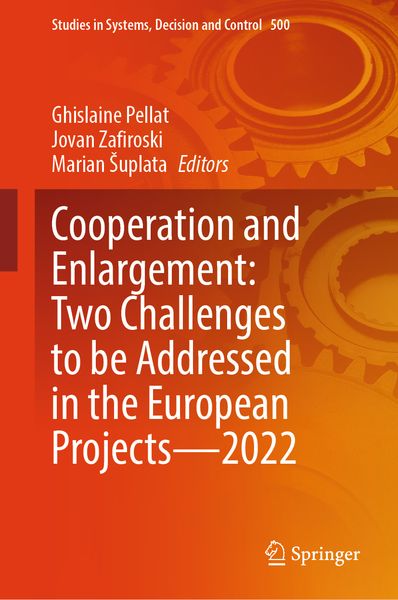
Cooperation and Enlargement: Two Challenges to be Addressed in the European Projects—2022
-
- Hardcover ausgewählt
- Taschenbuch
- eBook
-
Sprache:Englisch
Fr. 241.00
inkl. gesetzl. MwSt.,
Beschreibung
Produktdetails
Einband
Gebundene Ausgabe
Erscheinungsdatum
11.11.2023
Abbildungen
VII, 374 p. 57 illus., 43 illus. in color.
Herausgeber
Ghislaine Pellat + weitereVerlag
SpringerSeitenzahl
374
Maße (L/B/H)
24.1/16/2.7 cm
Gewicht
740 g
Auflage
1st edition 2024
Sprache
Englisch
ISBN
978-3-031-42252-2
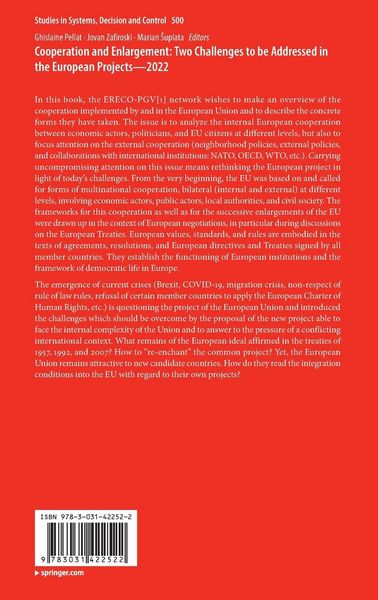
In this book, the ERECO-PGV[1] network wishes to make an overview of the cooperation implemented by and in the European Union and to describe the concrete forms they have taken. The issue is to analyze the internal European cooperation between economic actors, politicians, and EU citizens at different levels, but also to focus attention on the external cooperation (neighborhood policies, external policies, and collaborations with international institutions: NATO, OECD, WTO, etc.). Carrying uncompromising attention on this issue means rethinking the European project in light of today's challenges.
From the very beginning, the EU was based on and called for forms of multinational cooperation, bilateral (internal and external) at different levels, involving economic actors, public actors, local authorities, and civil society. The frameworks for this cooperation as well as for the successive enlargements of the EU were drawn up in the context of European negotiations, in particular during discussions on the European Treaties. European values, standards, and rules are embodied in the texts of agreements, resolutions, and European directives and Treaties signed by all member countries. They establish the functioning of European institutions and the framework of democratic life in Europe.The emergence of current crises (Brexit, COVID-19, migration crisis, non-respect of rule of law rules, refusal of certain member countries to apply the European Charter of Human Rights, etc.) is questioning the project of the European Union and introduced the challenges which should be overcome by the proposal of the new project able to face the internal complexity of the Union and to answer to the pressure of a conflicting international context. What remains of the European ideal affirmed in the treaties of 1957, 1992, and 2007? How to "re-enchant" the common project? Yet, the European Union remains attractive to new candidate countries. How do they read the integration conditions into the EU with regard to their own projects?
Noch keine Bewertungen vorhanden
Verfassen Sie die erste Bewertung zu diesem Artikel
Helfen Sie anderen Kundinnen und Kunden durch Ihre Meinung.