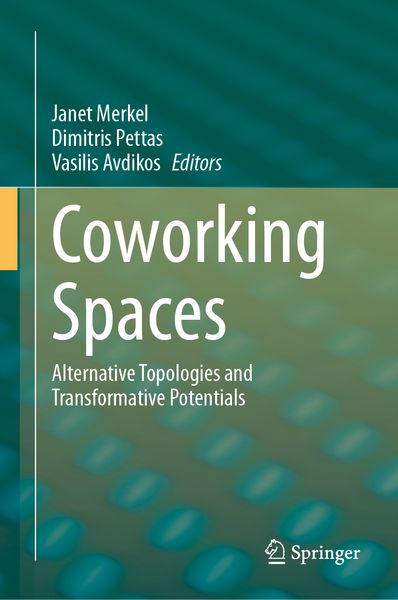
Coworking Spaces Alternative Topologies and Transformative Potentials
-
- Hardcover ausgewählt
- Taschenbuch
- eBook
-
Sprache:Englisch
Fr. 171.00
inkl. gesetzl. MwSt.,
Beschreibung
Produktdetails
Einband
Gebundene Ausgabe
Erscheinungsdatum
08.11.2023
Abbildungen
XIV, 243 p. 7 illus., 6 illus. in color.
Herausgeber
Janet Merkel + weitereVerlag
SpringerSeitenzahl
243
Maße (L/B/H)
24.1/16/1.9 cm
Gewicht
606 g
Auflage
23001 Auflage 1st ed. 2023
Sprache
Englisch
ISBN
978-3-031-42267-6
This contributed volume considers the emergence of coworking as centered in labor issues. More specifically, its chapters consider it as a coping mechanism in the worldwide rise of independent modes of work (i.e., self-employment) that leaves more and more workers exposed to precarity as they must organize and manage their own labor. Grounded in this perspective, this volume aims to understand the transformative social and political potentials emerging through coworking as a social and spatial practice. There is a distinct lack of discussion within coworking research on the emancipatory potentials of coworking—and if it is discussed, more cautionary views prevail, highlighting the ambivalence of coworking spaces both as a space of alternative economic practices and as integrated into market economies.
The aims of this collection are twofold: First, it aims to make visible the plurality of existing practices around shared resources in coworking and the assemblages of human and non-human actors as agents of change associated with coworking and the re-organization of work and labor power. And second, it aims to develop a more emancipatory narrative for coworking and the role of coworking spaces for workers but also the different spatial contexts in which these spaces are situated. A narrative that does not emphasize entrepreneurship or coworking as the epitome of the ‘neoliberal entrepreneurial self’ as in the dominant interpretations in the current research, but rather one that centers coworking in the creation of meaningful, careful social relationships, supporting empathy and an ethics that recognizes mutual interdependencies and builds a foundation for social change. So, it is about alternative narratives, emancipation politics and the wider social role that coworking spaces might play in neighborhoods, cities or beyond because they are crucial contexts for the formation and maintenance of social relations.
Withthis specific direction, this collection aims to bring coworking research into a fruitful dialog with other research fields-such as sociology of work, feminist perspectives on care, alternative and diverse economies, "post-capitalist" transformation, critical geography, positioning coworking within a range of progressive alternatives in the articulation of economic and social relationships.
Noch keine Bewertungen vorhanden
Verfassen Sie die erste Bewertung zu diesem Artikel
Helfen Sie anderen Kundinnen und Kunden durch Ihre Meinung.