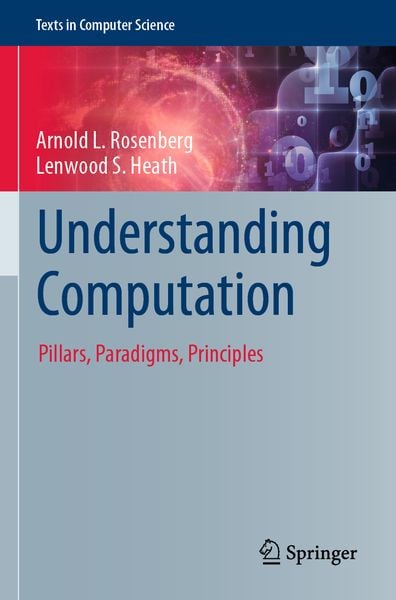
Understanding Computation Pillars, Paradigms, Principles
-
- Hardcover
- Taschenbuch ausgewählt
- eBook
-
Sprache:Englisch
Fr. 112.00
inkl. gesetzl. MwSt.,
Beschreibung
Produktdetails
Einband
Taschenbuch
Erscheinungsdatum
10.08.2023
Abbildungen
XVII, 570 p. 87 illus.
Verlag
SpringerSeitenzahl
570
Maße (L/B/H)
23.5/15.5/3.2 cm
Gewicht
879 g
Sprache
Englisch
ISBN
978-3-031-10057-4
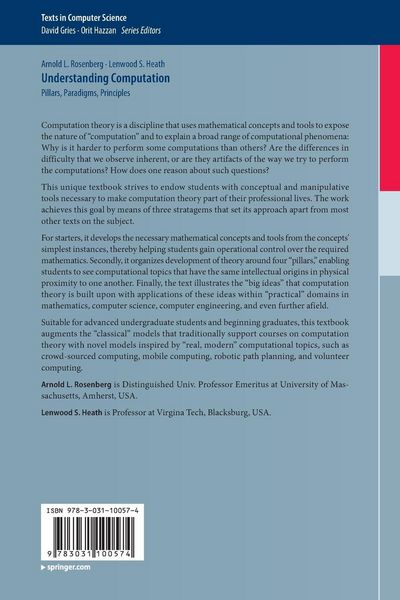
Computation theory is a discipline that uses mathematical concepts and tools to expose the nature of "computation" and to explain a broad range of computational phenomena: Why is it harder to perform some computations than others? Are the differences in difficulty that we observe inherent, or are they artifacts of the way we try to perform the computations? How does one reason about such questions?
This unique textbook strives to endow students with conceptual and manipulative tools necessary to make computation theory part of their professional lives. The work achieves this goal by means of three stratagems that set its approach apart from most other texts on the subject.
For starters, it develops the necessary mathematical concepts and tools from the concepts' simplest instances, thereby helping students gain operational control over the required mathematics. Secondly, it organizes development of theory around four "pillars," enabling students to see computational topics that have the same intellectual origins in physical proximity to one another. Finally, the text illustrates the "big ideas" that computation theory is built upon with applications of these ideas within "practical" domains in mathematics, computer science, computer engineering, and even further afield.
Suitable for advanced undergraduate students and beginning graduates, this textbook augments the "classical" models that traditionally support courses on computation theory with novel models inspired by "real, modern" computational topics,such as crowd-sourced computing, mobile computing, robotic path planning, and volunteer computing.
Arnold L. Rosenberg
is Distinguished Univ. Professor Emeritus at University of Massachusetts, Amherst, USA.
Lenwood S. Heath
is Professor at Virgina Tech, Blacksburg, USA.
Noch keine Bewertungen vorhanden
Verfassen Sie die erste Bewertung zu diesem Artikel
Helfen Sie anderen Kundinnen und Kunden durch Ihre Meinung.