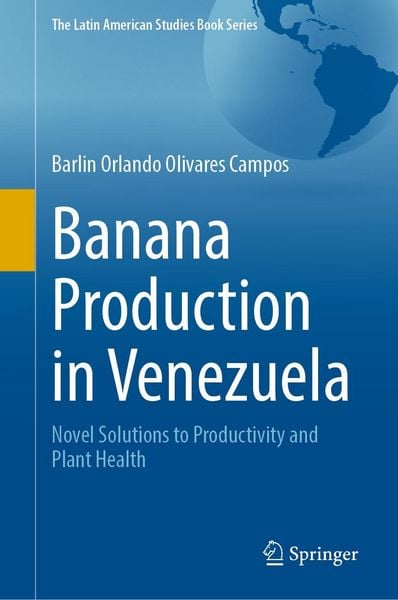
Banana Production in Venezuela Novel Solutions to Productivity and Plant Health
-
- Hardcover
- Taschenbuch
- eBook ausgewählt
-
Form:Einzelkauf Download
-
Sprache:Englisch
Fr. 187.90
inkl. gesetzl. MwSt.Beschreibung
Produktdetails
Format
Kopierschutz
Nein
Family Sharing
Nein
Text-to-Speech
Nein
Erscheinungsdatum
12.07.2023
Verlag
Springer Nature SwitzerlandSeitenzahl
176 (Printausgabe)
Dateigröße
10957 KB
Sprache
Englisch
EAN
9783031344756
This book presents an important contribution to the knowledge of the banana soils of Venezuela. Banana, the edible fruit of Musaceae, is a staple food for more than 400 million people worldwide due to their nutritional and energy attributes. This makes Musaceae a crop of worldwide relevance, particularly in tropical regions, highlighting the impact of improved Musaceae cropping systems in the current efforts worldwide oriented towards a new agricultural revolution based on sustainable intensification. To achieve this, better practices for food production based on scientific and technical research capable to consider the complexity and variability within the agri-food sector are necessary. The research presented in this book is oriented towards providing answers to the causes of two aspects considered of high relevance for banana production, both affecting productivity and sustainability, always addressed for the Venezuelan conditions, one of the world's largest producing countries: 1- The impact of phytosanitary risks related to Fusarium Wilt (FW) and the influence of the soil on the incidence of Banana Wilt (BW); and 2- An observed trend towards loss of productivity and decline of soil quality in some commercial farms of Aragua and Trujillo states in Venezuela.
The book presents a pioneering study in the application of categorical regression (CATREG) in the characterization of banana soils and analyses soil morphological variables, such as texture, dry consistency, biological activity, reaction to HCl, and type of structure to characterize soil productivity for growing healthy bananas. It develops, for the first time in Venezuela, risk analysis and climatic suitability maps for lethal wilt disease in bananas caused by Fusarium oxysporum f. sp. cubense (Foc) Tropical Race 4 (TR4) (syn. Fusarium odoratissimum). Innovative machine learning techniques are used to predict BW so that future crop development can be done more efficiently and sustainably.
Kundinnen und Kunden meinen
Verfassen Sie die erste Bewertung zu diesem Artikel
Helfen Sie anderen Kund*innen durch Ihre Meinung