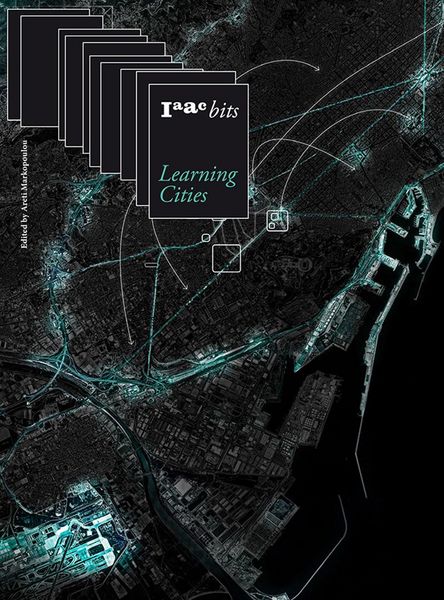
IAAC Bits 10 - Learning Cities Collective Intelligence in Urban Design
-
- Taschenbuch
- eBook ausgewählt
-
Form:Einzelkauf Download
-
Sprache:Englisch
Fr. 16.90
inkl. gesetzl. MwSt.Beschreibung
Produktdetails
Format
ePUB
Kopierschutz
Ja
Family Sharing
Nein
Text-to-Speech
Ja
Erscheinungsdatum
20.06.2023
Herausgeber
Areti MarkopoulouVerlag
Actar DSeitenzahl
200 (Printausgabe)
Dateigröße
114620 KB
Sprache
Englisch
EAN
9781638408130
The digital intelligence that is inevitably starting to penetrate every aspect of our previously analogue systems of living, working or social interacting calls for new models of designing our city and opens new territories of experimentation in the processes related to urban design.
While the idea of intelligent machines that simulate cognitive functions such as learning or problem solving is not new, its extensive use, in recent years, in the urban design discipline opens up a series of new possibilities as well as plenty of cultural, ethical or even aesthetic hesitations and risks.
How do our cities learn? Can machines design and what?
Is crowd intelligence appropriately harvested in our evolutionary and generative design processes? And has our current big data analysis approach reached the limit of human and computational intelligence?
Learning Cities explores the intelligence applied in the processes and outcomes of designing our urban environments. From a variety of applications of artificial intelligence and machine learning for urban planning to co-creation processes that merge crowd intelligence with digital technologies, Learning Cities highlights that intelligence in the built environment should be understood beyond human, object or machinic intelligence alone. Through a variety of contributions from experts in different fields the current IAAC Bits Journal Issue explores novel collective intelligence design processes in which designers, users, the built environment, and digital codes all play a fundamental role in a unique resonance that takes place among them.
With Contributions of Areti Markopoulou, Manuel Gausa, Jordi Vivaldi, Benjamin Bratton, John Frazer, Molly Wright Steenson, Stanislas Chaillou, Sarah Williams, Theodora Vardouli, Neil Leach, Angelos Chronis, José Sánchez, Mathilde Marengo, Aldo Sollazzo, Aleksandra Sojka, Matias del Campo, Chiara Farinea, Rodrigo Delso, Sandra Maninger, Javier Argota, Cobus Bothma and others.
While the idea of intelligent machines that simulate cognitive functions such as learning or problem solving is not new, its extensive use, in recent years, in the urban design discipline opens up a series of new possibilities as well as plenty of cultural, ethical or even aesthetic hesitations and risks.
How do our cities learn? Can machines design and what?
Is crowd intelligence appropriately harvested in our evolutionary and generative design processes? And has our current big data analysis approach reached the limit of human and computational intelligence?
Learning Cities explores the intelligence applied in the processes and outcomes of designing our urban environments. From a variety of applications of artificial intelligence and machine learning for urban planning to co-creation processes that merge crowd intelligence with digital technologies, Learning Cities highlights that intelligence in the built environment should be understood beyond human, object or machinic intelligence alone. Through a variety of contributions from experts in different fields the current IAAC Bits Journal Issue explores novel collective intelligence design processes in which designers, users, the built environment, and digital codes all play a fundamental role in a unique resonance that takes place among them.
With Contributions of Areti Markopoulou, Manuel Gausa, Jordi Vivaldi, Benjamin Bratton, John Frazer, Molly Wright Steenson, Stanislas Chaillou, Sarah Williams, Theodora Vardouli, Neil Leach, Angelos Chronis, José Sánchez, Mathilde Marengo, Aldo Sollazzo, Aleksandra Sojka, Matias del Campo, Chiara Farinea, Rodrigo Delso, Sandra Maninger, Javier Argota, Cobus Bothma and others.
Kundinnen und Kunden meinen
Verfassen Sie die erste Bewertung zu diesem Artikel
Helfen Sie anderen Kund*innen durch Ihre Meinung