Band 1870
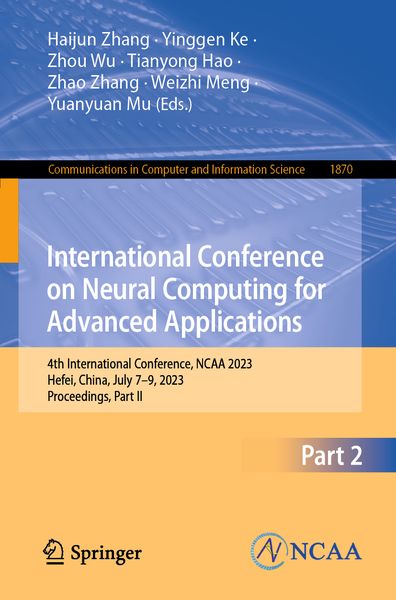
International Conference on Neural Computing for Advanced Applications 4th International Conference, NCAA 2023, Hefei, China, July 7–9, 2023, Proceedings, Part II
Aus der Reihe
Communications in Computer and Information Science
-
- Taschenbuch ausgewählt
- eBook
-
Sprache:Englisch
-
Auflage:1st ed. 2023
- 1st ed. 2023 Fr. 137.00
- 1st ed. 2023 Fr. 149.00 ausgewählt
Fr. 149.00
inkl. gesetzl. MwSt.,
Beschreibung
Produktdetails
Einband
Taschenbuch
Erscheinungsdatum
30.08.2023
Abbildungen
XXIV, 616 p. 264 illus., 197 illus. in color.
Herausgeber
Haijun Zhang + weitereVerlag
Springer SingaporeSeitenzahl
616
Maße (L/B/H)
23.5/15.5/3.5 cm
Gewicht
955 g
Auflage
1st ed. 2023
Sprache
Englisch
ISBN
978-981-9958-46-7
The two-volume set CCIS 1869 and 1870 constitutes the refereed proceedings of the 4th International Conference on Neural Computing for Advanced Applications, NCAA 2023, held in Hefei, China, in July 2023.
The 83 full papers and 1 short paper presented in these proceedings were carefully reviewed and selected from 211 submissions. The papers have been organized in the following topical sections: Neural network (NN) theory, NN-based control systems, neuro-system integration and engineering applications; Machine learning and deep learning for data mining and data-driven applications; Computational intelligence, nature-inspired optimizers, and their engineering applications; Deep learning-driven pattern recognition, computer vision and its industrial applications; Natural language processing, knowledge graphs, recommender systems, and their applications; Neural computing-based fault diagnosis and forecasting, prognostic management, and cyber-physical system security; Sequence learning for spreading dynamics, forecasting, and intelligent techniques against epidemic spreading (2); Applications of Data Mining, Machine Learning and Neural Computing in Language Studies; Computational intelligent Fault Diagnosis and Fault-Tolerant Control, and Their Engineering Applications; and Other Neural computing-related topics.
The 83 full papers and 1 short paper presented in these proceedings were carefully reviewed and selected from 211 submissions. The papers have been organized in the following topical sections: Neural network (NN) theory, NN-based control systems, neuro-system integration and engineering applications; Machine learning and deep learning for data mining and data-driven applications; Computational intelligence, nature-inspired optimizers, and their engineering applications; Deep learning-driven pattern recognition, computer vision and its industrial applications; Natural language processing, knowledge graphs, recommender systems, and their applications; Neural computing-based fault diagnosis and forecasting, prognostic management, and cyber-physical system security; Sequence learning for spreading dynamics, forecasting, and intelligent techniques against epidemic spreading (2); Applications of Data Mining, Machine Learning and Neural Computing in Language Studies; Computational intelligent Fault Diagnosis and Fault-Tolerant Control, and Their Engineering Applications; and Other Neural computing-related topics.
Noch keine Bewertungen vorhanden
Verfassen Sie die erste Bewertung zu diesem Artikel
Helfen Sie anderen Kundinnen und Kunden durch Ihre Meinung.