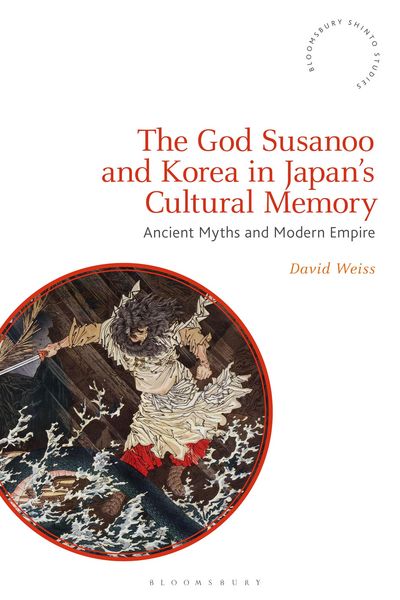
The God Susanoo and Korea in Japan's Cultural Memory Ancient Myths and Modern Empire
Aus der Reihe
Bloomsbury Shinto Studies
-
- Hardcover
- Taschenbuch
- eBook ausgewählt
-
Form:Einzelkauf Download
-
Sprache:Englisch
-
eBook Format:PDF
- PDF Fr. 37.90 ausgewählt
- ePUB Fr. 37.90
Fr. 37.90
inkl. gesetzl. MwSt.Beschreibung
Produktdetails
Format
Kopierschutz
Ja
Family Sharing
Nein
Text-to-Speech
Nein
Erscheinungsdatum
13.01.2022
Verlag
Bloomsbury eBooks UKSeitenzahl
256 (Printausgabe)
Auflage
1. Auflage
Sprache
Englisch
EAN
9781350271197
This book discusses how ancient Japanese mythology was utilized during the colonial period to justify the annexation of Korea to Japan, with special focus on the god Susanoo. Described as an ambivalent figure and wanderer between the worlds, Susanoo served as a foil to set off the sun goddess, who played an important role in the modern construction of a Japanese national identity.
Susanoo inhabited a sinister otherworld, which came to be associated with colonial Korea. Imperialist ideologues were able to build on these interpretations of the Susanoo myth to depict Korea as a dreary realm at the margin of the Japanese empire that made the imperial metropole shine all the more brightly. At the same time, Susanoo was identified as the ancestor of the Korean people. Thus, the colonial subjects were ideologically incorporated into the homogeneous Japanese "family state."
The book situates Susanoo in Japan's cultural memory and shows how the deity, while being repeatedly transformed in order to meet the religious and ideological needs of the day, continued to symbolize the margin of Japan.
Susanoo inhabited a sinister otherworld, which came to be associated with colonial Korea. Imperialist ideologues were able to build on these interpretations of the Susanoo myth to depict Korea as a dreary realm at the margin of the Japanese empire that made the imperial metropole shine all the more brightly. At the same time, Susanoo was identified as the ancestor of the Korean people. Thus, the colonial subjects were ideologically incorporated into the homogeneous Japanese "family state."
The book situates Susanoo in Japan's cultural memory and shows how the deity, while being repeatedly transformed in order to meet the religious and ideological needs of the day, continued to symbolize the margin of Japan.
Noch keine Bewertungen vorhanden
Verfassen Sie die erste Bewertung zu diesem Artikel
Helfen Sie anderen Kundinnen und Kunden durch Ihre Meinung.