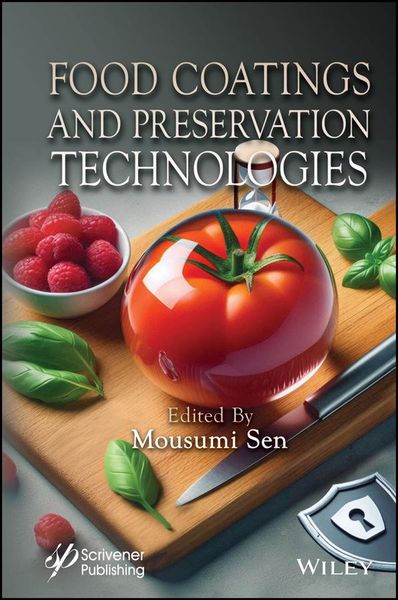
Produktbild: Food Coatings and Preservation Technologies

Food Coatings and Preservation Technologies

Fr. 333.00

inkl. gesetzl. MwSt., Versandkostenfrei


Beschreibung

Produktdetails

Einband

Gebundene Ausgabe

Erscheinungsdatum

05.11.2024

Herausgeber

Mousumi Sen

Verlag

Wiley

Seitenzahl

688

Gewicht

1234 g

Sprache

Englisch

ISBN

978-1-394-23758-6

Beschreibung

Produktdetails

Einband

Gebundene Ausgabe

Erscheinungsdatum

05.11.2024

Herausgeber

Mousumi Sen

Verlag

Wiley

Seitenzahl

688

Gewicht

1234 g

Sprache

Englisch

ISBN

978-1-394-23758-6

Kundinnen und Kunden meinen

0 Bewertungen

Informationen zu Bewertungen

Zur Abgabe einer Bewertung ist eine Anmeldung im Konto notwendig. Die Authentizität der Bewertungen wird von uns nicht überprüft. Wir behalten uns vor, Bewertungstexte, die unseren Richtlinien widersprechen, entsprechend zu kürzen oder zu löschen.

Die Bewertungen sind nach Format, Anzahl Sterne und Datum sortiert.

Verfassen Sie die erste Bewertung zu diesem Artikel

Helfen Sie anderen Kund*innen durch Ihre Meinung

Kundinnen und Kunden meinen

0 Bewertungen filtern

Die Leseprobe wird geladen.
  • Produktbild: Food Coatings and Preservation Technologies
  • Preface xxiii

    1 Edible Food Coatings are Biopolymers: Packaging and Preservation 1
    Mousumi Sen and Hemendra Pratap Singh

    1.1 Introduction 2

    1.2 Characteristics of Edible Coatings 4

    1.3 Nanocoating Preparation Techniques 5

    1.4 Coating 6

    1.5 Coating Methods with Applications 14

    1.6 Factors Affecting Coating Process 17

    1.7 Applications 18

    1.8 Future Perspectives and Challenges of Nanotechnology in Food 20

    1.9 Conclusion 20

    References 21

    2 Materials Used for Edible Coatings, Their Characteristics and Properties 27
    Panoth Abhirami and N. Venkatachalapathy

    2.1 Introduction 28

    2.2 Classification of Edible Coatings 31

    2.3 Recent Advances in Edible Coating 40

    2.4 Conclusion and Future Scope 44

    References 45

    3 Edible and Biodegradable Polymeric Materials for Food Packaging or Coatings 51
    D. Kavya Gupta, M. H. M. Phanisree, M. Penchalaraju and A. Surendra Babu

    3.1 Introduction 52

    3.2 Classification of Biobased Polymers 56

    3.3 Advanced Methods for the Synthesis of Biopolymers for Packaging Applications 60

    3.4 Properties of Biopolymers 64

    3.5 Tests for Determining the Biodegradation of Biopolymer 68

    3.6 Biopolymers and Their Potential Application as Edible, Nonedible Packaging, and Coating 73

    3.7 Future Aspects of Biopolymers in Packaging Applications 75

    3.8 Concluding Remarks 76

    References 76

    4 Active and Intelligent Antimicrobial Coating Systems 85
    Dineshkumar T., Sakthivel Sangeetha, Pragalyaashree M. M. and Freeda Blessie R.

    4.1 Introduction 87

    4.2 Antimicrobial Agents 88

    4.3 Antimicrobial Agent for Active and Intelligent Package of Food 99

    4.4 Active Coating 99

    4.5 Intelligent Packaging 110

    4.6 Market Potential for Antimicrobial, Active, and Intelligent Coating 117

    4.7 Conclusion 118

    References 119

    5 Edible Coatings-Medical Foods and Nutraceuticals 127
    Sakthivel Sangeetha, Dineshkumar T., Pragalyaashree M. M. and Freeda Blessie R.

    5.1 Introduction on Edible Coatings 128

    5.2 Edible Coating on Tablets 132

    5.3 Edible Coating on Nutraceuticals 133

    5.4 Edible Coating Methods 134

    5.5 Edible Coating Materials 143

    5.6 Edible-Coated Products 150

    5.7 Properties of Edible Coating 155

    5.8 Stability of Edible Coating 156

    5.9 Bioavailability of Edible Coating 157

    5.10 Delivery System of Edible Coating 158

    5.11 Evaluation of Edible Coating 159

    5.12 Market Potential of Edible Coating in Food 160

    5.13 Conclusion 161

    References 161

    6 Edible Packaging: Extension of Shelf Life and Improvement of Food Quality 167
    Ritika and Rizwana

    6.1 Introduction 168

    6.2 Facilitating Convenience and Functionality 170

    6.3 Addressing Environmental Concerns 171

    6.4 Proteins 174

    6.5 Polysaccharides 174

    6.6 Lipids 175

    6.7 Mechanisms of Shelf Life Extension by Edible Packaging 179

    6.8 Enhancement of Food Quality 182

    6.9 Consumer Acceptance and Perception of Edible Packaging 184

    6.10 Challenges and Solutions 186

    6.11 Trends and Application of Edible Packaging 189

    6.12 Conclusion 200

    References 201

    7 Coat the Flavor, Preserve the Quality: Elevating Food Stability with Cutting-Edge Coating Materials 211
    Swetha Priya Gali, Reshma R. G., Srinivasan Krishnamoorthy and R. Meenatchi

    7.1 Biodegradable Coating Materials 212

    7.2 Nano-Based Food Coating Materials 229

    7.3 Methods of Food Coating 230

    7.4 Parameter/Factors in Food Stability 233

    7.5 Coating-Specific Quality Attributes 236

    7.6 Commercial Applications in Edible Food Coatings 239

    7.7 Challenges in Edible Coating Application 241

    7.8 Further Research 245

    7.9 Conclusion 248

    References 249

    8 Food Stability Simulation: Accelerated Shelf-Life Mechanism 259
    Somashree Bandyopadhaya, Urmi Sarkar and Debabrata Bera

    8.1 Introduction 260

    8.2 Fundamentals of Food Shelf Life and Storage Stability 261

    8.3 Accelerated Shelf-Life Testing 273

    8.4 Limitations of Accelerated Shelf-Life Testing 278

    8.5 Food Stability Simulation: Predictive Models of Food Deterioration 279

    8.6 Extension of Food Shelf Life 291

    8.7 Ethical Considerations in Food Stability Simulation 292

    8.8 Future Scope 293

    8.9 Conclusion 294

    References 295

    9 Edible Biopolymer Coatings/Films Used for Packaging and Preserving Foods 301
    Latha Sukumaran and Negasso Argeta Jano

    9.1 Introduction 302

    9.2 Types and Composition of Edible Biopolymer Coatings or Films 304

    9.3 Dual Role of Films/Coating in Food Industry 307

    9.4 The Mechanisms of Biopolymer-Based Preservation 311

    9.5 The Role of Biopolymers in Physical Protection During Packaging 313

    9.6 Biopolymer Coatings and Films for Different Classes of Foods 315

    9.7 Application Techniques 320

    9.8 Current Challenges and Future Perspectives 326

    9.9 Possible Solutions and Ongoing Research to Address the Challenges 328

    9.10 Conclusion 333

    References 333

    10 Nanoemulsion: A Potential Strategy Toward Edible Coatings 339
    Aditi Negi, Vanmathi Mugasundari A. and Jeyan A. Moses

    10.1 Introduction 340

    10.2 Nanoemulsion Structure and Composition 341

    10.3 Approaches for the Preparation of Nanoemulsions 343

    10.4 Application of Nanoemulsion-Based Food Packaging Materials 347

    10.5 Challenges Associated with Food Grade Nanoemulsions 356

    10.6 Conclusion 357

    References 358

    11 Long-Term Enhancement of Food Stability Using Encapsulation-Based Coating 367
    Snigdha Homroy, Monika Chand, Binanshu Talwar, Aishwarya Dhiman, Priyanka Kumari Singh, Abdul Wahid and Rajni Chopra

    11.1 Introduction 368

    11.2 Role of Encapsulation in Shelf Life Enhancement 369

    11.3 Role of Encapsulation in Prevention of Food Deterioration 371

    11.4 Encapsulation Methods and Product Forms 373

    11.5 Encapsulation Matrix for Specific Food Applications and Stability Enhancement 387

    11.6 Safety Evaluation 391

    11.7 Future Perspectives and Challenges in Food Stability Enhancement 395

    11.8 Conclusion 397

    References 397

    12 Role of Bioactive Carrier in Edible Films: Encapsulation Theory 403
    Sudarshan Ramanathan, Leya B., Freeda Blessie R. and M. M. Pragalyaashree

    12.1 Introduction 404

    12.2 Definition and Types of Bioactive Carriers 406

    12.3 Influence of Bioactive Carriers on Food Preservation 409

    12.4 Encapsulation Theory 412

    12.5 Mechanism of Encapsulation Theory 413

    12.6 Factors Affecting Encapsulation Efficiency 418

    12.7 Edible Film Technology 423

    12.8 Recent Advances in Edible Film Encapsulation 428

    12.9 Advantages and Limitations of Bioactive Carriers in Edible Films 431

    12.10 Future Perspectives 432

    12.11 Summary and Conclusion 433

    References 434

    13 Edible Material as a Sustainable Eco-Friendly Option of Food Packaging 447
    Arushi Phillips and Mousumi Sen

    13.1 Introduction 448

    13.2 Edible Packaging 452

    13.3 Production of Edible Film 455

    13.4 Edible Packaging Materials 457

    13.5 Polysaccharide-Based Packaging Materials 458

    13.6 Protein-Based Packaging Materials 463

    13.7 Lipid-Based Packaging Materials 466

    13.8 Barrier Properties of Edible Packaging Materials 470

    13.9 Challenges and Opportunities 473

    References 477

    14 Edible Coating Deposition Methods: Dipping, Spraying, Fluidized Bed, and Panning 485
    Leya B., Nivetha T. U., Freeda Blessie R. and M. M. Pragalyaashree

    14.1 Introduction 486

    14.2 Definition and Classification of Edible Coating Materials 487

    14.3 Deposition Methods of Edible Coating 491

    14.4 Factors Affecting Edible Coating 496

    14.5 Application of Edible Coating 499

    14.6 Advantages of Edible Coating 504

    14.7 Limitations of Edible Coating 505

    14.8 Future Perspectives 506

    14.9 Summary and Conclusion 507

    References 508

    15 Biobased Antimicrobial Food Packaging Coatings 515
    Arushi Phillips and Mousumi Sen

    15.1 Introduction 516

    15.2 Bioactive Packaging 518

    15.3 Antimicrobial Agents 522

    15.4 Animal-Derived Polypeptides 523

    15.5 Antagonistic Microorganisms and Bacteriocins 525

    15.6 Applications of Edible Antimicrobial Films in Food 532

    15.7 Conclusion and Future Roadmap 536

    References 537

    16 Prebiotics and Probiotics Food: Future Aspects 551
    Sankarganesh, P., S. A. O. Adeyeye, Ashok Kumar Chakka and A. Surendra Babu

    16.1 Introduction 552

    16.2 Established Health Benefits of Prebiotics 556

    16.3 Established Health Benefits of Probiotics 559

    16.4 Future Aspects of Prebiotics: Prebiotics-Beyond the Fiber Revolution 561

    16.5 Future Aspects of Probiotics 566

    16.6 Concluding Remarks and Future Perspectives 573

    References 574

    17 Functional Food and Food Innovation Toward Quality and Safety Regulations 585
    Susmita Ghosh, Tanmay Sarkar and Runu Chakraborty

    17.1 Introduction 586

    17.2 Functional Food and Nutraceutical 588

    17.3 The Functional Food Innovation System 591

    17.4 Nutritional Function 593

    17.5 Designing of Functional Food Development Cycle 594

    17.6 Consumer Trends and Attitudes to Functional Foods 596

    17.7 Functional Foods From Plant and Animal Sources 597

    17.8 Quality, Safety Regulations, and Functionality of Functional Foods 599

    17.9 Integrating Modern Processing Technology to Develop Novel Functional Foods 601

    17.10 The Future of Functional Foods 602

    17.11 Conclusion 604

    References 606

    18 Bacterial Cellulose Synthesis, Characterization, and Its Application in Food Packaging/Functional Foods 611
    Poulami Mukherjee, Senthilkumar Sivaprakasam and Sreedeep Sekharan

    18.1 Introduction 612

    18.2 Bacterial Cellulose Synthesis 616

    18.3 Characterization and Application of Bacterial Cellulose in the Food Industry 625

    18.4 Conclusion and Future Prospective 634

    References 634

    Index 643