Gutscheinbedingungen

*Gültig bis 07.06.2026 auf (fast) alles. Ausgeschlossen sind Smartboxen, Zeitschriften, Tickets, Lebensmittel, Gaming-Elektroartikel, Tinte/Toner, Gutscheine, Geschenkkarten, Blumen und Abos | Einlösbar in allen Buchhandlungen von Orell Füssli, Barth Bücher, Buchladen Rapunzel, Schuler Orell Füssli, Stauffacher und ZAP unter Vorweisung des Gutscheins, auf www.orellfüssli.ch durch Eingabe des Gutscheincodes. Beim Service „eBooks verschenken“ und bei eBook-Käufen via eReader nicht einlösbar | Mindesteinkaufswert: Fr. 100.- | Nicht mit anderen Rabatten kumulierbar.

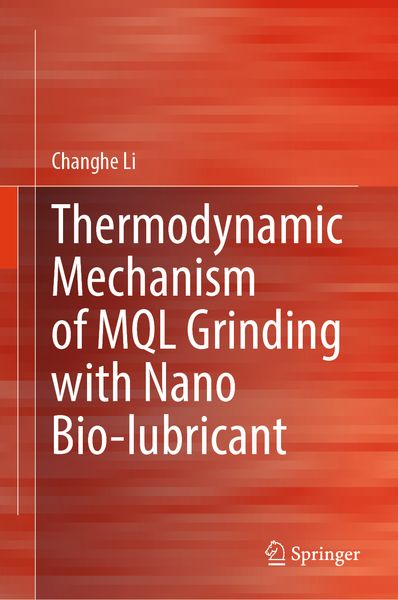
Produktbild: Thermodynamic Mechanism of MQL Grinding with Nano Bio-lubricant

Thermodynamic Mechanism of MQL Grinding with Nano Bio-lubricant

Fr. 201.00

inkl. gesetzl. MwSt., Versandkostenfrei


Beschreibung

Produktdetails

Einband

Gebundene Ausgabe

Erscheinungsdatum

31.10.2023

Verlag

Springer Singapore

Seitenzahl

395

Maße (L/B/H)

24.1/16/2.7 cm

Auflage

1. Auflage

Sprache

Englisch

ISBN

978-981-9962-64-8

Beschreibung

Produktdetails

Einband

Gebundene Ausgabe

Erscheinungsdatum

31.10.2023

Verlag

Springer Singapore

Seitenzahl

395

Maße (L/B/H)

24.1/16/2.7 cm

Auflage

1. Auflage

Sprache

Englisch

ISBN

978-981-9962-64-8

Herstelleradresse

Springer-Verlag KG
Sachsenplatz 4-6
1201 Wien
AT

Email: ProductSafety@springernature.com

Kundinnen und Kunden meinen

0 Bewertungen

Informationen zu Bewertungen

Zur Abgabe einer Bewertung ist eine Anmeldung im Konto notwendig. Die Authentizität der Bewertungen wird von uns nicht überprüft. Wir behalten uns vor, Bewertungstexte, die unseren Richtlinien widersprechen, entsprechend zu kürzen oder zu löschen.

Die Bewertungen sind nach Format, Anzahl Sterne und Datum sortiert.

Verfassen Sie die erste Bewertung zu diesem Artikel

Helfen Sie anderen Kund*innen durch Ihre Meinung

Kundinnen und Kunden meinen

0 Bewertungen filtern

  • Produktbild: Thermodynamic Mechanism of MQL Grinding with Nano Bio-lubricant
  • Chapter 1. Prolegomenon.- Chapter 2. Prediction model of grinding force under different lubrication conditions based on the principle of material fracture removal and plastic accumulation.- Chapter 3. Velocity effects and material removal mechanical behavior under different lubrication conditions.- Chapter 4. Probability density distribution of droplet size and convective heat transfer mechanism of nano bio-lubricant.- Chapter 5. Design and experimental evaluation of the measurement system for convective heat transfer coefficient of nano bio-lubricant spray Cooling.- Chapter 6. Dynamic model of temperature field in micro-grinding of biological bone cooled by nano bio-lubricant spray.- Chapter 7. Design of orthogonal experiments for grinding titanium alloys under different working conditions and analysis of signal-to-noise ratio and grey correlation.- Chapter 8. Numerical simulation and experimental validation of the temperature field of cryogenic air nano bio-lubricant MQL grinding.-Chapter 9. Experimental study of grinding ratio grinding energy and friction coefficient of cryogenic air nano bio-lubricant MQL grinding.- Chapter 10. The influence of vortex tube cold flow ratio on heat transfer mechanism of cryogenic air nano bio-lubricant MQL grinding.- Chapter 11. The influence of volume fraction of nano bio-lubricant on heat transfer mechanism of cryogenic air nano bio-lubricant MQL grinding.- Chapter 12. MQL grinding mechanism of Al2O3/SiC hybrid nano bio-lubricant and evaluation method of surface morphology.- Chapter 13. The influence of different ratios of Al2O3/SiC hybrid nano-biolubricants on the grinding performance of MQL.- Chapter 14. The influence of different physical synergies of hybrid nanoparticles on MQL grinding performance and microscopic characterization of surface morphology.- Chapter 15. Optimal design of MQL grinding jet parameters for nano bio-lubricant and evaluation of power spectral density functions for MQL.