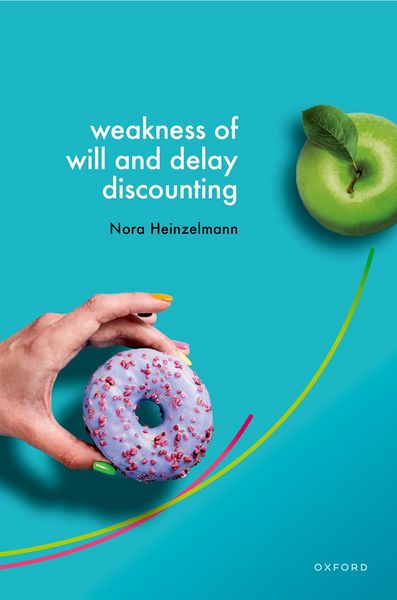
Weakness of Will and Delay Discounting
-
Form:Einzelkauf Download
-
Sprache:Englisch
-
eBook Format:PDF
- PDF Fr. 64.90 ausgewählt
- ePUB Fr. 72.90
Fr. 64.90
inkl. gesetzl. MwSt.Beschreibung
Produktdetails
Format
Kopierschutz
Ja
Family Sharing
Nein
Text-to-Speech
Nein
Erscheinungsdatum
30.08.2023
Verlag
OUP eBookSeitenzahl
256 (Printausgabe)
Dateigröße
1685 KB
Sprache
Englisch
EAN
9780192690715
Breaking one's dieting rule or resolution to quit smoking, procrastination, convenient lies, even the failure of entire nations to follow through with plans to cut greenhouse gas emissions or keep a pandemic in check - these phenomena have been discussed by philosophers and behavioural scientists as examples of weakness of will and delay discounting. Despite the common subject matter both fields have to date rarely worked together for mutual benefit. For the empirical literature is hardly accessible to a reader not familiar with econometric theory; and researchers in the behavioural sciences may find philosophical accounts invoking discounting models difficult to understand without inside knowledge of the debates and historical background.
Nora Heinzelmann targets this lacuna by making the ideas and findings from both disciplines intelligible to outsiders. This reveals that discounting - as philosophers have conceived of it - is neither necessary nor sufficient for weakness of will, even though there is substantial overlap. Heinzelmann develops a richer descriptive account of weakness of will that is based on the empirically founded assumption that weak-willed behaviour is determined by uncertainty about whether or when a good materialises. She also explains why weakness of the will understood in this way is irrational: the agent yields to a cognitive bias that leads them to underestimate the greater good they think they ought to and can obtain. Finally, she explores practical implications for individuals and policymakers.
Nora Heinzelmann targets this lacuna by making the ideas and findings from both disciplines intelligible to outsiders. This reveals that discounting - as philosophers have conceived of it - is neither necessary nor sufficient for weakness of will, even though there is substantial overlap. Heinzelmann develops a richer descriptive account of weakness of will that is based on the empirically founded assumption that weak-willed behaviour is determined by uncertainty about whether or when a good materialises. She also explains why weakness of the will understood in this way is irrational: the agent yields to a cognitive bias that leads them to underestimate the greater good they think they ought to and can obtain. Finally, she explores practical implications for individuals and policymakers.
Kundinnen und Kunden meinen
Verfassen Sie die erste Bewertung zu diesem Artikel
Helfen Sie anderen Kund*innen durch Ihre Meinung