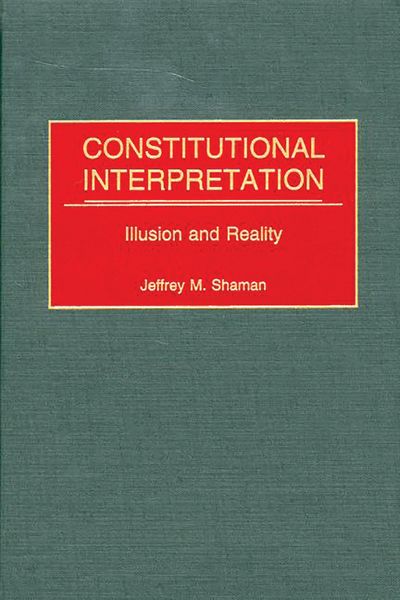
Constitutional Interpretation Illusion and Reality
Fr. 90.90
inkl. gesetzl. MwSt.Beschreibung
Produktdetails
Format
Kopierschutz
Ja
Family Sharing
Nein
Text-to-Speech
Nein
Altersempfehlung
ab 7 Jahr(e)
Erscheinungsdatum
30.11.2000
Verlag
Bloomsbury eBooks USSeitenzahl
288 (Printausgabe)
Auflage
1. Auflage
Sprache
Englisch
EAN
9780313000973
This study analyzes the process of constitutional interpretation, that is, the methodology by which the Supreme Court goes about interpreting the Constitution, and offers a comprehensive view of constitutional law through the lens of history, political science, and jurisprudence. Shaman examines the practice of creating meaning for the Constitution, the dichotomy of legal formalism and realism, the levels of judicial scrutiny, the perception of reality, and the puzzle of legislative motive. While the book traces the historical development of constitutional law, its main focus is on modern jurisprudence, including analyses of the major themes of constitutional interpretation developed by the Warren, Burger, and Rehnquist Courts.
Shaman details the Warren Court's move to a more realistic jurisprudence and its development of a multi-level system of judicial review that has become increasingly more complex under the Burger and Rehnquist Courts. He critiques the Supreme Court's reversion in recent years to an old-fashioned formalistic jurisprudence and the growing tendency of the Court to look to the past rather than to future to interpret the Constitution. The book also includes discussion of recent major doctrinal developments such as constitutional theory underlying Supreme Court decisions on gender discrimination, discrimination on the basis of sexual preference, the right to die, abortion, and freedom of speech.
Shaman details the Warren Court's move to a more realistic jurisprudence and its development of a multi-level system of judicial review that has become increasingly more complex under the Burger and Rehnquist Courts. He critiques the Supreme Court's reversion in recent years to an old-fashioned formalistic jurisprudence and the growing tendency of the Court to look to the past rather than to future to interpret the Constitution. The book also includes discussion of recent major doctrinal developments such as constitutional theory underlying Supreme Court decisions on gender discrimination, discrimination on the basis of sexual preference, the right to die, abortion, and freedom of speech.
Kundinnen und Kunden meinen
Verfassen Sie die erste Bewertung zu diesem Artikel
Helfen Sie anderen Kund*innen durch Ihre Meinung