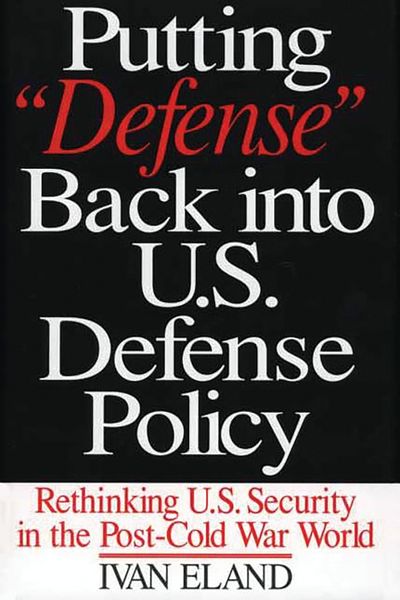
Putting Defense Back into U.S. Defense Policy Rethinking U.S. Security in the Post-Cold War World
Fr. 82.90
inkl. gesetzl. MwSt.Beschreibung
Produktdetails
Format
Kopierschutz
Ja
Family Sharing
Nein
Text-to-Speech
Nein
Altersempfehlung
ab 7 Jahr(e)
Erscheinungsdatum
30.09.2001
Verlag
Bloomsbury eBooks USSeitenzahl
256 (Printausgabe)
Auflage
1. Auflage
Sprache
Englisch
EAN
9780313007019
This book examines the implications of counterinsurgency wars for U.S. defense policy and makes the compelling argument that the United States' default position on counterinsurgency wars should be to avoid them.
In this compelling study, Eland questions the core assumptions of the American foreign policy and defense establishments that call for military interventions around the world and high and increasing defense budgets at home. He outlines a security policy more appropriate to the sober realities of the post-Cold War era. This is an approach that calls for military restraint overseas, taking advantage of the already secure U.S. geostrategic position, while safeguarding vital national interests. Eland details the military force structure needed for this new role and calculates the reduced defense budget required to pay for these forces.
This book is a timely wake-up call to those who make American foreign and defense policies. It demands a badly needed re-thinking of America's national interests. In the author's view, America's natural geostrategic position places it at a natural advantage, rendering unnecessary a forward defense posture. A non-interventionist foreign policy would save money by requiring lower defense budgets. An America less willing to get involved in complex overseas disputes unrelated to U.S vital interests would also be less likely to make enemies around the world.
In this compelling study, Eland questions the core assumptions of the American foreign policy and defense establishments that call for military interventions around the world and high and increasing defense budgets at home. He outlines a security policy more appropriate to the sober realities of the post-Cold War era. This is an approach that calls for military restraint overseas, taking advantage of the already secure U.S. geostrategic position, while safeguarding vital national interests. Eland details the military force structure needed for this new role and calculates the reduced defense budget required to pay for these forces.
This book is a timely wake-up call to those who make American foreign and defense policies. It demands a badly needed re-thinking of America's national interests. In the author's view, America's natural geostrategic position places it at a natural advantage, rendering unnecessary a forward defense posture. A non-interventionist foreign policy would save money by requiring lower defense budgets. An America less willing to get involved in complex overseas disputes unrelated to U.S vital interests would also be less likely to make enemies around the world.
Kundinnen und Kunden meinen
Verfassen Sie die erste Bewertung zu diesem Artikel
Helfen Sie anderen Kund*innen durch Ihre Meinung