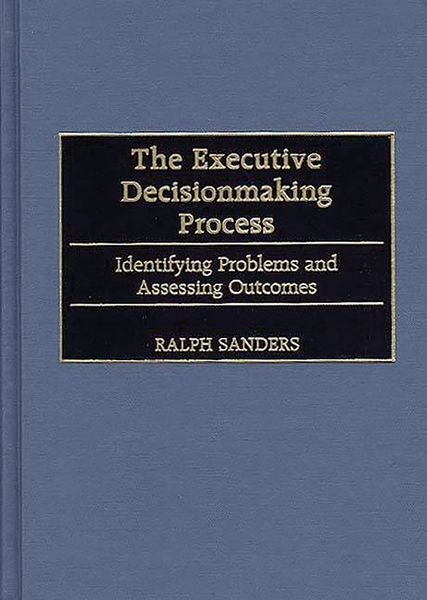
The Executive Decisionmaking Process Identifying Problems and Assessing Outcomes
Fr. 90.90
inkl. gesetzl. MwSt.Beschreibung
Produktdetails
Format
Kopierschutz
Ja
Family Sharing
Nein
Text-to-Speech
Nein
Altersempfehlung
ab 7 Jahr(e)
Erscheinungsdatum
30.09.1999
Verlag
Bloomsbury eBooks USSeitenzahl
192 (Printausgabe)
Auflage
1. Auflage
Sprache
Englisch
EAN
9780313004438
Decisionmaking literature, which has emphasized the act of solving problems, has long neglected the need to identify problems as precisely as possible. This book examines the nature of problems and decisionmaking and their impact on people who direct an organization. It further focuses on how executives respond to take action at the upper levels of their organizations.
The book stresses problem identification, which executives frequently ignore because of their preoccupation with problem solving. It looks at the need to avoid viewing solutions as remedies achieved at predetermined milestones. It examines options other than solutions, such as accommodation and coping, and it looks at the executive environment associated with outcomes along a spectrum ranging from perfection, to progress, to failure. The author argues that executives should abandon the attempt to predetermine objectives over time and adopt a Problem Exchange Ratio (PER) concept. The executive then compares the status of problems over time, creating a ratio. The PER approach considers the problems that solutions themselves trigger. It then allows executives to see where they stand and suggests ways of ameliorating unwanted conditions. The author provides illustrative cases and episodes from both the public and private sectors. Combining theory and practical aspects of executive decisionmaking, this book gives the reader a fuller understanding of the link between decisions and problems.
The book stresses problem identification, which executives frequently ignore because of their preoccupation with problem solving. It looks at the need to avoid viewing solutions as remedies achieved at predetermined milestones. It examines options other than solutions, such as accommodation and coping, and it looks at the executive environment associated with outcomes along a spectrum ranging from perfection, to progress, to failure. The author argues that executives should abandon the attempt to predetermine objectives over time and adopt a Problem Exchange Ratio (PER) concept. The executive then compares the status of problems over time, creating a ratio. The PER approach considers the problems that solutions themselves trigger. It then allows executives to see where they stand and suggests ways of ameliorating unwanted conditions. The author provides illustrative cases and episodes from both the public and private sectors. Combining theory and practical aspects of executive decisionmaking, this book gives the reader a fuller understanding of the link between decisions and problems.
Kundinnen und Kunden meinen
Verfassen Sie die erste Bewertung zu diesem Artikel
Helfen Sie anderen Kund*innen durch Ihre Meinung