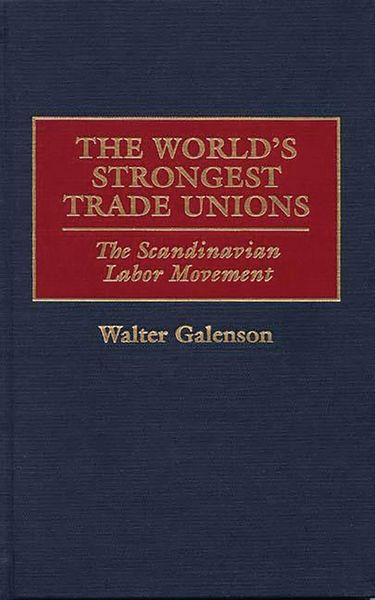
The World's Strongest Trade Unions The Scandinavian Labor Movement
Fr. 90.90
inkl. gesetzl. MwSt.Beschreibung
Produktdetails
Format
Kopierschutz
Ja
Family Sharing
Nein
Text-to-Speech
Nein
Altersempfehlung
ab 7 Jahr(e)
Erscheinungsdatum
23.10.1998
Verlag
Bloomsbury eBooks USSeitenzahl
168 (Printausgabe)
Auflage
1. Auflage
Sprache
Englisch
EAN
9781567507683
Despite the general decline of trade unions throughout the Western world, unions in Denmark, Norway, and Sweden have prospered. Why? Galenson cites their ability to organize white collar workers, the special attention they give to recruitment of women, and their ability to undergo structural change under employer pressure. He analyzes these factors in the belief that if unions in other parts of the world understand why and how unionism is succeeding in Scandinavia, its deterioration may be slowed and even reversed. In doing so, Galenson offers specific advice on how industrial relations professionals should manage to avoid breakdown of existing systems elsewhere. Labor unions, officials, and organization executives, as well as executives throughout the public sectors, will find Galenson's views informative and enlightening.
Although there has been a good deal written about the Scandinavian labor movements in Dano-Norwegian and Swedish, there has been nothing comprehensive in English that deals with the labor movements in the three countries. Nor has there been a systematic analysis of their policies and practices. Galenson provides readers, now, with an account of how unions in the Scandinavian countries have managed to secure the world's highest rates of organization: up to 90% of all who are employed in Sweden, and somewhat less in Denmark and Norway, are trade union members, compared with 15% in the United States. The countries in which they operate are welfare states and are among the wealthiest countries in the world, yet remarkably little is known about the systems of industrial relations that have contributed to these results. Galenson's book will fill that gap and in doing so, make a unique contribution to the determination of policy in other countries.
Although there has been a good deal written about the Scandinavian labor movements in Dano-Norwegian and Swedish, there has been nothing comprehensive in English that deals with the labor movements in the three countries. Nor has there been a systematic analysis of their policies and practices. Galenson provides readers, now, with an account of how unions in the Scandinavian countries have managed to secure the world's highest rates of organization: up to 90% of all who are employed in Sweden, and somewhat less in Denmark and Norway, are trade union members, compared with 15% in the United States. The countries in which they operate are welfare states and are among the wealthiest countries in the world, yet remarkably little is known about the systems of industrial relations that have contributed to these results. Galenson's book will fill that gap and in doing so, make a unique contribution to the determination of policy in other countries.
Kundinnen und Kunden meinen
Verfassen Sie die erste Bewertung zu diesem Artikel
Helfen Sie anderen Kund*innen durch Ihre Meinung